Nicolás Marisa F, Ramos Pablo Ivan Pereira, Marques de Carvalho Fabíola, Camargo Dhian R A, de Fátima Morais Alves Carlene, Loss de Morais Guilherme, Almeida Luiz G P, Souza Rangel C, Ciapina Luciane P, Vicente Ana C P, Coimbra Roney S, Ribeiro de Vasconcelos Ana T
Laboratório Nacional de Computação Científica, Petrópolis, Brazil.
Instituto Gonçalo Moniz, Fundação Oswaldo Cruz, Salvador, Brazil.
Front Microbiol. 2018 Feb 16;9:220. doi: 10.3389/fmicb.2018.00220. eCollection 2018.
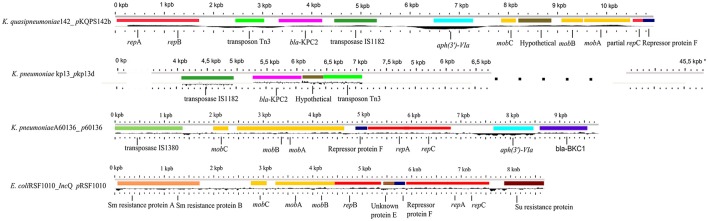
The aim of this study was to unravel the genetic determinants responsible for multidrug (including carbapenems) resistance and virulence in a clinical isolate of subsp. by whole-genome sequencing and comparative analyses. Eighty-three clinical isolates initially identified as carbapenem-resistant were collected from nosocomial infections in southeast Brazil. After RAPD screening, the KPC-142 isolate, showing the most divergent DNA pattern, was selected for complete genome sequencing in an Illumina HiSeq 2500 instrument. Reads were assembled into scaffolds, gaps between scaffolds were resolved by gap filling and extensive bioinformatics analyses were performed, using multiple comparative analysis tools and databases. Genome sequencing allowed to correct the classification of the KPC-142 isolate as subsp. . To the best of our knowledge this is the first complete genome reported to date of a clinical isolate of this subspecies harboring both class A beta-lactamases KPC-2 and OKP-B-6 from South America. KPC-142 has one 5.2 Mbp chromosome (57.8% G+C) and two plasmids: 190 Kbp KQPS142a (50.7% G+C) and 11 Kbp KQPS142b (57.3% G+C). The 3 Kbp region in KQPS142b containing the was found highly similar to that of Kp13d of Kp13 isolated in Southern Brazil in 2009, suggesting the horizontal transfer of this resistance gene between different species of . KPC-142 additionally harbors an integrative conjugative element ICE that could be involved in the mobilization of KQPS142b and determinants of resistance to other classes of antimicrobials, including aminoglycoside and silver. We present the completely assembled genome sequence of a clinical isolate of subsp. , a KPC-2 and OKP-B-6 beta-lactamases producer and discuss the most relevant genomic features of this important resistant pathogen in comparison to several strains belonging to subsp. (phylogroup II-B), subsp. (phylogroup II-A), (phylogroup I), and (phylogroup III). Our study contributes to the description of the characteristics of a novel subsp. strain circulating in South America that currently represent a serious potential risk for nosocomial settings.
本研究的目的是通过全基因组测序和比较分析,揭示亚种临床分离株中对多种药物(包括碳青霉烯类)耐药和毒力的遗传决定因素。从巴西东南部的医院感染中收集了83株最初被鉴定为耐碳青霉烯类的临床分离株。经过随机扩增多态性DNA(RAPD)筛选,选择了DNA图谱差异最大的KPC-142分离株,在Illumina HiSeq 2500仪器上进行全基因组测序。读取的序列被组装成支架,通过填补缺口解决支架之间的间隙,并使用多种比较分析工具和数据库进行广泛的生物信息学分析。基因组测序纠正了KPC-142分离株作为亚种的分类。据我们所知,这是迄今为止报道的来自南美洲的该亚种临床分离株的首个完整基因组,该分离株携带A类β-内酰胺酶KPC-2和OKP-B-6。KPC-142有一条5.2 Mbp的染色体(G+C含量为57.8%)和两个质粒:190 Kbp的KQPS142a(G+C含量为50.7%)和11 Kbp的KQPS142b(G+C含量为57.3%)。发现KQPS142b中包含的3 Kbp区域与2009年在巴西南部分离的肺炎克雷伯菌Kp13的Kp13d高度相似,这表明该耐药基因在不同肺炎克雷伯菌物种之间发生了水平转移。KPC-142还含有一个整合性接合元件ICE,它可能参与KQPS142b的转移以及对其他抗菌药物(包括氨基糖苷类和银)的耐药决定因素。我们展示了亚种临床分离株的完整组装基因组序列,该分离株是KPC-2和OKP-B-6β-内酰胺酶的产生者,并与属于亚种(系统发育群II-B)、亚种(系统发育群II-A)、肺炎克雷伯菌(系统发育群I)和产酸克雷伯菌(系统发育群III)的几种菌株进行比较,讨论了这种重要耐药病原体最相关的基因组特征。我们的研究有助于描述在南美洲传播的新型亚种菌株的特征,该菌株目前对医院环境构成严重的潜在风险。