Department of Medical Imaging, Sunnybrook Health Sciences Centre, University of Toronto, Toronto, Canada.
Department of Medical Imaging, University of Toronto, Toronto, Canada.
Sci Rep. 2018 Mar 5;8(1):4003. doi: 10.1038/s41598-018-22357-y.
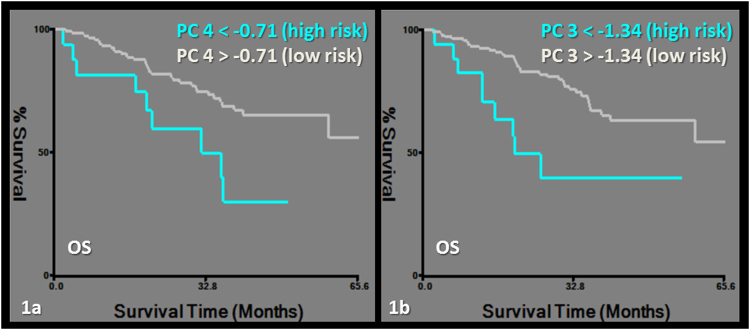
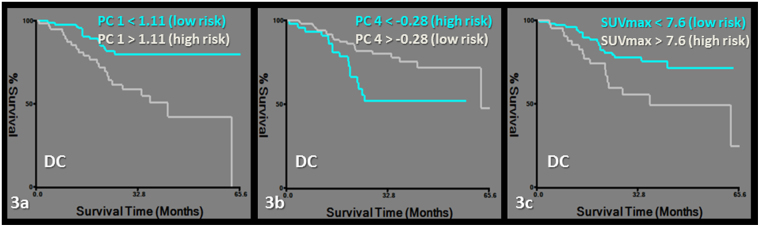
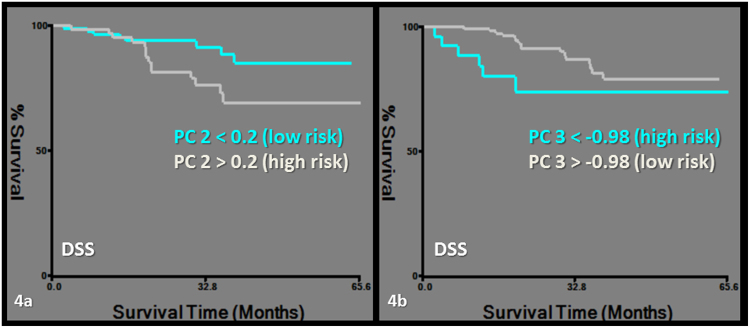
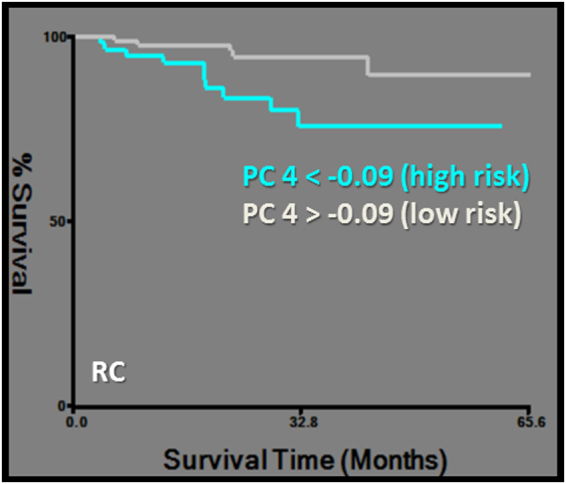
We sought to quantify contribution of radiomics and SUVmax at PET/CT to predict clinical outcome in lung cancer patients treated with stereotactic body radiotherapy (SBRT). 150 patients with 172 lung cancers, who underwent SBRT were retrospectively included. Radiomics were applied on PET/CT. Principal components (PC) for 42 CT and PET-derived features were examined to determine which ones accounted for most of variability. Survival analysis quantified ability of radiomics and SUVmax to predict outcome. PCs including homogeneity, size, maximum intensity, mean and median gray level, standard deviation, entropy, kurtosis, skewness, morphology and asymmetry were included in prediction models for regional control (RC) [PC4-HR:0.38, p = 0.02], distant control (DC) [PC4-HR:0.51, p = 0.02 and PC1-HR:1.12, p = 0.01], recurrence free probability (RFP) [PC1-HR:1.08, p = 0.04], disease specific survival (DSS) [PC2-HR:1.34, p = 0.03 and PC3-HR:0.64, p = 0.02] and overall survival (OS) [PC4-HR:0.45, p = 0.004 and PC3-HR:0.74, p = 0.02]. In combined analysis with SUVmax, PC1 lost predictive ability over SUVmax for RFP [HR:1.1, p = 0.04] and DC [HR:1.13, p = 0.002], while PC4 remained predictive of DC independent of SUVmax [HR:0.5, p = 0.02]. Radiomics remained the only predictors of OS, DSS and RC. Neither SUVmax nor radiomics predicted recurrence free survival. Radiomics on PET/CT provided complementary information for prediction of control and survival in SBRT-treated lung cancer patients.
我们旨在量化放射组学和 PET/CT 中的 SUVmax 对接受立体定向体部放疗 (SBRT) 的肺癌患者临床结局的预测作用。回顾性纳入了 150 名接受 SBRT 的 172 例肺癌患者。在 PET/CT 上应用放射组学。检查了 42 个 CT 和 PET 衍生特征的主成分 (PC),以确定哪些特征可以解释大部分变异。生存分析量化了放射组学和 SUVmax 预测结局的能力。包括同质性、大小、最大强度、平均和中位数灰度、标准差、熵、峰度、偏度、形态和不对称性的 PC 被纳入局部控制 (RC) [PC4-HR:0.38,p=0.02]、远处控制 (DC) [PC4-HR:0.51,p=0.02 和 PC1-HR:1.12,p=0.01]、无复发生存率 (RFP) [PC1-HR:1.08,p=0.04]、疾病特异性生存率 (DSS) [PC2-HR:1.34,p=0.03 和 PC3-HR:0.64,p=0.02]和总生存率 (OS) [PC4-HR:0.45,p=0.004 和 PC3-HR:0.74,p=0.02]预测模型。在与 SUVmax 的联合分析中,PC1 对 RFP 和 DC 的预测能力超过了 SUVmax [HR:1.1,p=0.04]和 DC [HR:1.13,p=0.002],而 PC4 仍然独立于 SUVmax 预测 DC [HR:0.5,p=0.02]。放射组学仍然是 OS、DSS 和 RC 的唯一预测因子。SUVmax 和放射组学均未预测无复发生存率。PET/CT 上的放射组学为 SBRT 治疗的肺癌患者的控制和生存预测提供了补充信息。