Department of Surgery, Division of Otolaryngology - Head and Neck Surgery, University of Alberta, Edmonton, AB, Canada.
1E4 Walter C Mackenzie Centre, 8440-112 Street NW, Edmonton, AB, T6G 2B7, Canada.
J Otolaryngol Head Neck Surg. 2018 Mar 7;47(1):20. doi: 10.1186/s40463-018-0264-0.
Recent studies have examined the effects of brief electrical stimulation (BES) on nerve regeneration, with some suggesting that BES accelerates facial nerve recovery. However, the facial nerve outcome measurement in these studies has not been precise or accurate. Furthermore, no previous studies have been able to demonstrate the effect of BES on synkinesis. The objective of this study is to examine the effect of brief electrical stimulation (BES) on facial nerve function and synkinesis in a rat model.
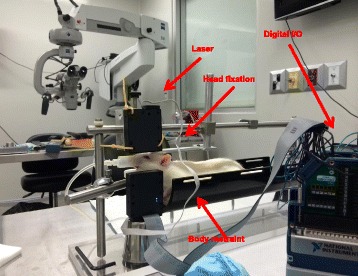
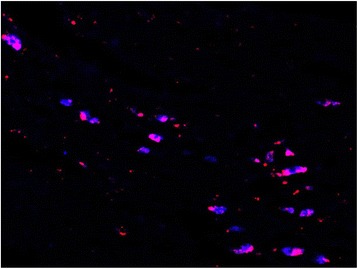
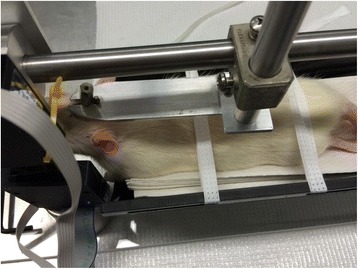
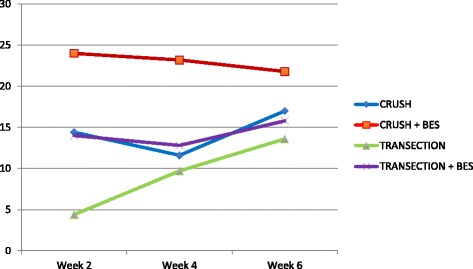
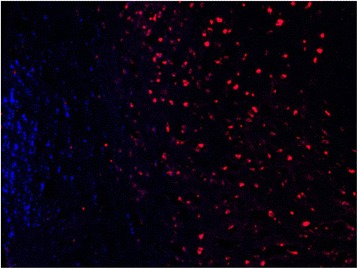
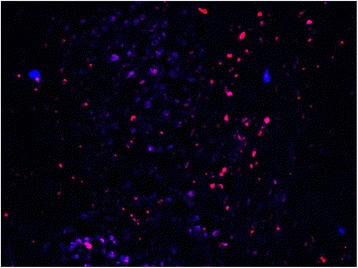
Four groups of six rats underwent a facial nerve injury procedure. Group 1 and 2 underwent a crush injury at the main trunk of the nerve, with group 2 additionally receiving BES for 1 h. Group 3 and 4 underwent a transection injury at the main trunk, with group 4 additionally receiving BES for 1 h. A laser curtain model was used to measure amplitude of whisking at 2, 4, and 6 weeks. Fluorogold and fluororuby neurotracers were additionally injected into each facial nerve to measure synkinesis. Buccal and marginal mandibular branches of the facial nerve were each injected with different neurotracers at 3 months following injury. Based on facial nucleus motoneuron labelling of untreated rats, comparison was made to post-treatment animals to deduce whether synkinesis had taken place. All animals underwent trans-cardiac perfusion with subsequent neural tissue sectioning.
At week two, the amplitude observed for group 1 and 2 was 14.4 and 24.0 degrees, respectively (p = 0.0004). Group 4 also demonstrated improved whisking compared to group 3. Fluorescent neuroimaging labelling appear to confirm improved pathway specific regeneration with BES following facial nerve injury.
This is the first study to use an implantable stimulator for serial BES following a crush injury in a validated animal model. Results suggest performing BES after facial nerve injury is associated with accelerated facial nerve function and improved facial nerve specific pathway regeneration in a rat model.
最近的研究检查了短暂电刺激(BES)对神经再生的影响,一些研究表明 BES 加速了面神经的恢复。然而,这些研究中的面神经结果测量并不精确或准确。此外,以前没有研究能够证明 BES 对面肌联动的影响。本研究的目的是在大鼠模型中检查短暂电刺激(BES)对面神经功能和面肌联动的影响。
四组六只大鼠进行面神经损伤手术。第 1 组和第 2 组在神经主干处进行挤压伤,第 2 组额外接受 1 小时的 BES。第 3 组和第 4 组在神经主干处进行横断伤,第 4 组额外接受 1 小时的 BES。激光幕模型用于测量 2、4 和 6 周时的刷动幅度。此外,在每个面神经中注射荧光金和荧光红神经示踪剂,以测量面肌联动。面神经的颊支和下颌缘支在损伤后 3 个月分别注射不同的神经示踪剂。基于未治疗大鼠面神经核运动神经元的标记,与治疗后的动物进行比较,以推断是否发生了面肌联动。所有动物均进行心脏灌流,随后进行神经组织切片。
第 2 周时,第 1 组和第 2 组观察到的幅度分别为 14.4 和 24.0 度(p=0.0004)。与第 3 组相比,第 4 组的刷动也得到了改善。荧光神经成像标记似乎证实了在面神经损伤后,BES 可促进特定面神经通路的再生。
这是第一项在经过验证的动物模型中,使用可植入刺激器进行连续 BES 治疗挤压伤的研究。结果表明,面神经损伤后进行 BES 治疗与大鼠模型中面神经功能的加速恢复和特定面神经通路再生的改善有关。