Section on Neuronal Connectivity, Eunice Kennedy Shriver National Institute of Child Health and Human Development, National Institutes of Health, Bethesda, MD, United States.
Front Neural Circuits. 2018 Feb 23;12:16. doi: 10.3389/fncir.2018.00016. eCollection 2018.
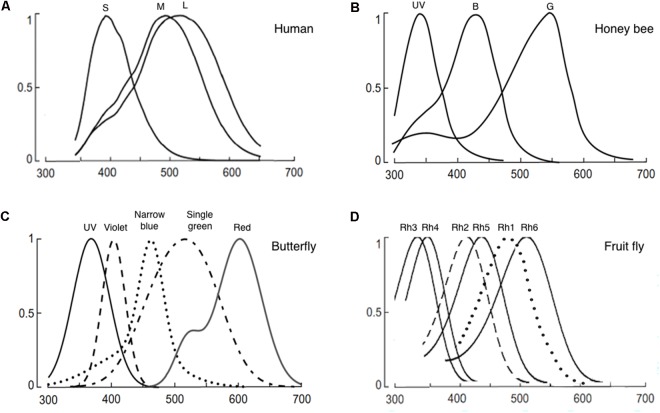
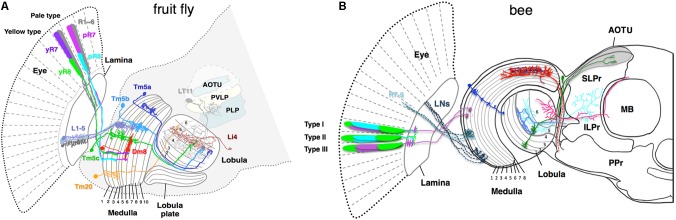
Many visual animals exploit spectral information for seeking food and mates, for identifying preys and predators, and for navigation. Animals use chromatic information in two ways. "True color vision," the ability to discriminate visual stimuli on the basis of their spectral content independent of brightness, is thought to play an important role in object identification. In contrast, "wavelength-specific behavior," which is strongly dependent on brightness, often associates with foraging, navigation, and other species-specific needs. Among animals capable of chromatic vision, insects, with their diverse habitats, stereotyped behaviors, well-characterized anatomy and powerful genetic tools, are attractive systems for studying chromatic information processing. In this review, we first discuss insect photoreceptors and the relationship between their spectral sensitivity and animals' color vision and ecology. Second, we review recent studies that dissect chromatic circuits and explore neural mechanisms of chromatic information processing. Finally, we review insect behaviors involving "true color vision" and "wavelength-specific behaviors," especially in bees, butterflies, and flies. We include examples of high-order color vision, such as color contrast and constancy, which are shared by vertebrates. We focus on studies that identified neuronal correlates of color vision and innate spectral preferences. We also discuss the electrophysiological studies in bees that reveal color encoding. Despite structural differences between insects' and vertebrates' visual systems, their chromatic vision appears to employ the same processing principles, such as color opponency, suggesting convergent solutions of neural computation to common problems.
许多视觉动物利用光谱信息来寻找食物和配偶,识别猎物和捕食者,以及进行导航。动物以两种方式利用色觉信息。“真色觉”,即根据视觉刺激的光谱内容而不依赖亮度来区分视觉刺激的能力,被认为在物体识别中起着重要作用。相比之下,“波长特异性行为”强烈依赖于亮度,通常与觅食、导航和其他特定于物种的需求有关。在具有色觉能力的动物中,昆虫因其多样化的栖息地、刻板的行为、特征明显的解剖结构和强大的遗传工具,成为研究色觉信息处理的有吸引力的系统。在这篇综述中,我们首先讨论了昆虫的光感受器及其与动物的色觉和生态学之间的关系。其次,我们回顾了最近的研究,这些研究剖析了色觉回路,并探讨了色觉信息处理的神经机制。最后,我们回顾了涉及“真色觉”和“波长特异性行为”的昆虫行为,特别是在蜜蜂、蝴蝶和苍蝇中。我们包括了一些高等色觉的例子,如颜色对比和颜色恒常性,这些例子是脊椎动物所共有的。我们重点介绍了那些确定了色觉神经元相关性和先天光谱偏好的研究。我们还讨论了蜜蜂的电生理研究,这些研究揭示了颜色的编码方式。尽管昆虫和脊椎动物的视觉系统结构存在差异,但它们的色觉似乎采用了相同的处理原则,如颜色拮抗,这表明神经计算的趋同解决方案可以解决共同的问题。