Zhu Jingzhen, Hu Xiaoyan, Dong Xingyou, Li Longkun
From the Department of Urology, Second Affiliated Hospital, Third Military Medical University, Chongqing, China.
Female Pelvic Med Reconstr Surg. 2019 May/Jun;25(3):238-246. doi: 10.1097/SPV.0000000000000531.
The purpose of this study was to investigate the risk factors of overactive bladder (OAB).
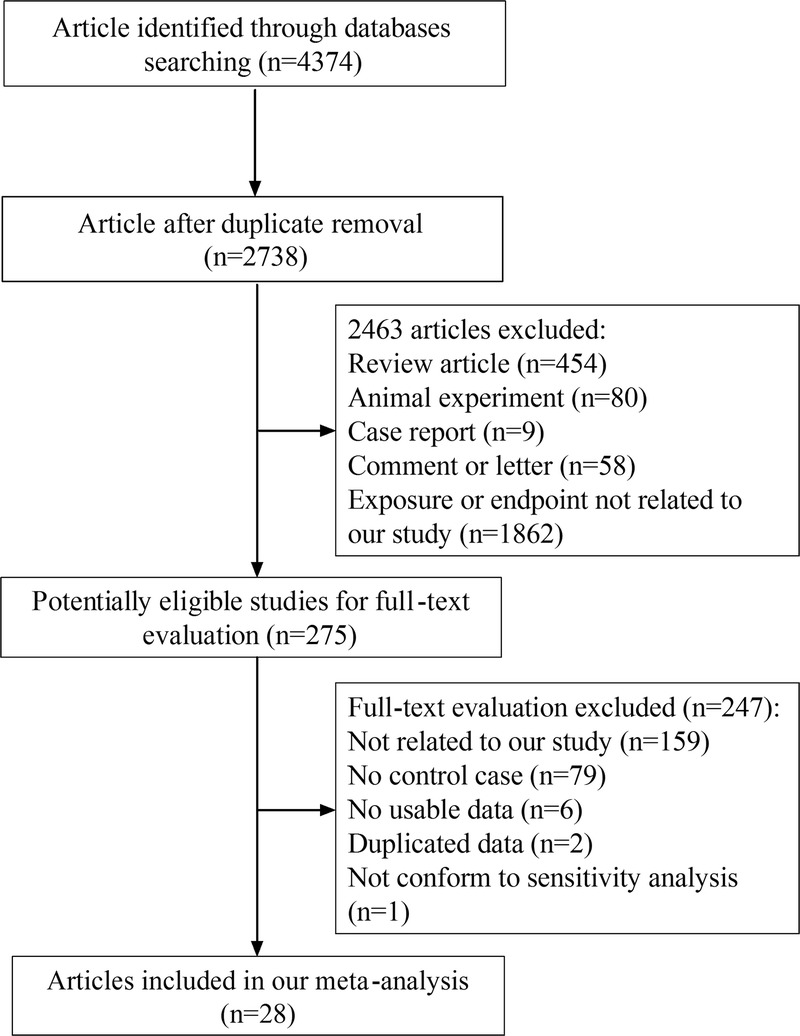
The PubMed, Embase, and Cochrane Library databases were retrieved through May 2016. Odds ratios (OR) or standard mean differences (SMDs) with 95% confidence intervals (CIs) were used to evaluate the associations between risk factors and OAB. Heterogeneity among studies was examined using χ test based on the Q and I tests.
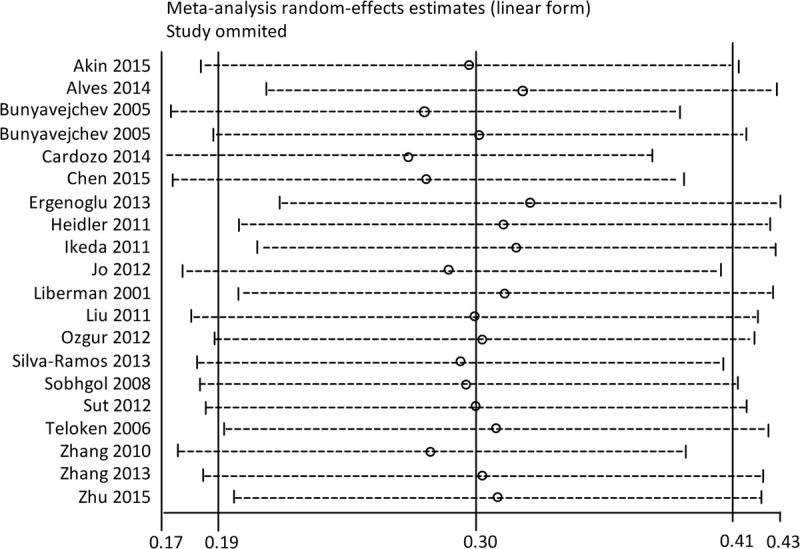
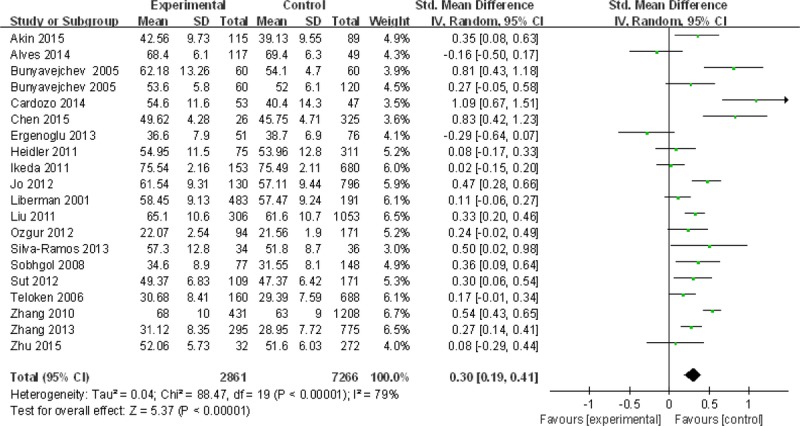
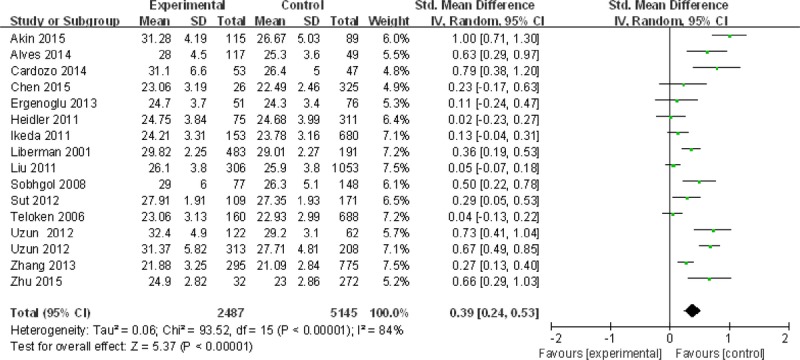
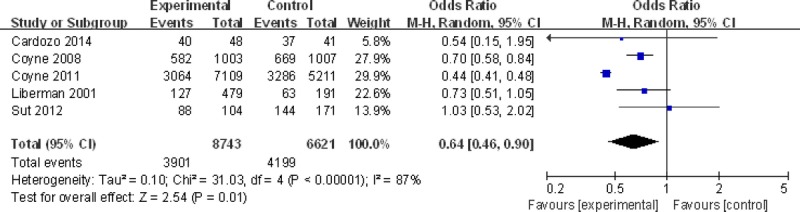
A total of 28 articles were analyzed in our study. The results suggested that age and body mass index were significantly higher in OAB patients than in non-OAB controls (SMDs [95% CIs], 0.30 [0.19-0.41] and 0.39 [0.24-0.53]). A significant negative association was found between employment status and OAB (OR [95% CIs], 0.64 [0.46-0.90]). However, sex, educational level, parity, vaginal delivery, race, menopause, marital status, smoking, and alcohol consumption were not significantly different in OAB and non-OAB control patients (ORs [95% CIs], 0.95 [0.59-1.55], 1.04 [0.82, 1.33], 0.98 [0.56-1.70], 1.66 [0.90-3.07], 0.98 [0.75-1.28], 1.84 [0.23-14.70], 0.97 [0.78-1.19], 0.91 [0.77-1.08], and 0.88 [0.71-1.09], respectively). In addition, the number of parities and vaginal deliveries in OAB patients also showed no significant differences compared with non-OAB control patients (SMDs [95% CI], 0.05 [-0.27 to 0.38] and -0.16 [0.40 to 0.09]).
This meta-analysis suggests that age and body mass index are associated with increased risks of OAB, whereas employment status is associated with a decreased risk of OAB. Further prospective studies with large sample sizes are needed to confirm this conclusion.
本研究旨在调查膀胱过度活动症(OAB)的危险因素。
检索截至2016年5月的PubMed、Embase和Cochrane图书馆数据库。采用比值比(OR)或标准化均数差(SMD)及95%置信区间(CI)来评估危险因素与OAB之间的关联。基于Q检验和I²检验,使用χ²检验来检查研究间的异质性。
本研究共分析了28篇文章。结果表明,OAB患者的年龄和体重指数显著高于非OAB对照组(SMD [95% CI],分别为0.30 [0.19 - 0.41]和0.39 [0.24 - 0.53])。就业状况与OAB之间存在显著负相关(OR [95% CI],0.64 [0.46 - 0.90])。然而,OAB患者与非OAB对照患者在性别、教育程度、产次、阴道分娩、种族、绝经、婚姻状况、吸烟和饮酒方面无显著差异(OR [95% CI],分别为0.95 [0.59 - 1.55]、1.04 [0.82, 1.33]、0.98 [0.56 - 1.70]、1.66 [0.90 - 3.07]、0.98 [0.75 - 1.28]、1.84 [0.23 - 14.70]、0.97 [0.78 - 1.19]、0.91 [0.77 - 1.08]和0.88 [0.71 - 1.09])。此外,与非OAB对照患者相比,OAB患者的产次和阴道分娩次数也无显著差异(SMD [95% CI],分别为0.05 [-0.27至0.38]和 -0.16 [ -0.40至0.09])。
这项荟萃分析表明,年龄和体重指数与OAB风险增加相关,而就业状况与OAB风险降低相关。需要进一步开展大样本量的前瞻性研究来证实这一结论。