Science Division, Diamond Light Source, Harwell Science and Innovation Campus, Didcot OX11 0DE, England.
Acta Crystallogr D Struct Biol. 2018 Feb 1;74(Pt 2):152-166. doi: 10.1107/S2059798317016709.
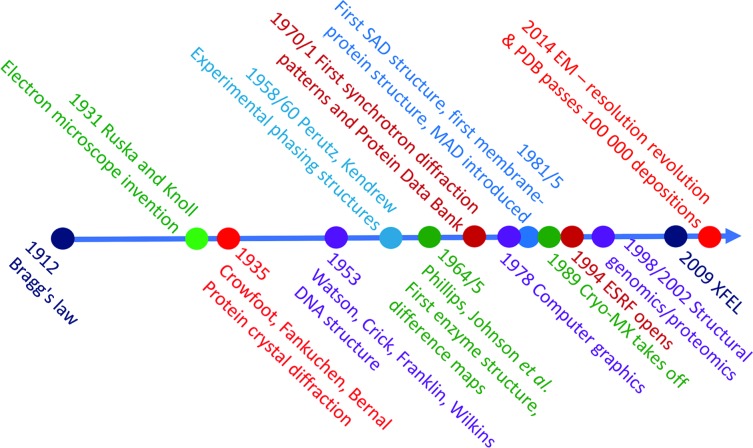
Macromolecular crystallography (MX) has been a motor for biology for over half a century and this continues apace. A series of revolutions, including the production of recombinant proteins and cryo-crystallography, have meant that MX has repeatedly reinvented itself to dramatically increase its reach. Over the last 30 years synchrotron radiation has nucleated a succession of advances, ranging from detectors to optics and automation. These advances, in turn, open up opportunities. For instance, a further order of magnitude could perhaps be gained in signal to noise for general synchrotron experiments. In addition, X-ray free-electron lasers offer to capture fragments of reciprocal space without radiation damage, and open up the subpicosecond regime of protein dynamics and activity. But electrons have recently stolen the limelight: so is X-ray crystallography in rude health, or will imaging methods, especially single-particle electron microscopy, render it obsolete for the most interesting biology, whilst electron diffraction enables structure determination from even the smallest crystals? We will lay out some information to help you decide.
大分子晶体学(MX)半个多世纪以来一直是生物学的动力,而且这种情况仍在继续。一系列的革命,包括重组蛋白的生产和 cryo-crystallography,意味着 MX 不断地自我革新,从而极大地扩大了其应用范围。在过去的 30 年中,同步加速器辐射引发了一系列的进展,从探测器到光学和自动化。这些进展反过来又为我们提供了机会。例如,在一般的同步加速器实验中,信号与噪声的比例可能会再提高一个数量级。此外,X 射线自由电子激光可以在不产生辐射损伤的情况下捕获倒易空间的片段,并开辟蛋白质动力学和活性的亚皮秒范围。但是,电子最近抢走了风头:那么 X 射线晶体学是处于健康状态,还是成像方法,特别是单粒子电子显微镜,将使其对最有趣的生物学变得过时,而电子衍射甚至可以从最小的晶体中确定结构?我们将提供一些信息来帮助您做出决定。