Infectious and Tropical Diseases Research Group (e-INTRO), Biomedical Research Institute of Salamanca-Research Centre for Tropical Diseases at the University of Salamanca (IBSAL-CIETUS), Faculty of Pharmacy, University of Salamanca, Salamanca, Spain.
Schistosomiasis Laboratory and Reference Service, Department of Parasitology, Aggeu Magalhães Institute, Fiocruz - Ministry of Health (MoH), Recife, Pernambuco, Brazil.
PLoS Negl Trop Dis. 2018 Mar 13;12(3):e0006314. doi: 10.1371/journal.pntd.0006314. eCollection 2018 Mar.
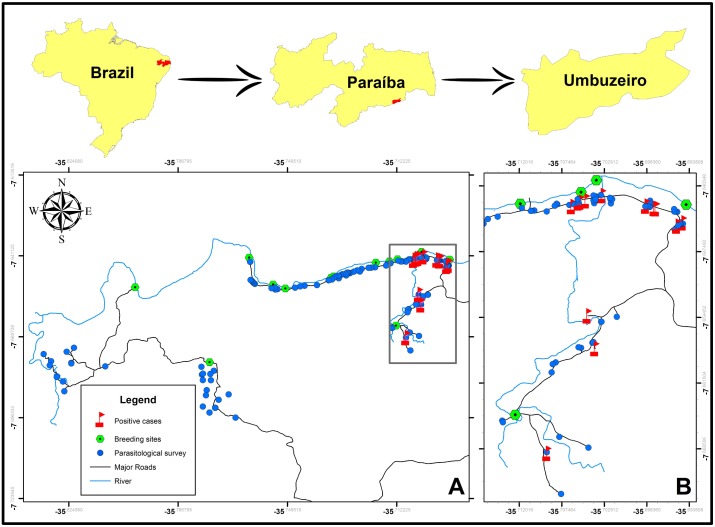
In Brazil, schistosomiasis is a parasitic disease of public health relevance, mainly in poor areas where Schistosoma mansoni is the only human species encountered and Biomphalaria straminea is one of the intermediate host snails. A nested-PCR based on a specific mitochondrial S. mansoni minisatellite DNA region has been successfully developed and applied as a reference method in Brazil for S. mansoni detection, mainly in host snails for epidemiological studies. The amplification efficiency of LAMP is known to be higher than PCR. The present work aimed to assess the utility of our previously described SmMIT-LAMP assay for S. mansoni detection in human stool and snail samples in a low-transmission area of schistosomiasis in the municipality of Umbuzeiro, Paraíba State, Northeast Region of Brazil.
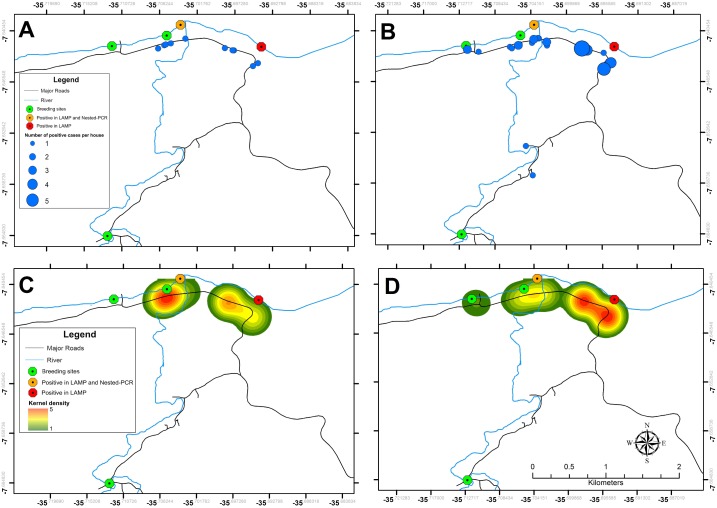
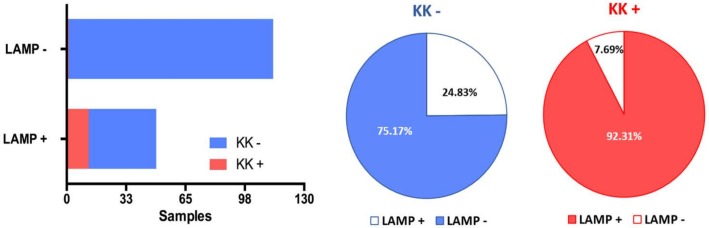
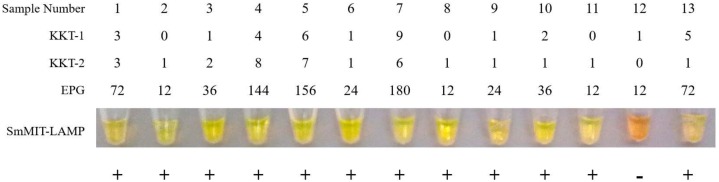
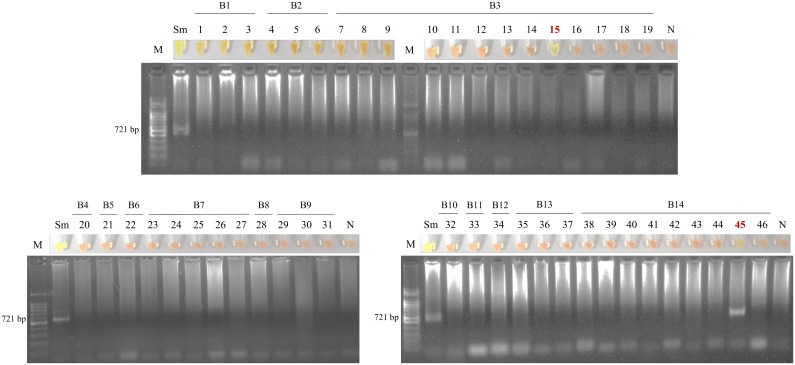
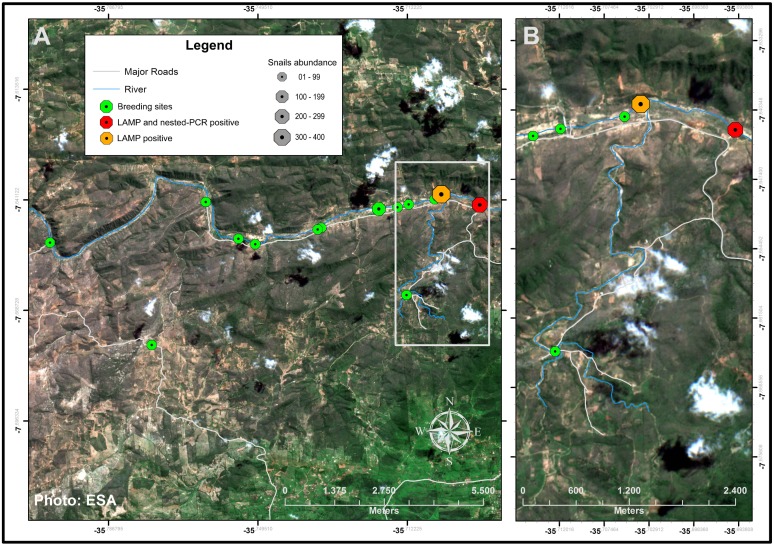
METHODOLOGY/PRINCIPAL FINDINGS: A total of 427 human stool samples were collected during June-July 2016 in the municipality of Umbuzeiro and an overall prevalence of 3.04% (13/427) resulted positive by duplicate Kato-Katz thick smear. A total of 1,175 snails identified as Biomphalaria straminea were collected from 14 breeding sites along the Paraíba riverbank and distributed in 46 pools. DNA from human stool samples and pooled snails was extracted using the phenol/chloroform method. When performing the SmMIT-LAMP assay a total of 49/162 (30.24%) stool samples resulted positive, including 12/13 (92.31%) that were Kato-Katz positive and 37/149 (24.83%) previously Kato-Katz negative. By nested-PCR, only 1/46 pooled DNA snail samples was positive. By SmMIT-LAMP assay, the same sample also resulted positive and an additional one was positive from a different breeding site. Data of human and snail surveys were used to build risk maps of schistosomiasis incidence using kernel density analysis.
CONCLUSIONS/SIGNIFICANCE: This is the first study in which a LAMP assay was evaluated in both human stool and snail samples from a low-transmission schistosomiasis-endemic area. Our SmMIT-LAMP proved to be much more efficient in detection of S. mansoni in comparison to the 'gold standard' Kato-Katz method in human stool samples and the reference molecular nested-PCR in snails. The SmMIT-LAMP has demonstrated to be a useful molecular tool to identify potential foci of transmission in order to build risk maps of schistosomiasis.
在巴西,血吸虫病是一种具有公共卫生相关性的寄生虫病,主要发生在贫穷地区,那里只发现有曼氏血吸虫,中间宿主蜗牛是纹沼螺。一种基于特定的曼氏血吸虫线粒体微卫星 DNA 区域的巢式 PCR 已被成功开发并应用于巴西的曼氏血吸虫检测,主要用于宿主蜗牛的流行病学研究。众所周知,LAMP 的扩增效率高于 PCR。本研究旨在评估我们之前描述的 SmMIT-LAMP 检测法在巴西帕拉伊巴州乌姆布泽罗市低传播区的人类粪便和蜗牛样本中检测曼氏血吸虫的效用。
方法/主要发现:2016 年 6 月至 7 月期间,共采集了 427 份来自乌姆布泽罗市的人类粪便样本,双重 Kato-Katz 厚涂片检测结果显示,总阳性率为 3.04%(13/427)。从帕拉伊巴河沿岸的 14 个繁殖点共采集了 1175 只纹沼螺,分布在 46 个池中。采用苯酚/氯仿法从人类粪便样本和混合蜗牛 DNA 中提取 DNA。当进行 SmMIT-LAMP 检测时,共有 49/162(30.24%)粪便样本呈阳性,其中 12/13(92.31%)Kato-Katz 阳性,37/149(24.83%)Kato-Katz 阴性。通过巢式 PCR,只有 1/46 个混合 DNA 蜗牛样本呈阳性。通过 SmMIT-LAMP 检测,同一样本也呈阳性,另一个来自不同繁殖点的样本也呈阳性。利用核密度分析,根据人类和蜗牛调查数据绘制血吸虫病发病率风险图。
结论/意义:这是首次在低传播血吸虫病流行地区的人类粪便和蜗牛样本中评估 LAMP 检测。与 Kato-Katz 法相比,我们的 SmMIT-LAMP 在检测人类粪便中的曼氏血吸虫方面更为有效,与蜗牛的参考分子巢式 PCR 相比也更为有效。SmMIT-LAMP 已被证明是一种有用的分子工具,可以识别潜在的传播焦点,以便绘制血吸虫病风险图。