George Julie, Walter Vonn, Peifer Martin, Alexandrov Ludmil B, Seidel Danila, Leenders Frauke, Maas Lukas, Müller Christian, Dahmen Ilona, Delhomme Tiffany M, Ardin Maude, Leblay Noemie, Byrnes Graham, Sun Ruping, De Reynies Aurélien, McLeer-Florin Anne, Bosco Graziella, Malchers Florian, Menon Roopika, Altmüller Janine, Becker Christian, Nürnberg Peter, Achter Viktor, Lang Ulrich, Schneider Peter M, Bogus Magdalena, Soloway Matthew G, Wilkerson Matthew D, Cun Yupeng, McKay James D, Moro-Sibilot Denis, Brambilla Christian G, Lantuejoul Sylvie, Lemaitre Nicolas, Soltermann Alex, Weder Walter, Tischler Verena, Brustugun Odd Terje, Lund-Iversen Marius, Helland Åslaug, Solberg Steinar, Ansén Sascha, Wright Gavin, Solomon Benjamin, Roz Luca, Pastorino Ugo, Petersen Iver, Clement Joachim H, Sänger Jörg, Wolf Jürgen, Vingron Martin, Zander Thomas, Perner Sven, Travis William D, Haas Stefan A, Olivier Magali, Foll Matthieu, Büttner Reinhard, Hayes David Neil, Brambilla Elisabeth, Fernandez-Cuesta Lynnette, Thomas Roman K
Department of Translational Genomics, Center of Integrated Oncology Cologne-Bonn, Medical Faculty, University of Cologne, Cologne, 50931, Germany.
UNC Lineberger Comprehensive Cancer Center School of Medicine, University of North Carolina at Chapel Hill, Chapel Hill, NC, 27599-7295, USA.
Nat Commun. 2018 Mar 13;9(1):1048. doi: 10.1038/s41467-018-03099-x.
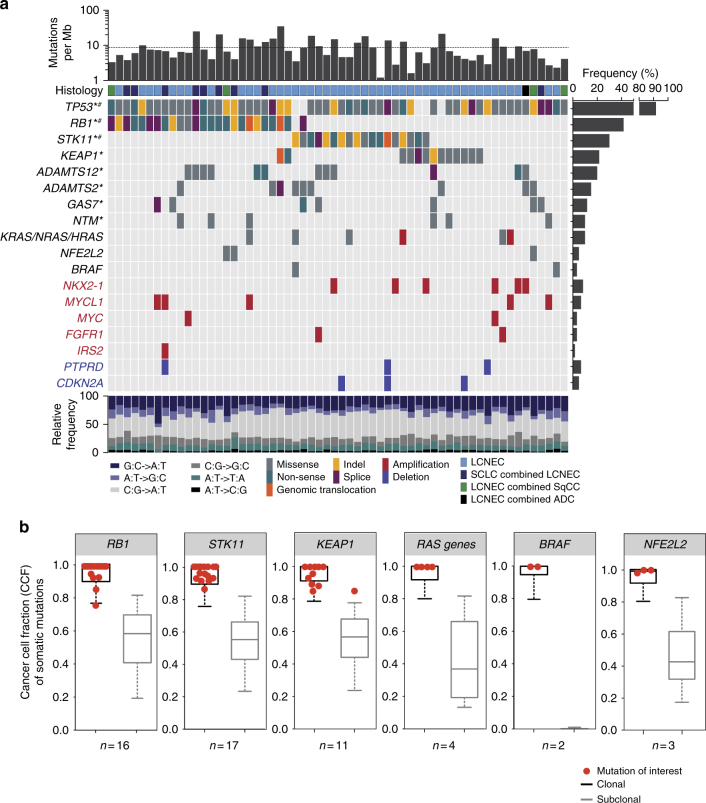
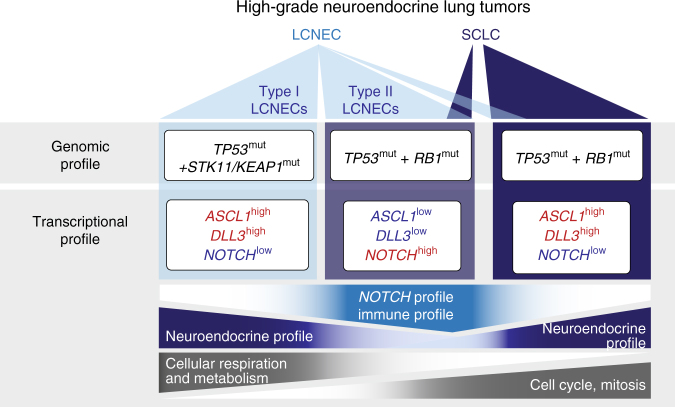
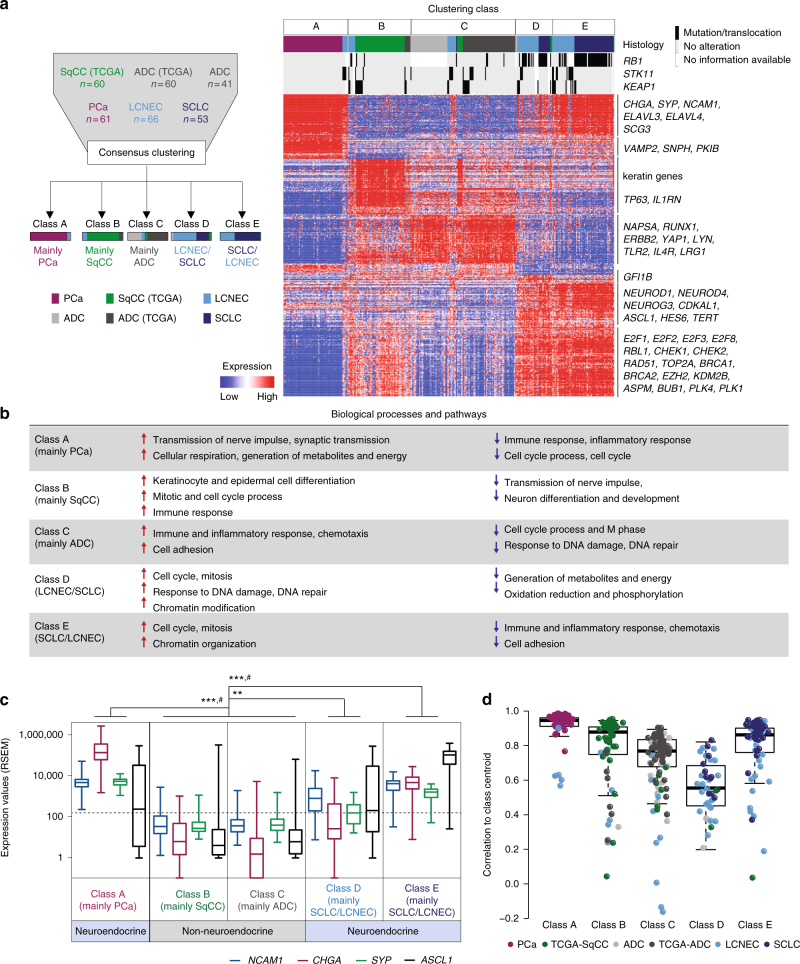
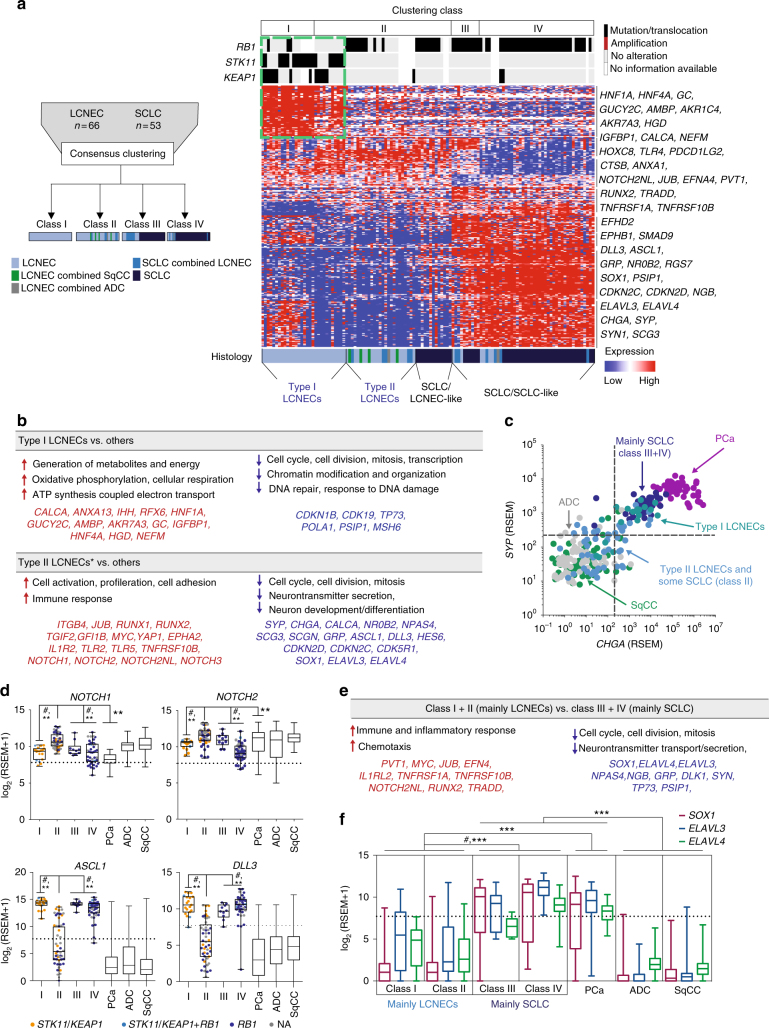
Pulmonary large-cell neuroendocrine carcinomas (LCNECs) have similarities with other lung cancers, but their precise relationship has remained unclear. Here we perform a comprehensive genomic (n = 60) and transcriptomic (n = 69) analysis of 75 LCNECs and identify two molecular subgroups: "type I LCNECs" with bi-allelic TP53 and STK11/KEAP1 alterations (37%), and "type II LCNECs" enriched for bi-allelic inactivation of TP53 and RB1 (42%). Despite sharing genomic alterations with adenocarcinomas and squamous cell carcinomas, no transcriptional relationship was found; instead LCNECs form distinct transcriptional subgroups with closest similarity to SCLC. While type I LCNECs and SCLCs exhibit a neuroendocrine profile with ASCL1/DLL3/NOTCH, type II LCNECs bear TP53 and RB1 alterations and differ from most SCLC tumors with reduced neuroendocrine markers, a pattern of ASCL1/DLL3/NOTCH, and an upregulation of immune-related pathways. In conclusion, LCNECs comprise two molecularly defined subgroups, and distinguishing them from SCLC may allow stratified targeted treatment of high-grade neuroendocrine lung tumors.
肺大细胞神经内分泌癌(LCNEC)与其他肺癌有相似之处,但其确切关系仍不明确。在此,我们对75例LCNEC进行了全面的基因组(n = 60)和转录组(n = 69)分析,确定了两个分子亚组:双等位基因TP53和STK11/KEAP1改变的“Ⅰ型LCNEC”(37%),以及富含双等位基因TP53和RB1失活的“Ⅱ型LCNEC”(42%)。尽管LCNEC与腺癌和鳞状细胞癌存在共同的基因组改变,但未发现转录关系;相反,LCNEC形成了与小细胞肺癌(SCLC)最相似的独特转录亚组。Ⅰ型LCNEC和SCLC表现出具有ASCL1/DLL3/NOTCH的神经内分泌特征,而Ⅱ型LCNEC存在TP53和RB1改变,与大多数SCLC肿瘤不同,其神经内分泌标志物减少、ASCL1/DLL3/NOTCH模式以及免疫相关途径上调。总之,LCNEC包含两个分子定义的亚组,将它们与SCLC区分开来可能有助于对高级别神经内分泌性肺肿瘤进行分层靶向治疗。