Ryan Jonathan C, Hubbard Alun, Stibal Marek, Irvine-Fynn Tristram D, Cook Joseph, Smith Laurence C, Cameron Karen, Box Jason
Centre for Glaciology, Department of Geography and Earth Sciences, Aberystwyth University, Aberystwyth, SY23 3DB, UK.
Department of Geography, University of California, Los Angeles, Los Angeles, CA, 90095, USA.
Nat Commun. 2018 Mar 14;9(1):1065. doi: 10.1038/s41467-018-03353-2.
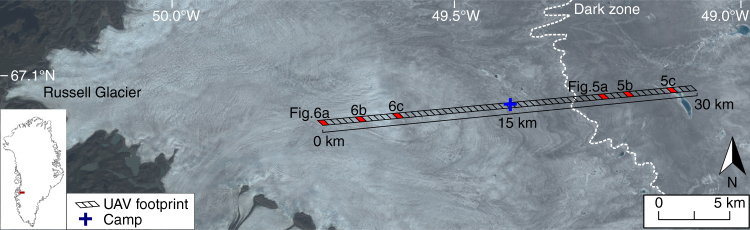
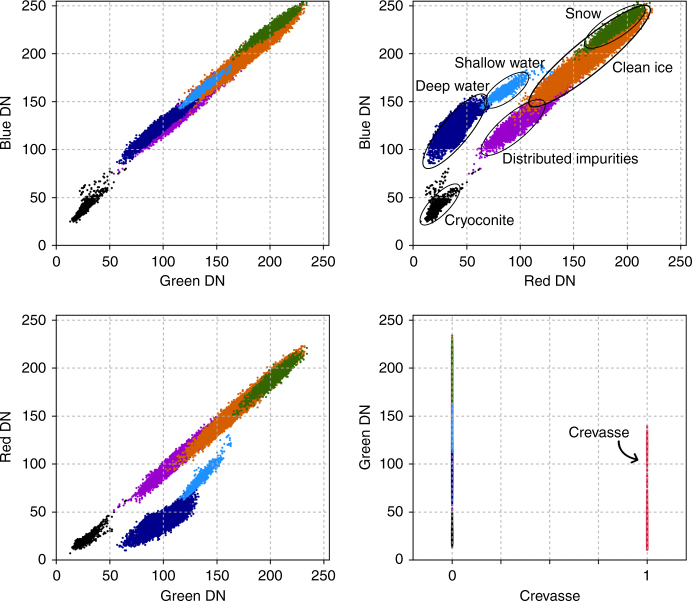
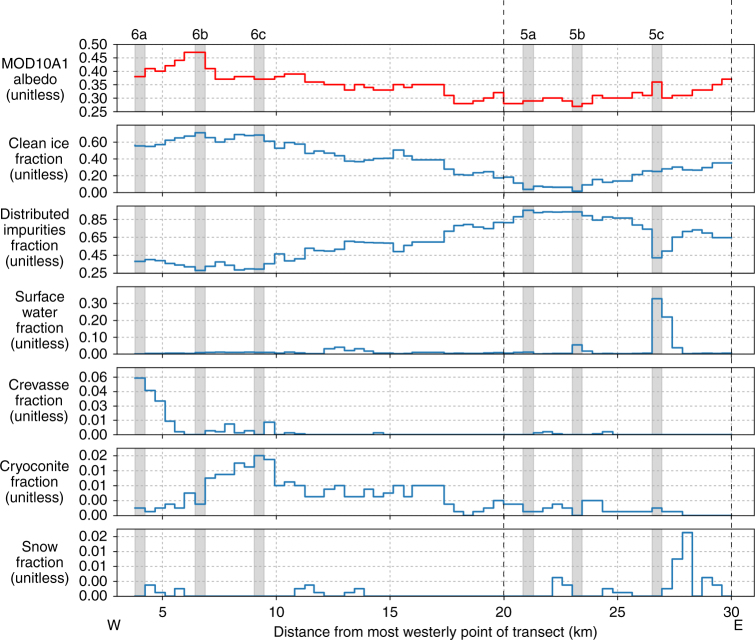
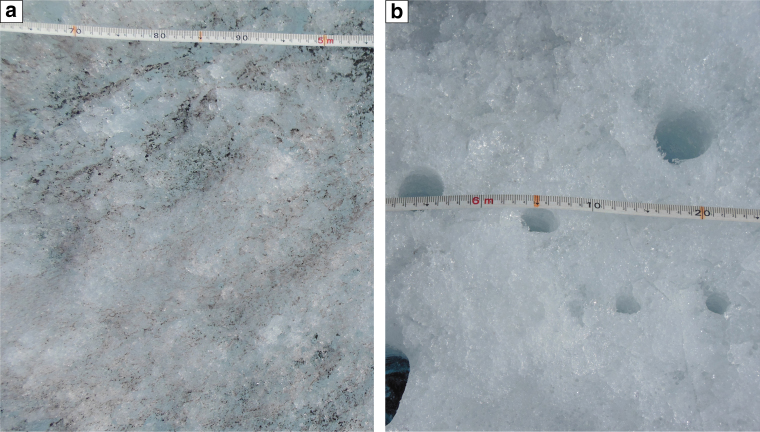
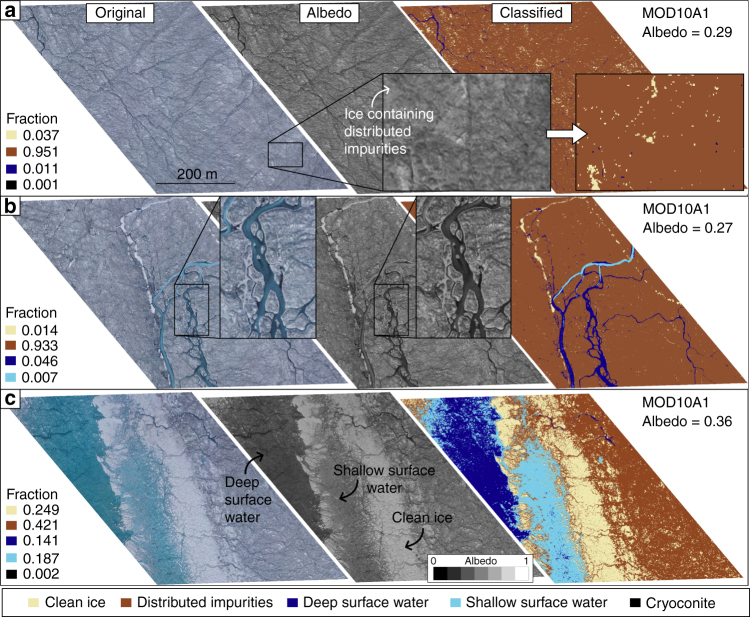
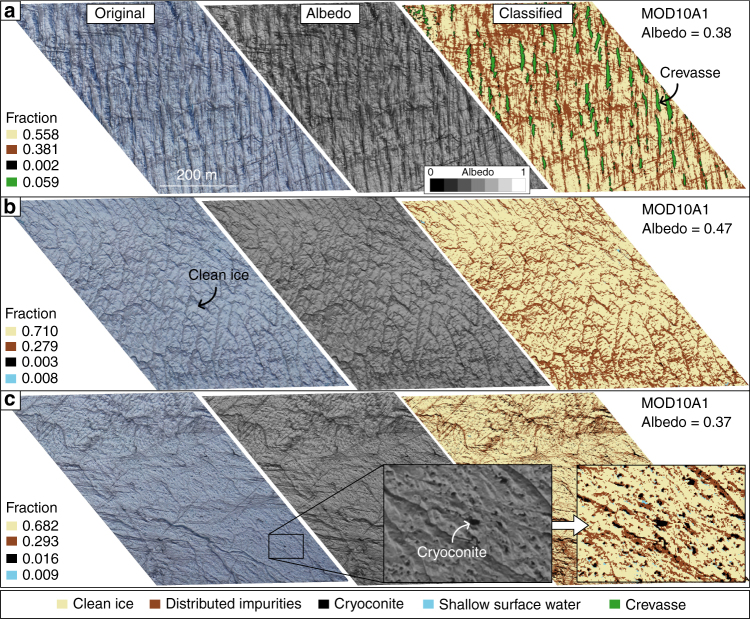
Albedo-a primary control on surface melt-varies considerably across the Greenland Ice Sheet yet the specific surface types that comprise its dark zone remain unquantified. Here we use UAV imagery to attribute seven distinct surface types to observed albedo along a 25 km transect dissecting the western, ablating sector of the ice sheet. Our results demonstrate that distributed surface impurities-an admixture of dust, black carbon and pigmented algae-explain 73% of the observed spatial variability in albedo and are responsible for the dark zone itself. Crevassing and supraglacial water also drive albedo reduction but due to their limited extent, explain just 12 and 15% of the observed variability respectively. Cryoconite, concentrated in large holes or fluvial deposits, is the darkest surface type but accounts for <1% of the area and has minimal impact. We propose that the ongoing emergence and dispersal of distributed impurities, amplified by enhanced ablation and biological activity, will drive future expansion of Greenland's dark zone.
反照率——表面融化的主要控制因素——在格陵兰冰原上变化很大,但构成其暗区的具体表面类型仍未得到量化。在这里,我们使用无人机图像,沿着一条25公里长的横断面,将七种不同的表面类型与观测到的反照率相关联,该横断面横穿冰原西部消融区。我们的结果表明,分布的表面杂质——灰尘、黑碳和有色藻类的混合物——解释了观测到的反照率空间变异性的73%,并导致了暗区的形成。裂隙和冰川上的水也会导致反照率降低,但由于它们的范围有限,分别只解释了观测到的变异性的12%和15%。集中在大洞或河流沉积物中的冰尘是最暗的表面类型,但占面积不到1%,影响最小。我们认为,持续出现和扩散的分布杂质,因增强的消融和生物活动而加剧,将推动格陵兰暗区未来的扩张。