Wellcome/EPSRC Centre for Interventional and Surgical Sciences, University College London, London, UK.
University College Hospital, London, UK.
Int J Comput Assist Radiol Surg. 2018 May;13(5):713-720. doi: 10.1007/s11548-018-1728-4. Epub 2018 Mar 15.
The standard clinical treatment of Twin-to-Twin transfusion syndrome consists in the photo-coagulation of undesired anastomoses located on the placenta which are responsible to a blood transfer between the two twins. While being the standard of care procedure, fetoscopy suffers from a limited field-of-view of the placenta resulting in missed anastomoses. To facilitate the task of the clinician, building a global map of the placenta providing a larger overview of the vascular network is highly desired.
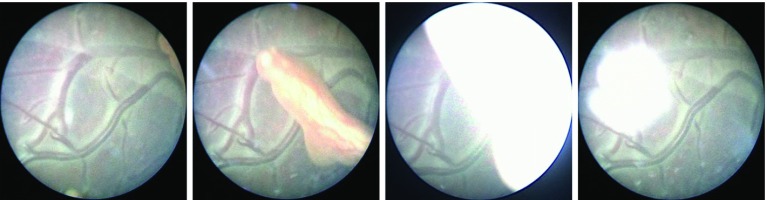
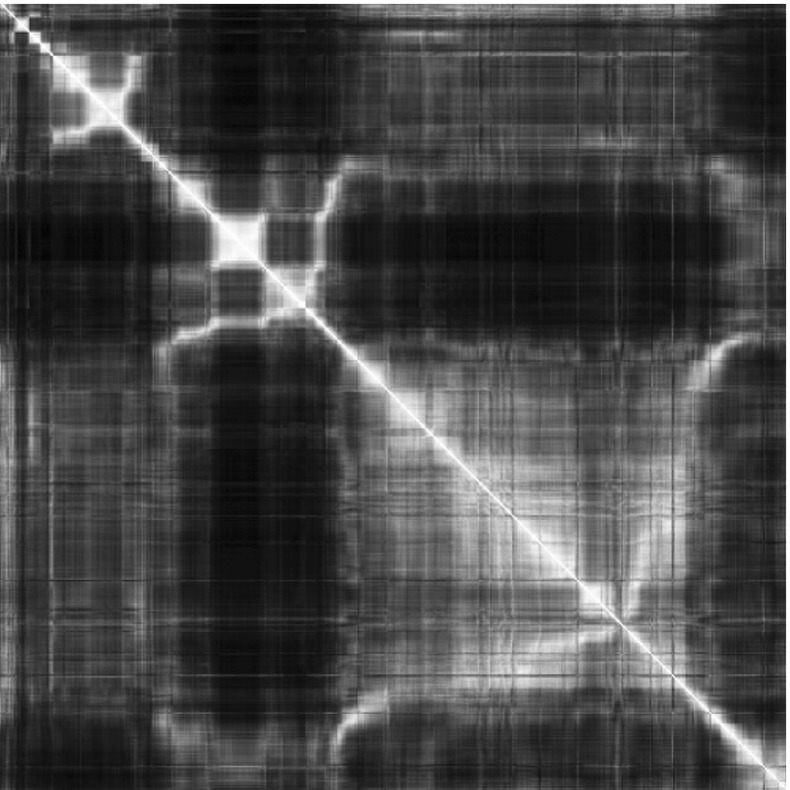
To overcome the challenging visual conditions inherent to in vivo sequences (low contrast, obstructions or presence of artifacts, among others), we propose the following contributions: (1) robust pairwise registration is achieved by aligning the orientation of the image gradients, and (2) difficulties regarding long-range consistency (e.g. due to the presence of outliers) is tackled via a bag-of-word strategy, which identifies overlapping frames of the sequence to be registered regardless of their respective location in time.
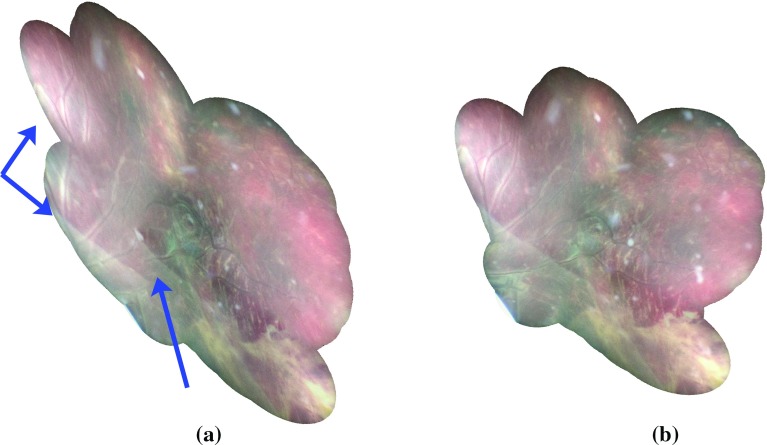
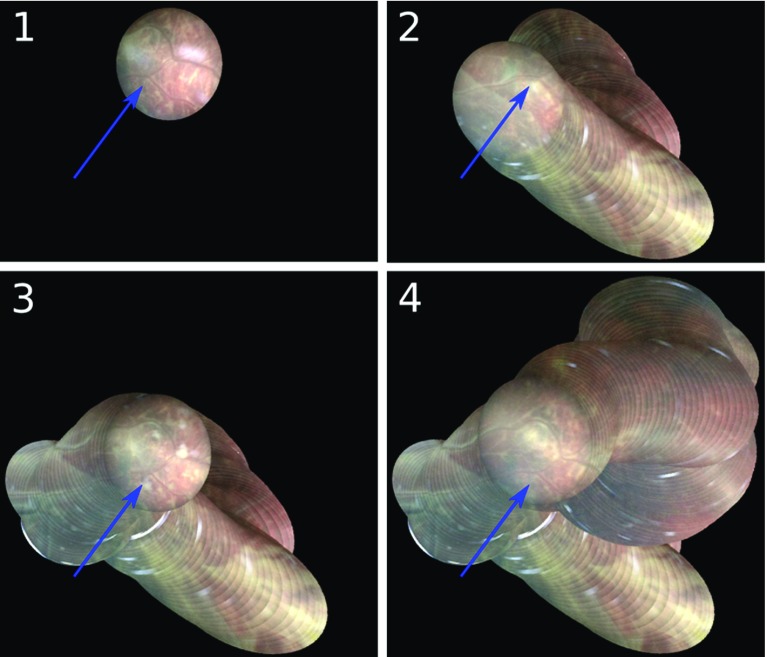
In addition to visual difficulties, in vivo sequences are characterised by the intrinsic absence of gold standard. We present mosaics motivating qualitatively our methodological choices and demonstrating their promising aspect. We also demonstrate semi-quantitatively, via visual inspection of registration results, the efficacy of our registration approach in comparison with two standard baselines.
This paper proposes the first approach for the construction of mosaics of placenta in in vivo fetoscopy sequences. Robustness to visual challenges during registration and long-range temporal consistency are proposed, offering first positive results on in vivo data for which standard mosaicking techniques are not applicable.
双胎输血综合征的标准临床治疗方法包括对胎盘上导致双胎间血液转移的不良吻合进行光凝固。虽然作为护理标准程序,但胎儿镜检查受到胎盘视场有限的限制,导致吻合口漏诊。为了方便临床医生的工作,构建提供胎盘血管网络更大概述的全局图谱是非常需要的。
为了克服体内序列固有的具有挑战性的视觉条件(对比度低、存在障碍物或伪影等),我们提出了以下贡献:(1)通过对齐图像梯度的方向来实现稳健的配对配准;(2)通过词袋策略解决长程一致性的困难,该策略识别要注册的序列的重叠帧,而不管它们在时间上的位置如何。
除了视觉困难外,体内序列的特点是本质上缺乏金标准。我们展示了拼贴画,定性地证明了我们方法选择的合理性,并展示了它们有前景的方面。我们还通过注册结果的视觉检查,展示了我们的注册方法与两个标准基线相比的有效性,这是半定量的。
本文提出了在体内胎儿镜检查序列中构建胎盘拼贴画的第一种方法。在注册过程中提出了对视觉挑战和长程时间一致性的稳健性,为标准拼接技术不适用于的体内数据提供了初步的积极结果。