University of Bordeaux, Bordeaux, France.
Wellcome/EPSRC Centre for Interventional and Surgical Sciences (WEISS) and Department of Computer Science, University College London, London, UK.
Int J Comput Assist Radiol Surg. 2022 Jun;17(6):1125-1134. doi: 10.1007/s11548-022-02623-1. Epub 2022 May 3.
Fetoscopic laser photocoagulation is a minimally invasive procedure to treat twin-to-twin transfusion syndrome during pregnancy by stopping irregular blood flow in the placenta. Building an image mosaic of the placenta and its network of vessels could assist surgeons to navigate in the challenging fetoscopic environment during the procedure.
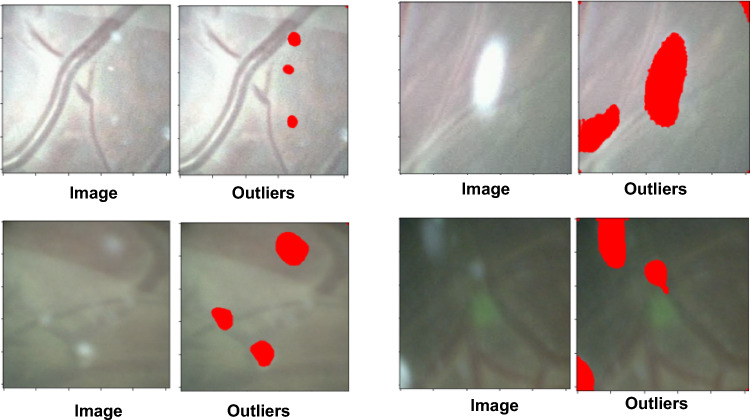
We propose a fetoscopic mosaicking approach by combining deep learning-based optical flow with robust estimation for filtering inconsistent motions that occurs due to floating particles and specularities. While the current state of the art for fetoscopic mosaicking relies on clearly visible vessels for registration, our approach overcomes this limitation by considering the motion of all consistent pixels within consecutive frames. We also overcome the challenges in applying off-the-shelf optical flow to fetoscopic mosaicking through the use of robust estimation and local refinement.
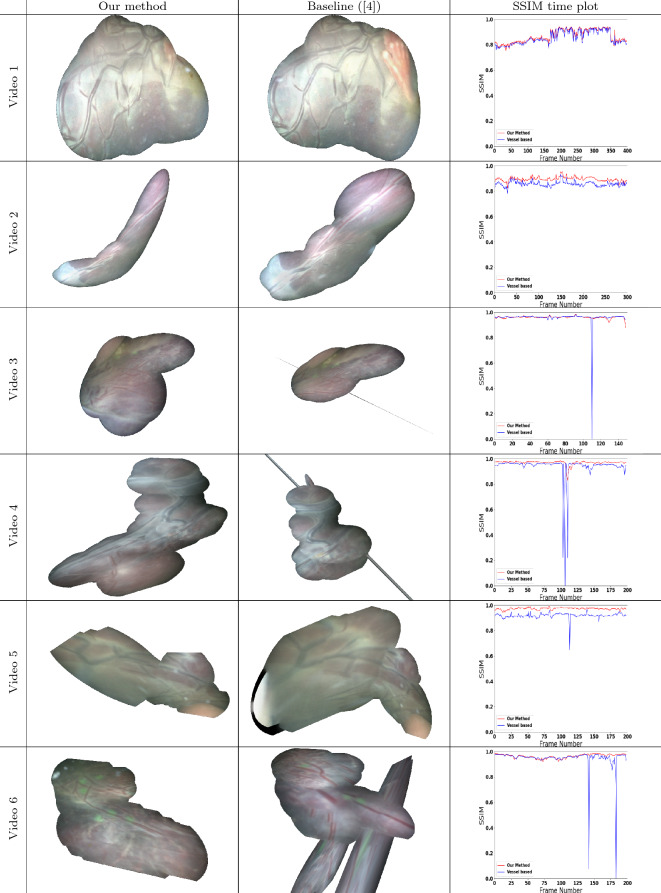
We compare our proposed method against the state-of-the-art vessel-based and optical flow-based image registration methods, and robust estimation alternatives. We also compare our proposed pipeline using different optical flow and robust estimation alternatives.
Through analysis of our results, we show that our method outperforms both the vessel-based state of the art and LK, noticeably when vessels are either poorly visible or too thin to be reliably identified. Our approach is thus able to build consistent placental vessel mosaics in challenging cases where currently available alternatives fail.
羊膜镜激光光凝术是一种通过阻止胎盘内不规则血流来治疗妊娠期间双胎输血综合征的微创手术。构建胎盘及其血管网络的图像镶嵌图可以帮助外科医生在手术中导航具有挑战性的羊膜镜环境。
我们提出了一种羊膜镜镶嵌方法,该方法将基于深度学习的光流与鲁棒估计相结合,以过滤由于浮动物体和镜面反射引起的不一致运动。虽然当前的羊膜镜镶嵌技术依赖于明显可见的血管进行注册,但我们的方法通过考虑连续帧中所有一致像素的运动克服了这一限制。我们还通过使用鲁棒估计和局部细化来克服将现成的光流应用于羊膜镜镶嵌的挑战。
我们将我们提出的方法与基于血管的和基于光流的图像注册方法的最新技术以及鲁棒估计的替代方法进行了比较。我们还比较了我们使用不同光流和鲁棒估计替代方案的提出的管道。
通过对结果的分析,我们表明我们的方法明显优于基于血管的最新技术和 LK,特别是当血管要么难以看到,要么太细而无法可靠识别时。因此,我们的方法能够在当前可用替代方案失败的情况下构建具有挑战性病例中的一致胎盘血管镶嵌图。