Department of Systems Neuroscience, University Medical Center Hamburg-Eppendorf, Hamburg, Germany.
Elife. 2018 Mar 20;7:e32930. doi: 10.7554/eLife.32930.
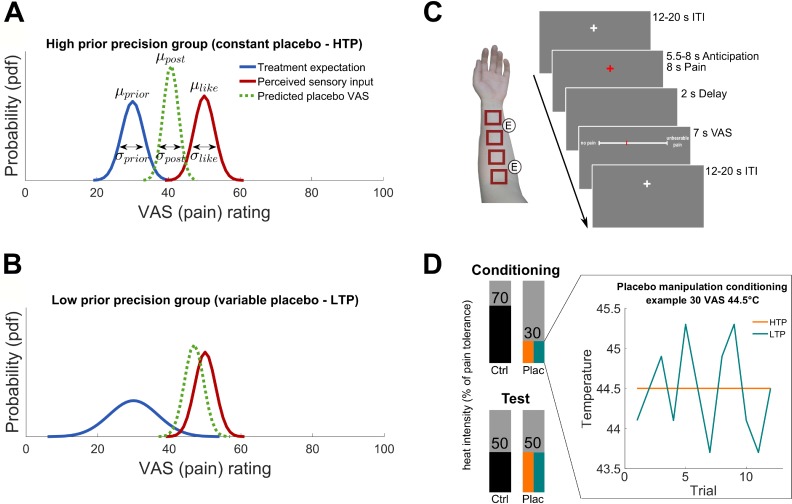
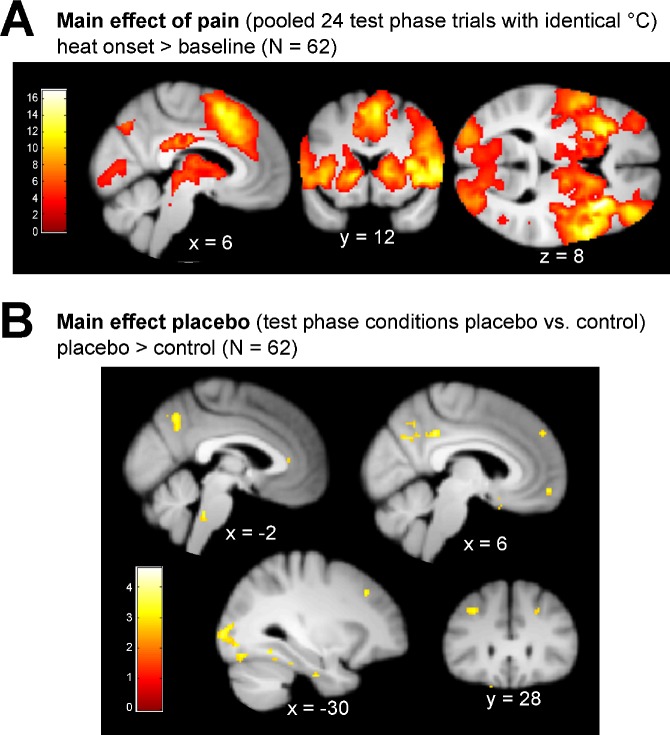
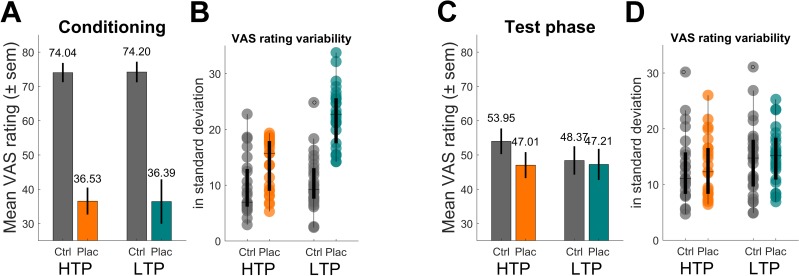
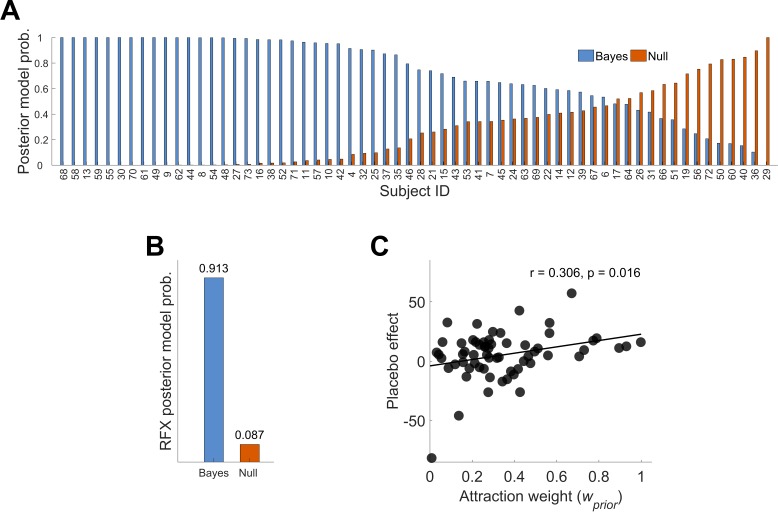
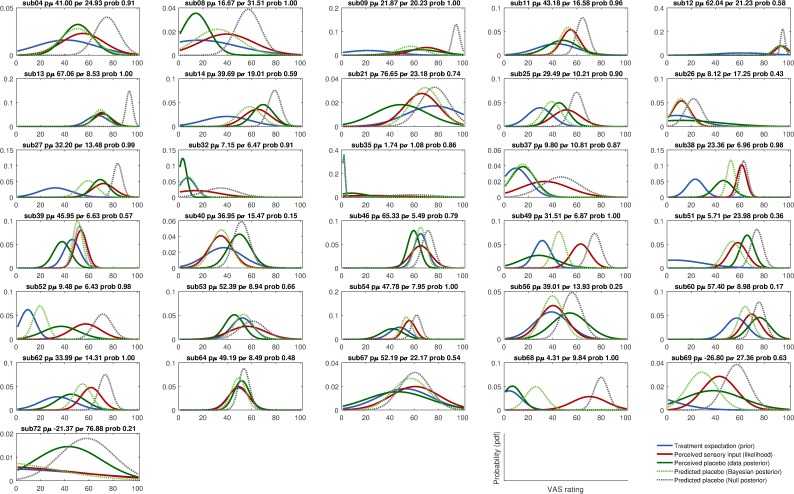
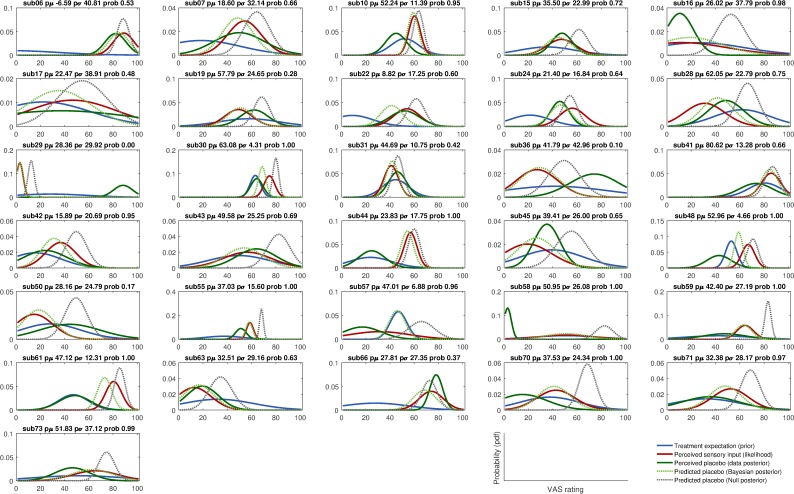
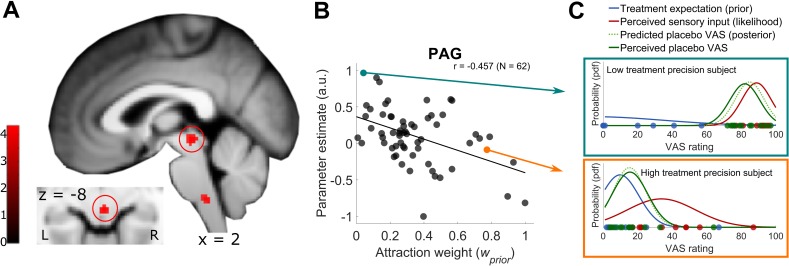
In placebo hypoalgesia research, the strength of treatment expectations and experiences are key components. However, the reliability or precision of expectations had been mostly ignored although being a likely source for interindividual differences. In the present study, we adopted a Bayesian framework, naturally combining expectation magnitudes and precisions. This postulates that expectations (prior) are integrated with incoming nociceptive information (likelihood) and both are weighted by their relative precision to form the pain percept and placebo effect. Sixty-two healthy subjects received heat pain during fMRI. Placebo effects were more pronounced in subjects with more precise treatment expectations and correlated positively with the relative precision of the prior expectation. Neural correlates of this precision were observed in the periaqueductal gray and the rostral ventromedial medulla, indicating that already at the level of the brainstem the precision of an expectation can influence pain perception presenting strong evidence for Bayesian integration in placebo hypoalgesia.
在安慰剂镇痛研究中,治疗期望和体验的强度是关键组成部分。然而,尽管期望可能是个体差异的一个来源,但它们的可靠性或精度大多被忽视了。在本研究中,我们采用了贝叶斯框架,自然地将期望幅度和精度结合在一起。这一假设认为,期望(先验)与传入的伤害性信息(似然)相结合,两者都由其相对精度加权,以形成疼痛感知和安慰剂效应。62 名健康受试者在 fMRI 期间接受热痛刺激。具有更精确治疗期望的受试者表现出更明显的安慰剂效应,并且与先验期望的相对精度呈正相关。在中脑导水管周围灰质和吻侧腹内侧髓质中观察到这种精度的神经相关性,表明在脑干水平,期望的精度可以影响疼痛感知,为安慰剂镇痛中的贝叶斯整合提供了有力证据。