Department of Psychology, Lund University, Lund, Sweden.
Department of Philosophy and Cognitive Science, Lund University, Lund, Sweden.
Sci Rep. 2018 Mar 19;8(1):4826. doi: 10.1038/s41598-018-23297-3.
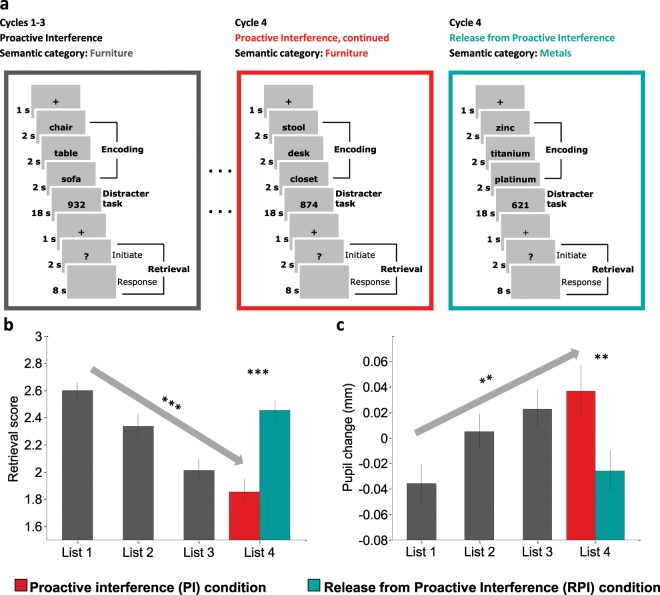
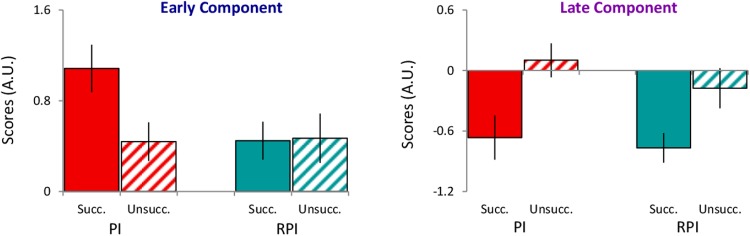
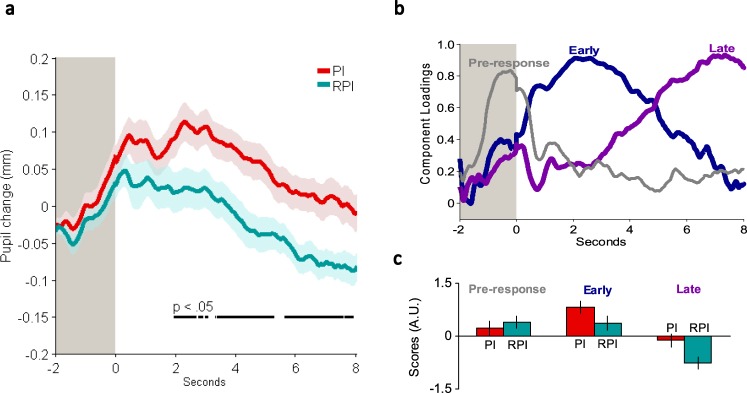
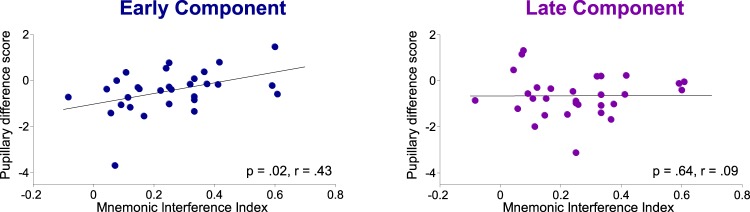
Mnemonic interference refers to the inability to retrieve a goal-relevant memory due to interference from goal-irrelevant memories. Understanding the causes of such interference and how it is overcome has been a central goal in the science of memory for more than a century. Here, we shed new light on this fundamental issue by tracking participants' pupil response when they encode and retrieve memories in the face of competing goal-irrelevant memories. We show that pupil dilation systematically increased in accordance with interference from competing memory traces when participants retrieved previously learned information. Moreover, our results dissociate two main components in the pupillary response signal: an early component, which peaked in a time window where the pupillary waveform on average had its maximum peak, and a late component, which peaked towards the end of the retrieval task. We provide evidence that the early component is specifically modulated by the cognitive effort needed to handle interference from competing memory traces whereas the late component reflects general task engagement. This is the first demonstration that mnemonic interference resolution can be tracked online in the pupil signal and offers novel insight into the underlying dynamics.
记忆干扰是指由于与目标无关的记忆的干扰,无法检索到与目标相关的记忆。理解这种干扰的原因以及如何克服这种干扰,是一个多世纪以来记忆科学的核心目标。在这里,我们通过在参与者面对竞争的与目标无关的记忆时对他们的瞳孔反应进行追踪,为这个基本问题提供了新的认识。我们表明,当参与者检索以前学过的信息时,瞳孔扩张会随着竞争记忆痕迹的干扰而系统地增加。此外,我们的结果分离了瞳孔反应信号中的两个主要成分:一个早期成分,在瞳孔波形平均达到最大峰值的时间窗口内达到峰值,以及一个晚期成分,在检索任务接近尾声时达到峰值。我们提供的证据表明,早期成分是专门由处理竞争记忆痕迹干扰所需的认知努力来调节的,而晚期成分反映了一般的任务参与。这是首次证明记忆干扰的解决可以在瞳孔信号中在线追踪,并为潜在的动态提供了新的见解。