Kitsios Georgios D
Division of Pulmonary, Allergy and Critical Care Medicine, Department of Medicine, University of Pittsburgh School of Medicine and University of Pittsburgh Medical Center, Pittsburgh, Pennsylvania, USA.
Center for Medicine and the Microbiome, University of Pittsburgh, Pittsburgh, Pennsylvania, USA.
mSystems. 2018 Mar 13;3(2). doi: 10.1128/mSystems.00153-17. eCollection 2018 Mar-Apr.
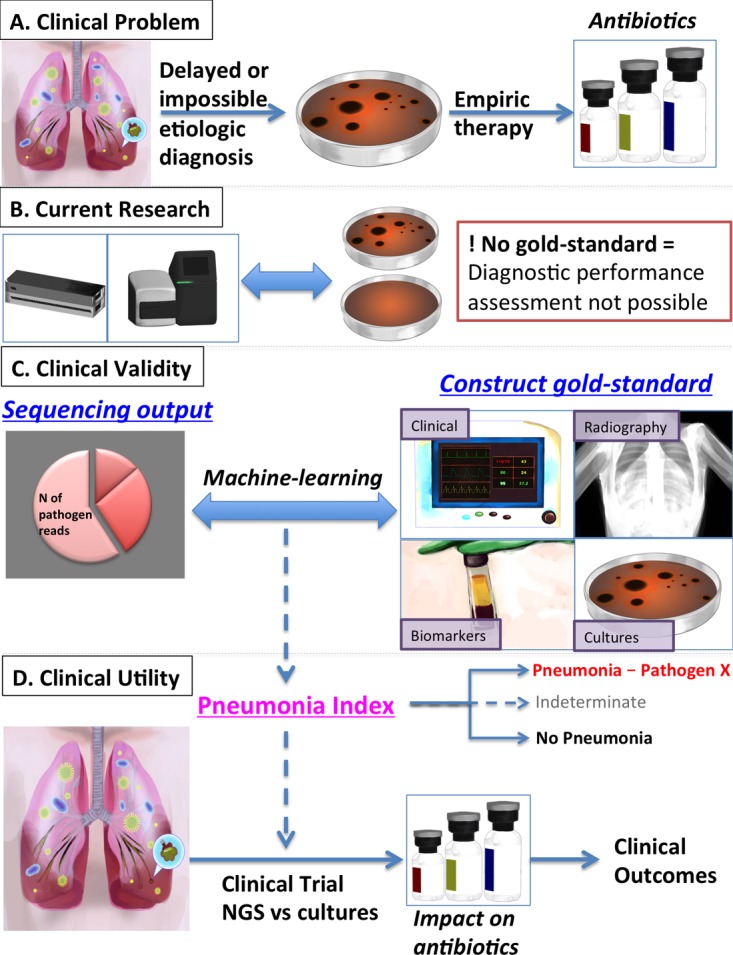
Severe bacterial pneumonia is a major global cause of morbidity and mortality, yet current diagnostic approaches rely on identification of causative pathogens by cultures, which require extended incubation periods and often fail to detect relevant pathogens. Consequently, patients are prescribed broad-spectrum antibiotics in a "one-size-fits-all" manner, which may be inappropriate for their individual needs and promote antibiotic resistance. My research focuses on leveraging next-generation sequencing of microbial DNA directly from patient samples for the development of new, culture-independent definitions of pneumonia. In this perspective article, I discuss the current state of the field and focus on the conceptual and research design challenges for clinical translation. With ongoing technological advancements and application of computational biology methods for assessing clinical validity and utility, I anticipate that sequencing-based diagnostics will soon be able to positively disrupt the way we think about, diagnose, and treat pulmonary infections.
重症细菌性肺炎是全球发病和死亡的主要原因,但目前的诊断方法依赖于通过培养来鉴定致病病原体,这需要较长的培养时间,而且常常无法检测到相关病原体。因此,患者被“一刀切”地使用广谱抗生素,这可能不符合他们的个体需求,并会促进抗生素耐药性。我的研究重点是利用直接从患者样本中进行的微生物DNA下一代测序,来开发新的、不依赖培养的肺炎定义。在这篇观点文章中,我讨论了该领域的现状,并重点关注临床转化中的概念和研究设计挑战。随着技术的不断进步以及计算生物学方法在评估临床有效性和实用性方面的应用,我预计基于测序的诊断很快将能够积极改变我们对肺部感染的思考、诊断和治疗方式。