Department of Physiology, Faculty of Medicine, University of Medical Sciences & Technology, Khartoum, Sudan.
Graduate Entry Medical School, University of Limerick, Limerick, Ireland.
Lipids Health Dis. 2018 Mar 20;17(1):56. doi: 10.1186/s12944-018-0711-y.
There is a strong association between cardiometabolic risk and adipose tissue dysfunction with great consequences on type 2 diabetic patients. Visceral Adiposity Index (VAI) is an indirect clinical marker of adipose tissue dysfunction. Gum Arabic (GA) is a safe dietary fiber, an exudate of Acacia Senegal. Gum Arabic had shown lipid lowering effect in both humans and animals. The aim of this trial was to determine the effect of GA supplementation on anthropometric obesity marker, Visceral Adiposity Index (VAI) and blood pressure in patients with type 2 diabetes mellitus.
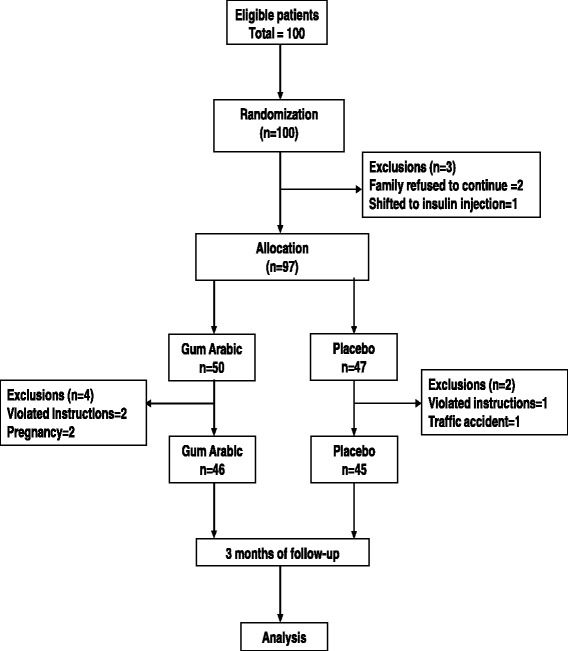
This randomized, double blinded, placebo controlled trial recruited a total of 91 type 2 diabetic patients (73 females, 18 males), age (mean ± SD) 50.09 ± 9.3 years on hypoglycemic agents and were randomly assigned into two groups, either to consume 30 g of GA or 5 g of placebo daily for 3 months. Anthropometric obesity markers were measured and indices were calculated. Blood pressure was measured and high density lipoprotein (HDL) and triglycerides (TG) were determined in fasting blood samples at the start and end of the study period.
After intervention, Gum Arabic decreased BMI and VAI significantly (P < 0.05) in GA group by 2 and 23.7% respectively. Body adiposity index significantly decreased by 3.9% in GA group while there were no significant changes in waist circumference or waist-to-hip ratio (WHR). Systolic blood pressure significantly decreased by 7.6% in GA group and by 2.7% in placebo group from baseline with no significant changes in diastolic blood pressure in the two groups.
Gum Arabic consumption at a dose of 30 g/d for 3 months may play an effective role in preventing weight gain and modulating adipose tissue dysfunction in type 2 diabetic patients, although no effect has been shown in waist-to-hip ratio.
The trial had been registered as prospective interventional clinical trials in the Pan African Clinical Trial Registry (PACTR) PACTR201403000785219 , on 7th March 2014.
心血管代谢风险与脂肪组织功能障碍之间存在很强的关联,这对 2 型糖尿病患者有很大的影响。内脏脂肪指数(VAI)是脂肪组织功能障碍的间接临床标志物。阿拉伯胶(GA)是一种安全的膳食纤维,是 Acacia Senegal 的渗出物。阿拉伯胶在人和动物中均显示出降低血脂的作用。本试验旨在确定 GA 补充剂对 2 型糖尿病患者的人体肥胖标志物、内脏脂肪指数(VAI)和血压的影响。
这项随机、双盲、安慰剂对照试验共招募了 91 名 2 型糖尿病患者(73 名女性,18 名男性),年龄(均值±标准差)为 50.09±9.3 岁,正在服用降糖药,并随机分为两组,分别每天服用 30 克 GA 或 5 克安慰剂,持续 3 个月。测量人体肥胖标志物并计算指数。在研究开始和结束时,测量血压并检测空腹血样中的高密度脂蛋白(HDL)和甘油三酯(TG)。
干预后,GA 组的 BMI 和 VAI 分别显著下降 2%和 23.7%(P<0.05)。GA 组的身体脂肪指数显著下降 3.9%,而腰围或腰臀比(WHR)无明显变化。GA 组的收缩压显著下降 7.6%,安慰剂组下降 2.7%,两组的舒张压均无明显变化。
每天摄入 30 克 GA 持续 3 个月可能在预防 2 型糖尿病患者体重增加和调节脂肪组织功能障碍方面发挥有效作用,尽管对腰臀比没有影响。
该试验已于 2014 年 3 月 7 日在泛非临床试验注册中心(PACTR)以前瞻性干预性临床试验的形式注册(PACTR201403000785219)。