Department of Internal and Integrative Medicine, Kliniken Essen-Mitte, Faculty of Medicine, University of Duisburg-Essen, Essen, Germany.
BMC Psychiatry. 2018 Mar 22;18(1):72. doi: 10.1186/s12888-018-1650-x.
Yoga is increasingly used as a therapeutic treatment and seems to improve psychiatric conditions such as anxiety disorders and depression. The aim of this systematic review was to assess the evidence of yoga for reducing symptoms of posttraumatic stress disorder (PTSD).
The Cochrane Library, Medline/PubMed, PsycINFO, Scopus, and IndMED were searched through July 2017 for randomized controlled trials (RCTs) assessing the effects of yoga on symptoms of PTSD. Mean differences (MD) and standardized mean differences (SMD) with 95% confidence intervals (CI) were computed. The quality of evidence and the strength of recommendation were graded according to the GRADE recommendations.
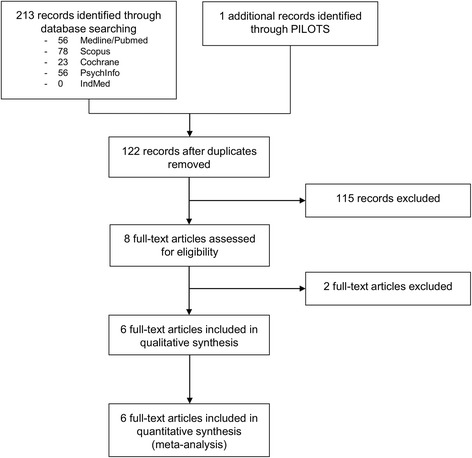
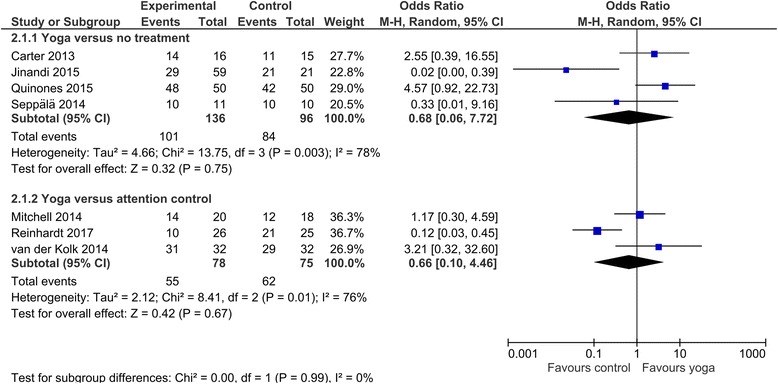
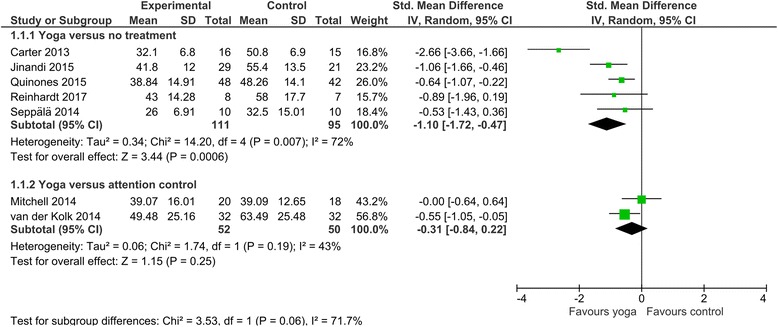
Seven RCTs (N = 284) were included. Meta-analysis revealed low quality evidence for clinically relevant effects of yoga on PTSD symptoms compared to no treatment (SMD = - 1.10, 95% CI [- 1.72, - 0.47], p < .001, I = 72%; MD = - 13.11, 95% CI [- 17.95, - 8.27]); and very low evidence for comparable effects of yoga and attention control interventions (SMD = - 0.31, 95%CI = [- 0.84, 0.22], p = .25; I = 43%). Very low evidence was found for comparable retention of patients in the trial for yoga and no treatment (OR = 0.68, 95%CI [0.06, 7.72]) or attention control interventions (OR = 0.66, 95%CI [0.10, 4.46]). No serious adverse events were reported.
Few RCTs with only limited sample size were available.
Only a weak recommendation for yoga as an adjunctive intervention for PTSD can be made. More high quality research is needed to confirm or disconfirm these findings.
瑜伽作为一种治疗手段,在改善焦虑症和抑郁症等精神疾病方面似乎效果显著。本系统综述旨在评估瑜伽对减轻创伤后应激障碍(PTSD)症状的效果。
通过 Cochrane Library、Medline/PubMed、PsycINFO、Scopus 和 IndMED 数据库检索截至 2017 年 7 月评估瑜伽对 PTSD 症状影响的随机对照试验(RCT)。采用均数差值(MD)和标准化均数差值(SMD)及其 95%置信区间(CI)进行分析。根据 GRADE 建议对证据质量和推荐强度进行分级。
纳入 7 项 RCT(N=284)。与无治疗相比,瑜伽对 PTSD 症状的临床相关影响的 Meta 分析显示为低质量证据(SMD=-1.10,95%CI[-1.72,-0.47],p<0.001,I=72%;MD=-13.11,95%CI[-17.95,-8.27]);瑜伽与对照干预(注意力控制)的效果相当,证据质量为极低(SMD=-0.31,95%CI[-0.84,0.22],p=0.25;I=43%)。瑜伽与无治疗或对照干预的患者保留率相当,证据质量为极低(OR=0.68,95%CI[0.06,7.72])或注意力控制干预(OR=0.66,95%CI[0.10,4.46])。未报告严重不良事件。
纳入的 RCT 数量有限,样本量小。
只能给出瑜伽作为 PTSD 辅助治疗的弱推荐。需要更多高质量的研究来证实或否定这些发现。