Roslund Marja I, Grönroos Mira, Rantalainen Anna-Lea, Jumpponen Ari, Romantschuk Martin, Parajuli Anirudra, Hyöty Heikki, Laitinen Olli, Sinkkonen Aki
Faculty of Biological and Environmental Sciences, Ecosystems and Environment Research Programme, University of Helsinki, Lahti, Finland.
Division of Biology, Kansas State University, Kansas, Manhattan, United States of America.
PeerJ. 2018 Mar 19;6:e4508. doi: 10.7717/peerj.4508. eCollection 2018.
Polycyclic aromatic hydrocarbons (PAHs) accumulate in urban soils, and PAH contamination can change soil microbial community composition. Environmental microbiota is associated with human commensal microbiota, immune system and health. Therefore, studies investigating the degradation of PAHs, and the consequences of soil pollution on microbial communities in urban landscaping materials, are crucial.
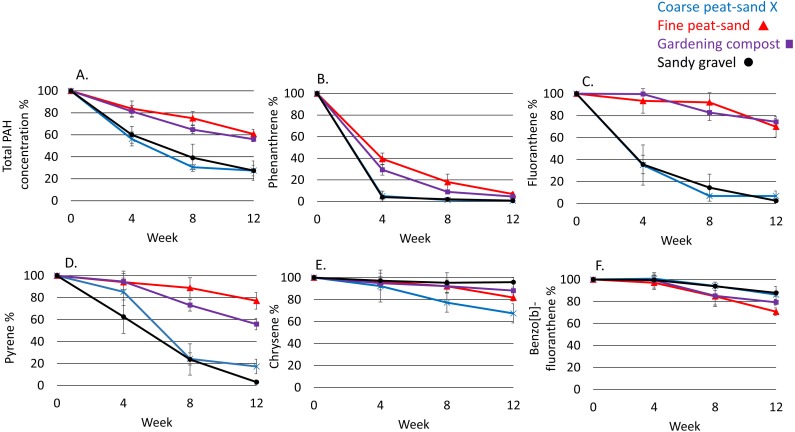
Four landscaping materials (organic matter 1, 2, 13 and 56%) were contaminated with PAHs commonly found at urban sites (phenanthrene, fluoranthene, pyrene, chrysene and benzo(b)fluoranthene) in PAH concentrations that reflect urban soils in Finland (2.4 µg g soil dry weight). PAHs were analyzed initially and after 2, 4, 8 and 12 weeks by gas chromatography-mass spectrometry. Half-lives of PAHs were determined based on 12-weeks degradation. Bacterial communities were analyzed at 1 and 12 weeks after contamination using Illumina MiSeq 16S rRNA gene metabarcoding.
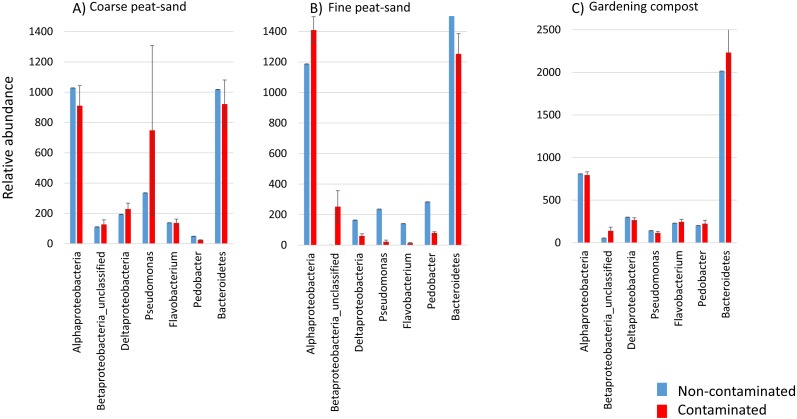
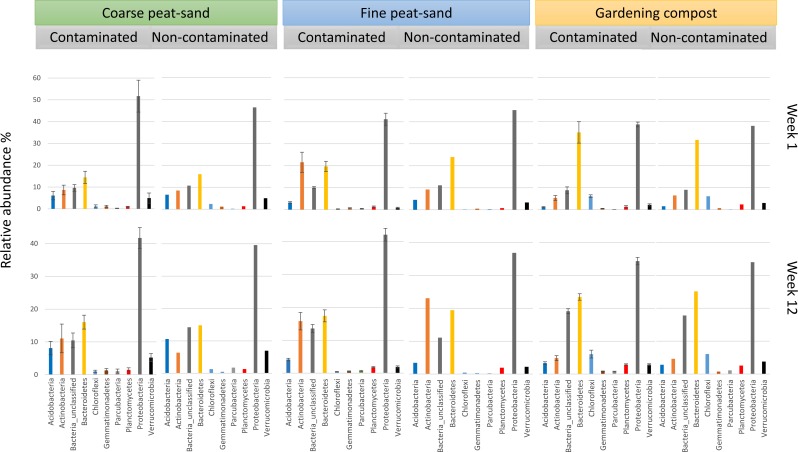
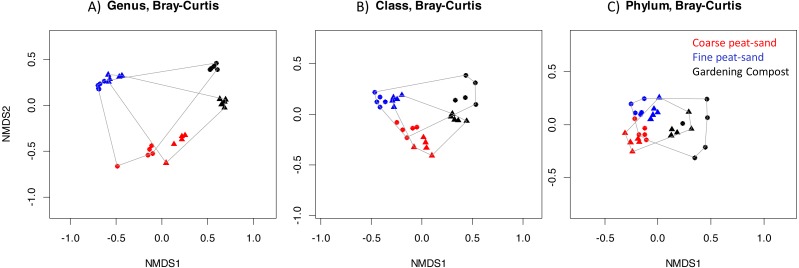
Half-lives ranged from 1.5 to 4.4 weeks for PAHs with relatively low molecular weights (phenanthrene, fluoranthene and pyrene) in landscaping materials containing 1-2% organic matter. In contrast, in materials containing 13% and 56% organic matter, the half-lives ranged from 2.5 to 52 weeks. Shorter half-lives of phenanthrene and fluoranthene were thus associated with low organic matter content. The half-life of pyrene was inversely related to the relative abundance of Beta-, Delta- and Gammaproteobacteria, and diversity of Bacteroidetes and Betaprotebacteria. Compounds with higher molecular weights followed compound-specific patterns. Benzo(b)fluoranthene was resistant to degradation and half-life of chrysene was shorter when the relative abundance of Betaproteobacteria was high. Temporal microbiota changes involved increase in the relative abundance of Deltaproteobacteria and decrease in genera and . Exposure to PAHs seems to adjust microbial community composition, particularly within class Beta- and Deltaproteobacteria.
In this study, PAH degradation depended on the organic matter content and bacterial community composition of landscaping materials. Contamination seems to alter bacterial community composition in landscaping materials depending on material type. This alteration includes changes in bacterial phyla associated with human health and immune system. This may open new possibilities for managing urban environments by careful selection of landscaping materials, to benefit health and wellbeing.
多环芳烃(PAHs)在城市土壤中积累,PAH污染会改变土壤微生物群落组成。环境微生物群与人类共生微生物群、免疫系统和健康相关。因此,研究PAHs的降解以及城市景观材料中土壤污染对微生物群落的影响至关重要。
四种景观材料(有机物含量分别为1%、2%、13%和56%)被城市常见的PAHs(菲、荧蒽、芘、屈和苯并[b]荧蒽)污染,PAH浓度反映了芬兰城市土壤的情况(2.4 µg/g土壤干重)。最初以及在2、4、8和12周后通过气相色谱-质谱法分析PAHs。基于12周的降解情况确定PAHs的半衰期。在污染后1周和12周使用Illumina MiSeq 16S rRNA基因宏条形码分析细菌群落。
在有机物含量为1%-2%的景观材料中,分子量相对较低的PAHs(菲、荧蒽和芘)的半衰期为1.5至4.4周。相比之下,在有机物含量为13%和56%的材料中,半衰期为2.5至52周。因此,菲和荧蒽较短的半衰期与低有机物含量有关。芘的半衰期与β-、δ-和γ-变形菌的相对丰度以及拟杆菌门和β-变形菌的多样性呈负相关。分子量较高的化合物遵循化合物特异性模式。当β-变形菌的相对丰度较高时,苯并[b]荧蒽抗降解,屈的半衰期较短。微生物群落的时间变化包括δ-变形菌的相对丰度增加以及某属和另一属的减少。接触PAHs似乎会调整微生物群落组成,特别是在β-和δ-变形菌纲内。
在本研究中,PAH降解取决于景观材料的有机物含量和细菌群落组成。污染似乎会根据材料类型改变景观材料中的细菌群落组成。这种改变包括与人类健康和免疫系统相关的细菌门的变化。这可能通过谨慎选择景观材料为管理城市环境开辟新的可能性,以促进健康和福祉。