Departmento de Nutrición, Diabetes y Metabolismo, Escuela de Medicina, Pontificia Universidad Católica de Chile, Santiago, Chile.
PLoS One. 2018 Mar 26;13(3):e0194644. doi: 10.1371/journal.pone.0194644. eCollection 2018.
BACKGROUND/OBJECTIVES: Abdominal obesity (AO) is associated with elevated risk for cardiovascular diseases; however, this association is less clear for non-obese people. We estimated the association of AO and cardiovascular risk factors (CVRF) and disease in non-obese adult individuals from Chile.
SUBJECTS/METHODS: 5248 adults (15 years of age or older) of both sexes from the Chilean National Health Survey (October 2009 -September 2010, response rate 85%.) were included. Information on myocardial infarction and stroke was self-reported. BMI, waist circumference (WC), arterial pressure, plasma glucose, and cholesterol levels were measured. Predictive accuracy of WC was evaluated by area under curve of receiver operating characteristic analysis and cut off points were established by Youden Index. Relationship between AO and CVRF was analyzed by Chi-squared tests.
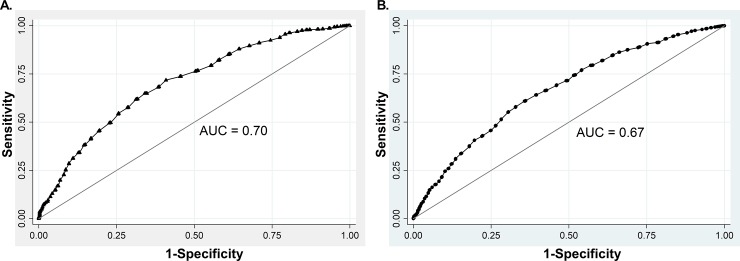
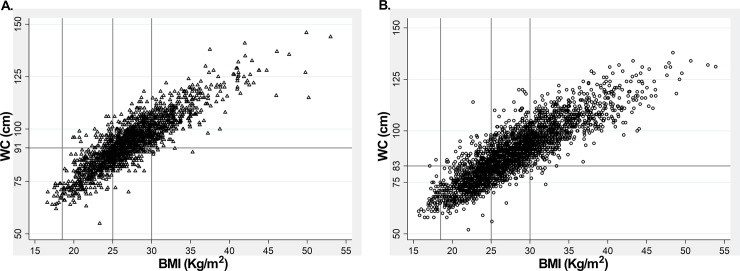
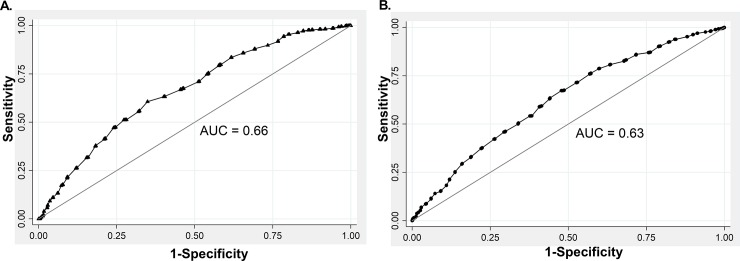
Normal weight/overweight/obesity were present in 34.4%/45.2%/18.1% of men and 33.4%/33.6%/27.5% of women. Predictive accuracy of WC to identify at least one CVRF was 0.70/0.67 and optimal cutoff points for WC in non-obese subjects were 91/83 cm in men/women, respectively. AO was present in 98.2%/99.1% of obese, 70.5%/77.4% of overweight and 12.4%/16.4% of normal weight men/women. AO was associated with increased frequency of CVRF in overweight men (6/8 and stroke) and women (4/8) and higher frequency in normal weight men (8/8 and myocardial infarction/stroke) and women (6/8 and myocardial infarction).
WC cutoff points calculated for non-obese chilean population discriminate more differences in CVRF in normal weight woman. AO significantly increases the frequency of CVRF and diseases in overweight and especially normal weight individuals. WC can be used as a low cost, feasible and reproducible predictor for CVRF in non-obese individuals in most clinical settings.
背景/目的:腹部肥胖(AO)与心血管疾病风险升高相关;然而,对于非肥胖人群,这种关联并不明确。我们评估了智利非肥胖成年个体中 AO 与心血管风险因素(CVRF)和疾病的相关性。
受试者/方法:共纳入 5248 名来自智利全国健康调查(2009 年 10 月至 2010 年 9 月,应答率 85%)的 15 岁及以上的男女两性成年人。心肌梗死和卒中的信息为自我报告。测量了 BMI、腰围(WC)、动脉压、血浆葡萄糖和胆固醇水平。通过受试者工作特征曲线下面积评估 WC 的预测准确性,并通过约登指数确定截断值。采用卡方检验分析 AO 与 CVRF 的关系。
男性正常体重/超重/肥胖者分别占 34.4%/45.2%/18.1%,女性分别占 33.4%/33.6%/27.5%。WC 识别至少一种 CVRF 的预测准确性为 0.70/0.67,非肥胖受试者的 WC 最佳截断值分别为男性 91cm/女性 83cm。男性肥胖者 AO 检出率为 98.2%/99.1%,超重者为 70.5%/77.4%,正常体重者为 12.4%/16.4%。女性肥胖者 AO 与 CVRF 频率增加相关(6/8 项,包括卒中),超重者相关(4/8 项),而正常体重者与 CVRF 频率增加显著相关(8/8 项,包括心肌梗死/卒中)。
为智利非肥胖人群计算的 WC 截断值可更好地区分正常体重女性的 CVRF 差异。AO 显著增加超重和尤其正常体重个体的 CVRF 和疾病频率。WC 可作为大多数临床环境中用于非肥胖个体的低成本、可行和可重复的 CVRF 预测指标。