Mikrobiologisches Institut - Klinische Mikrobiologie, Immunologie und Hygiene, Universitätsklinikum Erlangen und Friedrich-Alexander-Universität (FAU) Erlangen-Nürnberg, Wasserturmstr. 3/5, 91054, Erlangen, Germany.
Kinder- und Jugendklinik, Universitätsklinikum Erlangen und Friedrich-Alexander-Universität (FAU) Erlangen-Nürnberg, Erlangen, Germany.
BMC Pulm Med. 2018 Mar 27;18(1):52. doi: 10.1186/s12890-018-0614-8.
Aspergillus fumigatus is frequently encountered in sputum samples of patients with cystic fibrosis (CF), which traditionally has been interpreted as saprophytic airway colonization. However, this mere bystander role has been challenged by recent data. There is now evidence that Aspergillus fumigatus accelerates the decline of pulmonary function. (1→3)-β-D-glucan (BDG) and galactomannan (GM) are highly sensitive fungal biomarkers that are used to diagnose invasive fungal disease. However, their diagnostic value in CF patients is largely unknown.
We conducted a retrospective cohort study on 104 CF patients to determine whether serum BDG and GM levels correlate with parameters such as Aspergillus-positive sputum cultures and lung function.
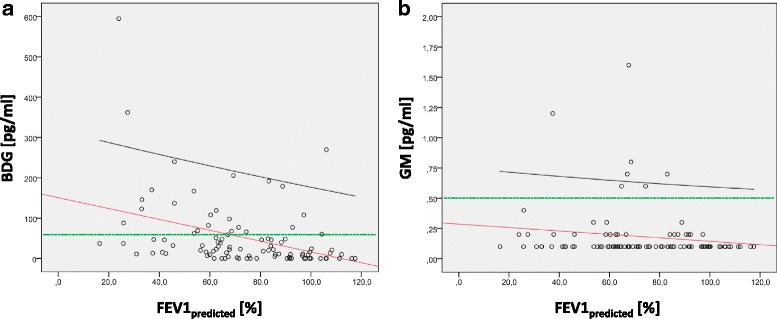
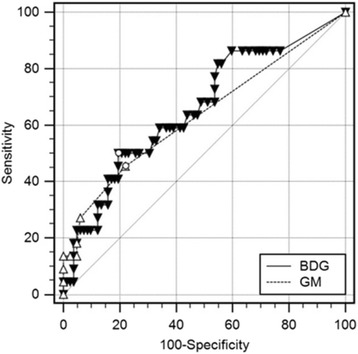
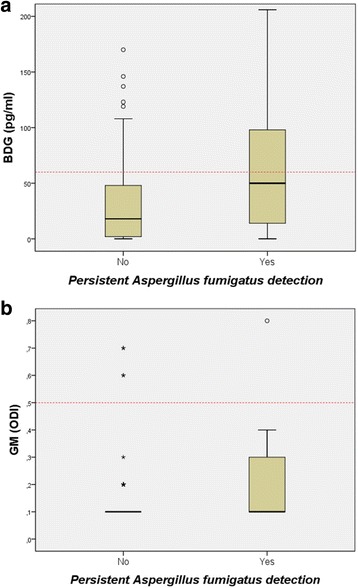
Aspergillus fumigatus was persistently detected in 22 of the 104 CF patients (21%). Mean serum BDG and GM levels in the Aspergillus-positive patients were significantly higher than in those without persistent Aspergillus detection (89 versus 40 pg/ml [p = 0.022] and 0.30 versus 0.15 ODI [p = 0.013], respectively). 27 and 7 patients had elevated BDG (≥ 60 pg/ml) or GM levels (> 0.5 ODI), respectivly. BDG and GM levels showed a significant correlation (p = 0.004). Patients with increased serum concentrations of BDG were more frequently Aspergillus-positive (40.7 versus 14.3%, p = 0.004) and had a significantly lower forced expiratory volume in one second (FEV1) than patients with a normal BDG (61.6 versus 77.1%, p = 0.007). In the multivariate analysis, BDG but not GM or the growth of A. fumigatus, proved to be an independent predictor for the FEV1.
CF patients with persistent Aspergillus detection have elevated BDG and GM levels which ranged between healthy and invasively infected patients. Serum BDG may be superior to GM and fungal culture in predicting an impaired lung function in CF patients.
烟曲霉常出现在囊性纤维化(CF)患者的痰样本中,传统上被解释为气道腐生性定植。然而,最近的数据对这种单纯的旁观者角色提出了挑战。现在有证据表明烟曲霉加速了肺功能的下降。(1→3)-β-D-葡聚糖(BDG)和半乳甘露聚糖(GM)是高度敏感的真菌生物标志物,用于诊断侵袭性真菌感染。然而,它们在 CF 患者中的诊断价值在很大程度上尚不清楚。
我们对 104 例 CF 患者进行了回顾性队列研究,以确定血清 BDG 和 GM 水平是否与烟曲霉阳性痰培养和肺功能等参数相关。
在 104 例 CF 患者中有 22 例(21%)持续检测到烟曲霉。烟曲霉阳性患者的平均血清 BDG 和 GM 水平明显高于未持续检测到烟曲霉的患者(89 与 40 pg/ml[P=0.022]和 0.30 与 0.15 ODI[P=0.013])。分别有 27 名和 7 名患者的 BDG(≥60 pg/ml)或 GM 水平(>0.5 ODI)升高。BDG 和 GM 水平呈显著相关性(P=0.004)。血清 BDG 浓度升高的患者烟曲霉阳性的频率更高(40.7%比 14.3%,P=0.004),其用力呼气量(FEV1)显著低于 BDG 正常的患者(61.6%比 77.1%,P=0.007)。在多变量分析中,BDG 而非 GM 或烟曲霉的生长,被证明是 FEV1 的独立预测因子。
持续检测到烟曲霉的 CF 患者的 BDG 和 GM 水平升高,介于健康患者和侵袭性感染患者之间。血清 BDG 可能优于 GM 和真菌培养,用于预测 CF 患者的肺功能受损。