Lozano-Lozano Mario, Galiano-Castillo Noelia, Martín-Martín Lydia, Pace-Bedetti Nicolás, Fernández-Lao Carolina, Arroyo-Morales Manuel, Cantarero-Villanueva Irene
Department of Physical Therapy, University of Granada, Granada, Spain.
Centro de Investigación Deporte y Salud, University of Granada, Granada, Spain.
JMIR Mhealth Uhealth. 2018 Mar 27;6(3):e67. doi: 10.2196/mhealth.9669.
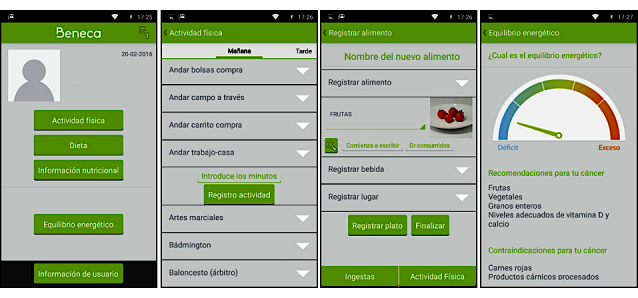
The majority of breast cancer survivors do not meet recommendations in terms of diet and physical activity. To address this problem, we developed a mobile health (mHealth) app for assessing and monitoring healthy lifestyles in breast cancer survivors, called the Energy Balance on Cancer (BENECA) mHealth system. The BENECA mHealth system is a novel and interactive mHealth app, which allows breast cancer survivors to engage themselves in their energy balance monitoring. BENECA was designed to facilitate adherence to healthy lifestyles in an easy and intuitive way.
The objective of the study was to assess the concurrent validity and test-retest reliability between the BENECA mHealth system and the gold standard assessment methods for diet and physical activity.
A reliability study was conducted with 20 breast cancer survivors. In the study, tri-axial accelerometers (ActiGraphGT3X+) were used as gold standard for 8 consecutive days, in addition to 2, 24-hour dietary recalls, 4 dietary records, and sociodemographic questionnaires. Two-way random effect intraclass correlation coefficients, a linear regression-analysis, and a Passing-Bablok regression were calculated.
The reliability estimates were very high for all variables (alpha≥.90). The lowest reliability was found in fruit and vegetable intakes (alpha=.94). The reliability between the accelerometer and the dietary assessment instruments against the BENECA system was very high (intraclass correlation coefficient=.90). We found a mean match rate of 93.51% between instruments and a mean phantom rate of 3.35%. The Passing-Bablok regression analysis did not show considerable bias in fat percentage, portions of fruits and vegetables, or minutes of moderate to vigorous physical activity.
The BENECA mHealth app could be a new tool to measure energy balance in breast cancer survivors in a reliable and simple way. Our results support the use of this technology to not only to encourage changes in breast cancer survivors' lifestyles, but also to remotely monitor energy balance.
ClinicalTrials.gov NCT02817724; https://clinicaltrials.gov/ct2/show/NCT02817724 (Archived by WebCite at http://www.webcitation.org/6xVY1buCc).
大多数乳腺癌幸存者在饮食和身体活动方面未达到相关建议。为解决这一问题,我们开发了一款用于评估和监测乳腺癌幸存者健康生活方式的移动健康(mHealth)应用程序,称为癌症能量平衡(BENECA)mHealth系统。BENECA mHealth系统是一款新颖且交互式的mHealth应用程序,它能让乳腺癌幸存者参与自身能量平衡监测。BENECA旨在以简单直观的方式促进对健康生活方式的坚持。
本研究的目的是评估BENECA mHealth系统与饮食和身体活动的金标准评估方法之间的同时效度和重测信度。
对20名乳腺癌幸存者进行了一项信度研究。在该研究中,除了两份24小时饮食回顾、四份饮食记录和社会人口统计学问卷外,连续8天使用三轴加速度计(ActiGraphGT3X+)作为金标准。计算了双向随机效应组内相关系数、线性回归分析和Passing-Bablok回归。
所有变量的信度估计都非常高(α≥0.90)。水果和蔬菜摄入量的信度最低(α = 0.94)。加速度计与针对BENECA系统的饮食评估工具之间的信度非常高(组内相关系数 = 0.90)。我们发现各工具之间的平均匹配率为93.51%,平均幻像率为3.35%。Passing-Bablok回归分析在脂肪百分比、水果和蔬菜份数或中度至剧烈身体活动分钟数方面未显示出明显偏差。
BENECA mHealth应用程序可能是一种以可靠且简单的方式测量乳腺癌幸存者能量平衡的新工具。我们的结果支持使用该技术不仅鼓励乳腺癌幸存者改变生活方式,还能远程监测能量平衡。
ClinicalTrials.gov NCT02817724;https://clinicaltrials.gov/ct2/show/NCT02817724(由WebCite存档于http://www.webcitation.org/6xVY1buCc)。