Brunelle A, Schleif R F
Department of Biochemistry, Brandeis University, Waltham, MA 02254.
Proc Natl Acad Sci U S A. 1987 Oct;84(19):6673-6. doi: 10.1073/pnas.84.19.6673.
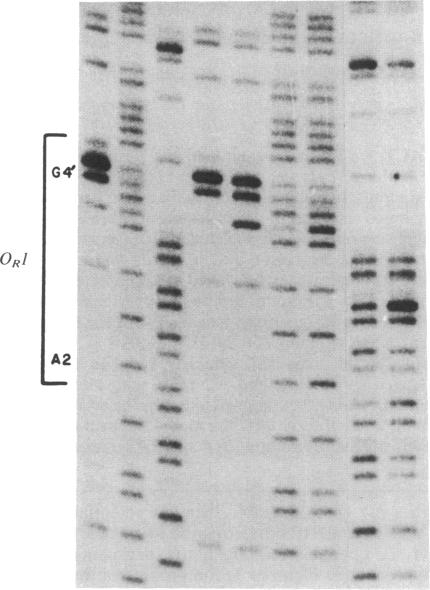
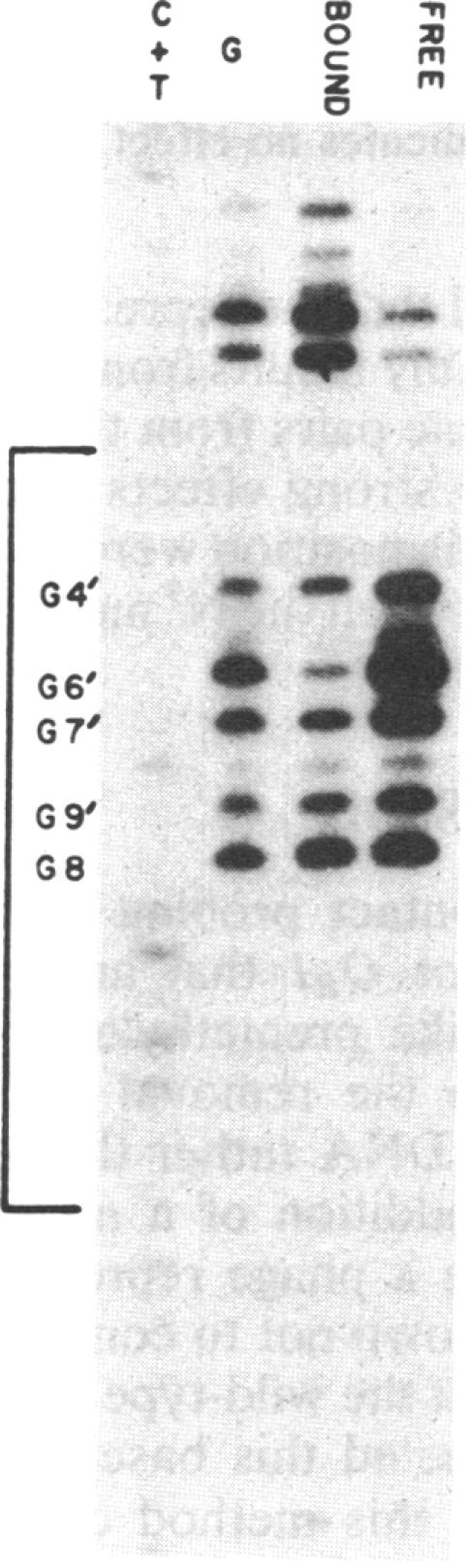
We have examined the positions of contact between lambda phage repressor protein and operator OR1 DNA by scanning populations of lightly depurinated or depyrimidated DNA for bases essential to or irrelevant to repressor binding. This global scanning technique delineates the apparent contact region between lambda repressor and operator and shows bases previously demonstrated or predicted to be contacted plus some additional bases. A mutant repressor, previously shown to contact DNA as wild-type repressor does with the exception of a missing contact to guanosine G4' [Hochschild, A. & Ptashne, M. (1986) Cell 44, 925-933], similarly failed to contact G4' when assayed by this method. Coupled with altering a test residue of a DNA-contacting protein to glycine or alanine so as to eliminate a specific contact, the method appears to provide an efficient means of scanning for specific residue-base contacts.
我们通过扫描轻度脱嘌呤或脱嘧啶的DNA群体,寻找对阻遏物结合至关重要或无关的碱基,来研究λ噬菌体阻遏蛋白与操纵基因OR1 DNA之间的接触位置。这种全局扫描技术描绘了λ阻遏蛋白与操纵基因之间的明显接触区域,并显示了先前已证明或预测会被接触的碱基以及一些其他碱基。一种突变阻遏蛋白,先前已表明其与DNA的接触方式与野生型阻遏蛋白相同,只是缺少与鸟苷G4'的接触[霍希尔德,A. & 普塔什内,M.(1986年)《细胞》44卷,925 - 933页],当用这种方法检测时,同样未能与G4'接触。再加上将DNA接触蛋白的一个测试残基改变为甘氨酸或丙氨酸以消除特定接触,该方法似乎提供了一种扫描特定残基 - 碱基接触的有效手段。