Faculty of Medicine, School of Biomedical Sciences, The Chinese University of Hong Kong, Shatin, Hong Kong.
Front Immunol. 2018 Mar 2;9:406. doi: 10.3389/fimmu.2018.00406. eCollection 2018.
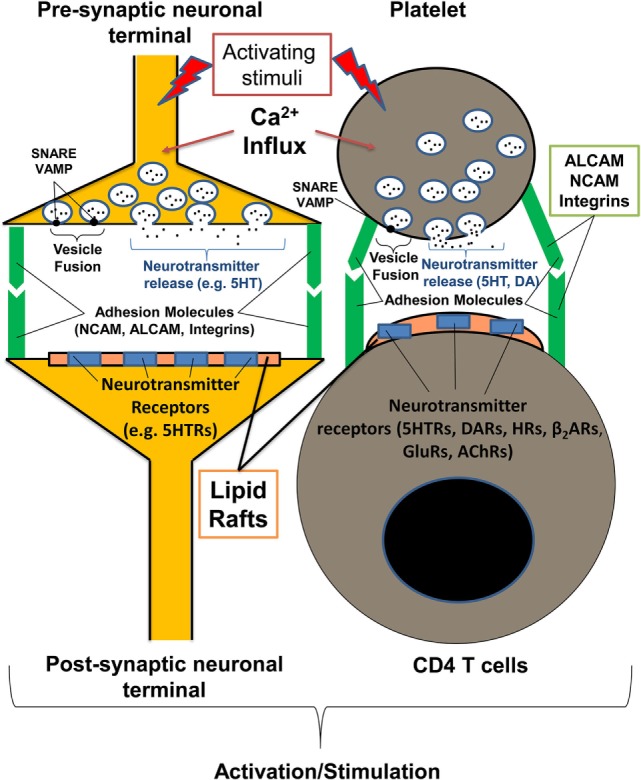
Recent studies suggest that in addition to their common function in the regulation of thrombosis and hemostasis, platelets also contribute to tissue inflammation affecting adaptive immunity. Platelets have a number of pro-inflammatory and regulatory mediators stored in their α-granules and dense granules, which are promptly released at sites of inflammation or tissue injury. Platelet-derived mediators include cytokines (IL-1α, IL-1β, and TGFβ1), chemokines (CXCL4 and CCL3), immunomodulatory neurotransmitters (serotonin, dopamine, epinephrine, histamine, and GABA), and other low-molecular-weight mediators. In addition, activated platelets synthesize a number of lipid pro-inflammatory mediators such as platelet-activating factor and prostaglandins/thromboxanes. Notably, platelets express multiple toll-like receptors and MHC class I on their surface and store IgG in their α-granules. Platelet-derived factors are highly effective in directly or indirectly modulating the priming and effector function of various subsets of T cells. Besides secreting soluble factors, activated platelets upregulate a number of integrins, adhesion molecules, and lectins, leading to the formation of platelet-T cells aggregates. Activated platelets are able to instantly release neurotransmitters acting similar to neuronal presynaptic terminals, affecting CD4 T cells and other cells in close contact with them. The formation of platelet-T cell aggregates modulates the functions of T cells direct cell-cell contact interactions and the local release of soluble factors including neurotransmitters. New data suggest an important role for platelets as neuronal and innate-like cells that directly recognize damage- or pathogen- associated molecular patterns and instantly communicate with T cells.
最近的研究表明,血小板除了在调节血栓形成和止血方面具有共同功能外,还参与影响适应性免疫的组织炎症。血小板在其α-颗粒和致密颗粒中储存了许多促炎和调节介质,这些介质会在炎症或组织损伤部位迅速释放。血小板衍生的介质包括细胞因子(IL-1α、IL-1β 和 TGFβ1)、趋化因子(CXCL4 和 CCL3)、免疫调节神经递质(血清素、多巴胺、肾上腺素、组胺和 GABA)和其他低分子量介质。此外,激活的血小板合成许多脂质促炎介质,如血小板激活因子和前列腺素/血栓素。值得注意的是,血小板在其表面表达多种 Toll 样受体和 MHC Ⅰ类,并在其α-颗粒中储存 IgG。血小板衍生因子在直接或间接调节各种 T 细胞亚群的启动和效应功能方面非常有效。除了分泌可溶性因子外,激活的血小板上调多种整合素、粘附分子和凝集素,导致血小板-T 细胞聚集的形成。激活的血小板能够立即释放作用类似于神经元突触前末端的神经递质,影响与它们密切接触的 CD4 T 细胞和其他细胞。血小板-T 细胞聚集的形成调节 T 细胞的功能,包括直接细胞-细胞接触相互作用和局部释放包括神经递质在内的可溶性因子。新数据表明,血小板作为神经元和先天样细胞具有重要作用,可直接识别损伤或病原体相关的分子模式,并立即与 T 细胞进行通讯。