Department of Pharmaceutical Sciences and Computational Chemical Genomics Screening Center, School of Pharmacy, University of Pittsburgh, 335 Sutherland Drive, 206 Salk Pavilion, Pittsburgh, Pennsylvania, 15261, USA.
NIH National Center of Excellence for Computational Drug Abuse Research, University of Pittsburgh, Pittsburgh, Pennsylvania, 15261, USA.
AAPS J. 2018 Mar 30;20(3):58. doi: 10.1208/s12248-018-0210-0.
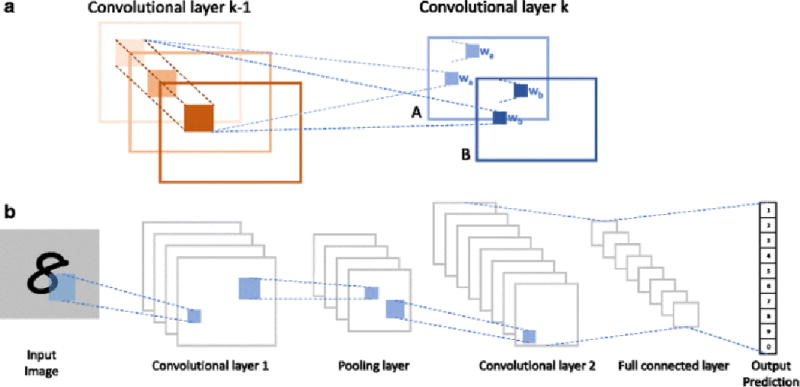
Over the last decade, deep learning (DL) methods have been extremely successful and widely used to develop artificial intelligence (AI) in almost every domain, especially after it achieved its proud record on computational Go. Compared to traditional machine learning (ML) algorithms, DL methods still have a long way to go to achieve recognition in small molecular drug discovery and development. And there is still lots of work to do for the popularization and application of DL for research purpose, e.g., for small molecule drug research and development. In this review, we mainly discussed several most powerful and mainstream architectures, including the convolutional neural network (CNN), recurrent neural network (RNN), and deep auto-encoder networks (DAENs), for supervised learning and nonsupervised learning; summarized most of the representative applications in small molecule drug design; and briefly introduced how DL methods were used in those applications. The discussion for the pros and cons of DL methods as well as the main challenges we need to tackle were also emphasized.
在过去的十年中,深度学习(DL)方法取得了巨大的成功,并被广泛应用于几乎所有领域的人工智能(AI)开发,尤其是在其在计算围棋方面取得了令人自豪的成绩之后。与传统的机器学习(ML)算法相比,DL 方法在小分子药物发现和开发的识别方面还有很长的路要走。对于推广和应用 DL 进行研究,例如小分子药物研究和开发,还有很多工作要做。在这篇综述中,我们主要讨论了几种最强大和主流的架构,包括卷积神经网络(CNN)、递归神经网络(RNN)和深度自动编码器网络(DAENs),用于监督学习和非监督学习;总结了小分子药物设计中最具代表性的应用;并简要介绍了 DL 方法在这些应用中的使用方式。还强调了 DL 方法的优缺点以及我们需要解决的主要挑战的讨论。