Food Safety and Environmental Stewardship Program, Environmental and Molecular Toxicology, Oregon State University, 1007 Agricultural and Life Sciences Building, Corvallis, OR, 97331, USA.
Columbia Center for Children's Environmental Health, Department of Environmental Health Sciences, Mailman School of Public Health, Columbia University, 722 West 168th Street, New York, NY, 10032, USA.
Anal Bioanal Chem. 2018 May;410(13):3059-3071. doi: 10.1007/s00216-018-0992-z. Epub 2018 Apr 2.
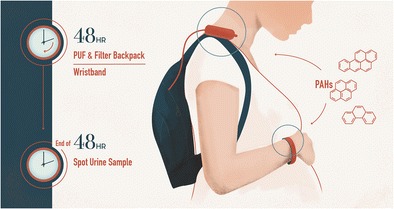
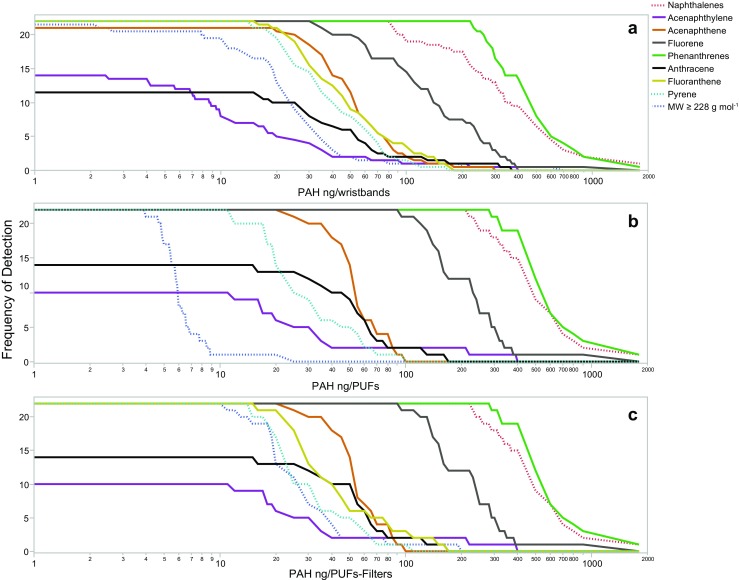
Currently there is a lack of inexpensive, easy-to-use technology to evaluate human exposure to environmental chemicals, including polycyclic aromatic hydrocarbons (PAHs). This is the first study in which silicone wristbands were deployed alongside two traditional personal PAH exposure assessment methods: active air monitoring with samplers (i.e., polyurethane foam (PUF) and filter) housed in backpacks, and biological sampling with urine. We demonstrate that wristbands worn for 48 h in a non-occupational setting recover semivolatile PAHs, and we compare levels of PAHs in wristbands to PAHs in PUFs-filters and to hydroxy-PAH (OH-PAH) biomarkers in urine. We deployed all samplers simultaneously for 48 h on 22 pregnant women in an established urban birth cohort. Each woman provided one spot urine sample at the end of the 48-h period. Wristbands recovered PAHs with similar detection frequencies to PUFs-filters. Of the 62 PAHs tested for in the 22 wristbands, 51 PAHs were detected in at least one wristband. In this cohort of pregnant women, we found more significant correlations between OH-PAHs and PAHs in wristbands than between OH-PAHs and PAHs in PUFs-filters. Only two comparisons between PAHs in PUFs-filters and OH-PAHs correlated significantly (r = 0.53 and p = 0.01; r = 0.44 and p = 0.04), whereas six comparisons between PAHs in wristbands and OH-PAHs correlated significantly (r = 0.44 to 0.76 and p = 0.04 to <0.0001). These results support the utility of wristbands as a biologically relevant exposure assessment tool which can be easily integrated into environmental health studies. Graphical abstract PAHs detected in samples collected from urban pregnant women.
目前,缺乏廉价、易用的技术来评估人类接触环境化学物质,包括多环芳烃 (PAHs)。这是第一项研究,其中硅树脂腕带与两种传统的个人 PAH 暴露评估方法一起部署:装有采样器(即聚氨酯泡沫 (PUF) 和过滤器)的背包中的主动空气监测,以及尿液中的生物采样。我们证明,在非职业环境中佩戴 48 小时的腕带可回收半挥发性 PAHs,并将腕带中的 PAHs 水平与 PUFs-过滤器中的 PAHs 以及尿液中的羟基-PAH (OH-PAH) 生物标志物进行比较。我们同时在一个已建立的城市出生队列中对 22 名孕妇进行了为期 48 小时的所有采样器部署。每位女性在 48 小时结束时提供一份点尿样。腕带回收的 PAHs 与 PUFs-过滤器的检测频率相似。在 22 个腕带中测试的 62 种 PAHs 中,有 51 种在至少一个腕带中被检测到。在这个孕妇队列中,我们发现腕带中的 OH-PAHs 与 PAHs 之间的相关性比 PUFs-过滤器中的 OH-PAHs 与 PAHs 之间的相关性更显著。只有两项 PUFs-过滤器中的 PAHs 与 OH-PAHs 之间的比较显著相关(r=0.53,p=0.01;r=0.44,p=0.04),而腕带中的 PAHs 与 OH-PAHs 之间的六次比较显著相关(r=0.44 至 0.76,p=0.04 至 <0.0001)。这些结果支持腕带作为一种具有生物学相关性的暴露评估工具的实用性,它可以很容易地整合到环境健康研究中。