Oregon State University, Environmental and Molecular Toxicology, Food Safety and Environmental Stewardship Program, Corvallis, OR, USA.
Pacific Northwest National Laboratory, Biological Sciences Division, Richland, WA, USA.
Environ Int. 2022 May;163:107226. doi: 10.1016/j.envint.2022.107226. Epub 2022 Apr 4.
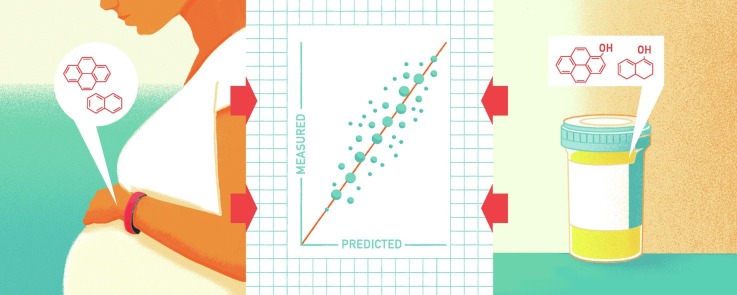
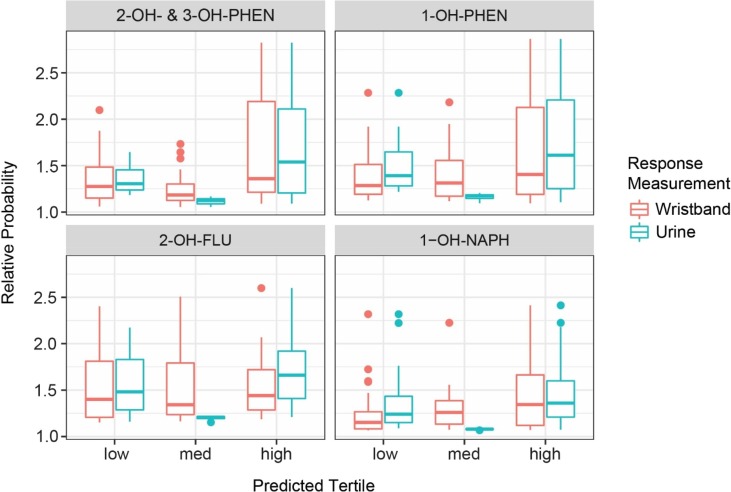
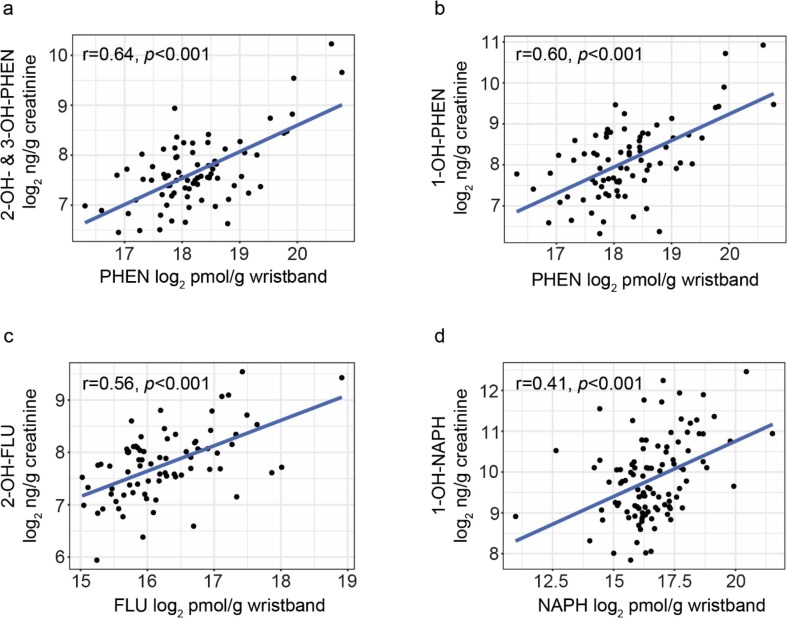
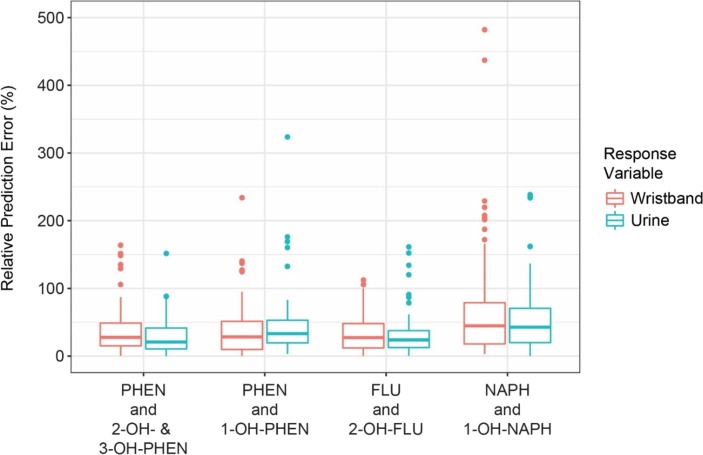
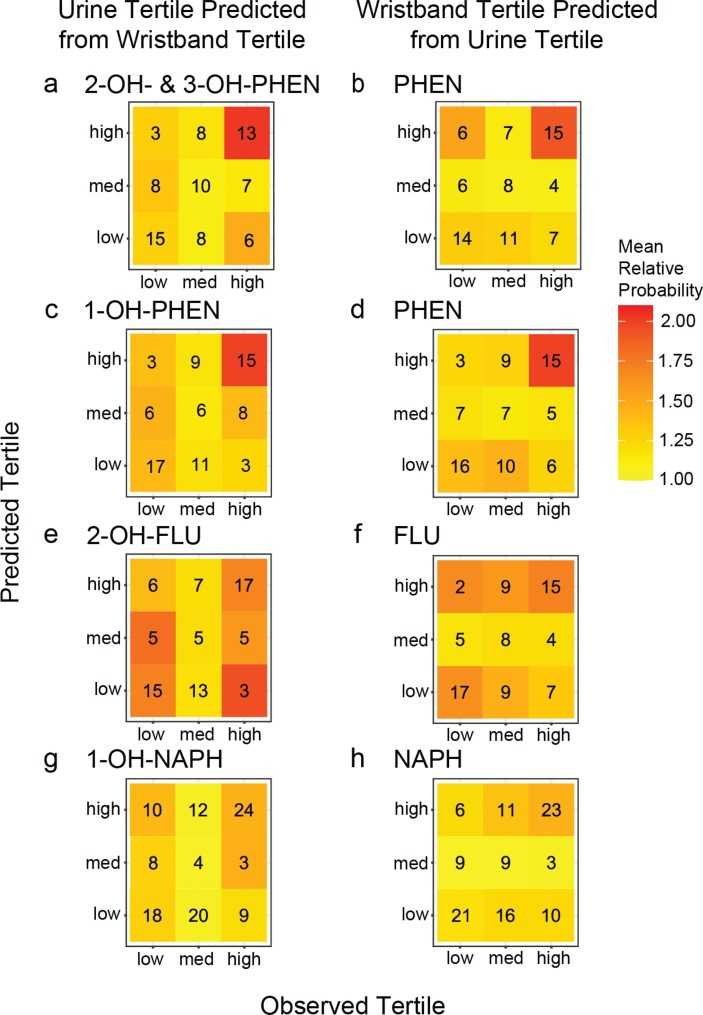
During events like the COVID-19 pandemic or a disaster, researchers may need to switch from collecting biological samples to personal exposure samplers that are easy and safe to transport and wear, such as silicone wristbands. Previous studies have demonstrated significant correlations between urine biomarker concentrations and chemical levels in wristbands. We build upon those studies and use a novel combination of descriptive statistics and supervised statistical learning to evaluate the relationship between polycyclic aromatic hydrocarbon (PAH) concentrations in silicone wristbands and hydroxy-PAH (OH-PAH) concentrations in urine. In New York City, 109 participants in a longitudinal birth cohort wore one wristband for 48 h and provided a spot urine sample at the end of the 48-hour period during their third trimester of pregnancy. We compared four PAHs with the corresponding seven OH-PAHs using descriptive statistics, a linear regression model, and a linear discriminant analysis model. Five of the seven PAH and OH-PAH pairs had significant correlations (Pearson's r = 0.35-0.64, p ≤ 0.003) and significant chi-square tests of independence for exposure categories (p ≤ 0.009). For these five comparisons, the observed PAH or OH-PAH concentration could predict the other concentration within a factor of 1.47 for 50-80% of the measurements (depending on the pair). Prediction accuracies for high exposure categories were at least 1.5 times higher compared to accuracies based on random chance. These results demonstrate that wristbands and urine provide similar PAH exposure assessment information, which is critical for environmental health researchers looking for the flexibility to switch between biological sample and wristband collection.
在 COVID-19 大流行或灾害等事件期间,研究人员可能需要将生物样本采集转换为易于运输和佩戴的个人暴露采样器,例如硅胶手环。先前的研究已经证明了尿液生物标志物浓度与手环中化学物质水平之间存在显著相关性。我们在这些研究的基础上,使用描述性统计和有监督的统计学习的新组合,评估了硅胶手环中多环芳烃(PAH)浓度与尿液中羟基多环芳烃(OH-PAH)浓度之间的关系。在纽约市,一项纵向出生队列研究的 109 名参与者在妊娠晚期的第三个 trimester 期间佩戴一个手环 48 小时,并在 48 小时结束时提供一个点尿样。我们使用描述性统计、线性回归模型和线性判别分析模型比较了四种 PAH 与相应的七种 OH-PAH。七种 PAH 和 OH-PAH 对中的五种具有显著相关性(Pearson r=0.35-0.64,p≤0.003),且暴露类别之间的卡方检验具有统计学意义(p≤0.009)。对于这五种比较,在 50-80%的测量值中(取决于对),观察到的 PAH 或 OH-PAH 浓度可以在 1.47 倍的因子内预测另一种浓度。高暴露类别下的预测准确率至少比基于随机机会的准确率高 1.5 倍。这些结果表明,手环和尿液提供了相似的 PAH 暴露评估信息,这对于环境健康研究人员来说至关重要,他们需要灵活地在生物样本采集和手环采集之间进行切换。