Graduate School of Public and International Affairs, University of Pittsburgh, Pittsburgh, PA 15260, USA.
School of Public Administration, University of Central Florida, Orlando, FL 32816, USA.
Int J Environ Res Public Health. 2018 Apr 1;15(4):650. doi: 10.3390/ijerph15040650.
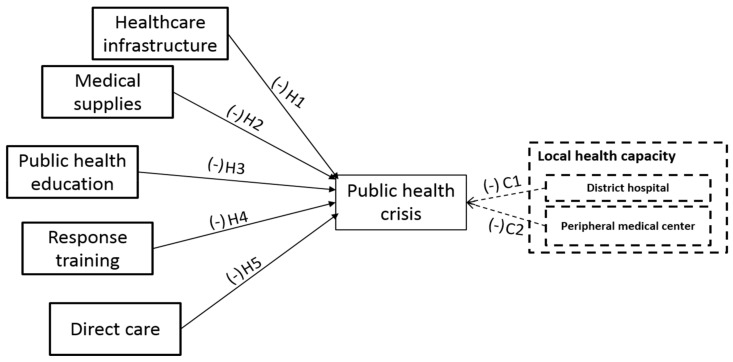
International Nongovernmental Organizations (INGOs) have played critical roles in improving the quality of primary health care in ordinary time and, indeed, responding to epidemic crises in developing countries. Due to a lack of empirical research for effectiveness of their responding activities, the legitimacy and accountability of nonprofits' engagement in the health crisis as a critical responder is doubted. This paper aims to examine the effectiveness of INGOs in a context of managing a fatal epidemic outbreak of Ebola in Sierra Leone during May-November, 2014; building healthcare infrastructures, providing medical supplies, educating local residents, and training response staffs. The analysis results show that development of healthcare infrastructures and provision of medical supplies have been significantly effective in terms of decreasing the severity of the crisis in chiefdoms. The findings imply that policy tools, which allow INGOs to enter to the field in a timely manner, can improve the effectiveness of INGOs' responses in current and future epidemic outbreaks in developing countries where people suffer from a lack of health infrastructures.
国际非政府组织(INGOs)在提高初级卫生保健质量方面发挥了关键作用,事实上,它们也在发展中国家应对疫情危机方面发挥了作用。由于缺乏对其应对活动效果的实证研究,非营利组织作为关键应对者参与卫生危机的合法性和问责制受到了质疑。本文旨在考察 INGO 在应对 2014 年 5 月至 11 月塞拉利昂致命埃博拉疫情爆发的背景下的有效性;建设医疗基础设施、提供医疗用品、教育当地居民和培训应对人员。分析结果表明,在酋长领地,医疗基础设施的发展和医疗用品的提供在降低危机严重程度方面具有显著的效果。研究结果表明,政策工具允许 INGO 及时进入现场,可以提高 INGO 在发展中国家应对当前和未来疫情爆发的效果,在这些国家,人们缺乏卫生基础设施。