Materials Science Division, Argonne National Laboratory, Argonne, IL, 60439, USA.
Department of Biomedical Engineering, Pennsylvania State University, University Park, PA, 16802, USA.
Nat Commun. 2018 Apr 3;9(1):1322. doi: 10.1038/s41467-018-03758-z.
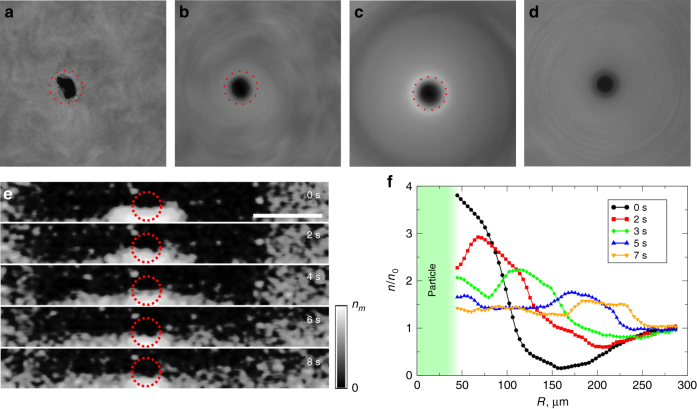
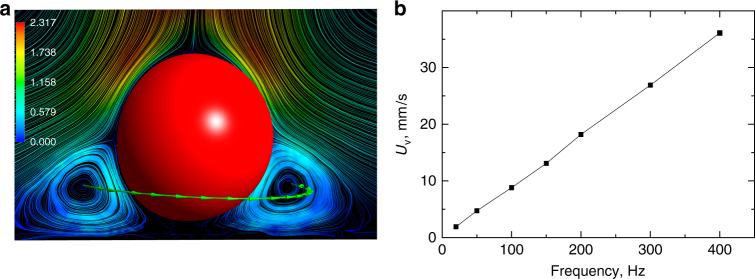
Suspensions of motile bacteria or synthetic microswimmers, termed active matter, manifest a remarkable propensity for self-organization, and formation of large-scale coherent structures. Most active matter research deals with almost homogeneous in space systems and little is known about the dynamics of strongly heterogeneous active matter. Here we report on experimental and theoretical studies on the expansion of highly concentrated bacterial droplets into an ambient bacteria-free fluid. The droplet is formed beneath a rapidly rotating solid macroscopic particle inserted in the suspension. We observe vigorous instability of the droplet reminiscent of a violent explosion. The phenomenon is explained in terms of continuum first-principle theory based on the swim pressure concept. Our findings provide insights into the dynamics of active matter with strong density gradients and significantly expand the scope of experimental and analytic tools for control and manipulation of active systems.
游动细菌或称为活性物质的合成微游泳者的悬浮液表现出显著的自组织倾向,并形成大规模的相干结构。大多数活性物质研究都涉及到几乎均匀的空间系统,对于强非均匀活性物质的动力学知之甚少。在这里,我们报告了关于高浓度细菌液滴在无细菌环境中扩展的实验和理论研究。液滴在悬浮液中插入的快速旋转固体宏观粒子的下方形成。我们观察到液滴的剧烈不稳定性,类似于剧烈爆炸。这一现象可以用基于游动压力概念的连续体第一性原理理论来解释。我们的发现为具有强密度梯度的活性物质动力学提供了深入的了解,并显著扩展了控制和操纵活性系统的实验和分析工具的范围。