• 文献检索
  • 文档翻译
  • 深度研究
  • 学术资讯
  • Suppr Zotero 插件Zotero 插件
  • 邀请有礼
  • 套餐&价格
  • 历史记录
应用&插件
Suppr Zotero 插件Zotero 插件浏览器插件Mac 客户端Windows 客户端微信小程序
定价
高级版会员购买积分包购买API积分包
服务
文献检索文档翻译深度研究API 文档MCP 服务
关于我们
关于 Suppr公司介绍联系我们用户协议隐私条款
关注我们

Suppr 超能文献

核心技术专利:CN118964589B侵权必究
粤ICP备2023148730 号-1Suppr @ 2026

文献检索

告别复杂PubMed语法,用中文像聊天一样搜索,搜遍4000万医学文献。AI智能推荐,让科研检索更轻松。

立即免费搜索

文件翻译

保留排版,准确专业,支持PDF/Word/PPT等文件格式,支持 12+语言互译。

免费翻译文档

深度研究

AI帮你快速写综述,25分钟生成高质量综述,智能提取关键信息,辅助科研写作。

立即免费体验

PVP-SVM:使用支持向量机基于序列预测噬菌体病毒粒子蛋白

PVP-SVM: Sequence-Based Prediction of Phage Virion Proteins Using a Support Vector Machine.

作者信息

Manavalan Balachandran, Shin Tae H, Lee Gwang

机构信息

Department of Physiology, Ajou University School of Medicine, Suwon, South Korea.

Institute of Molecular Science and Technology, Ajou University, Suwon, South Korea.

出版信息

Front Microbiol. 2018 Mar 16;9:476. doi: 10.3389/fmicb.2018.00476. eCollection 2018.

DOI:10.3389/fmicb.2018.00476
PMID:29616000
原文链接:https://pmc.ncbi.nlm.nih.gov/articles/PMC5864850/
Abstract

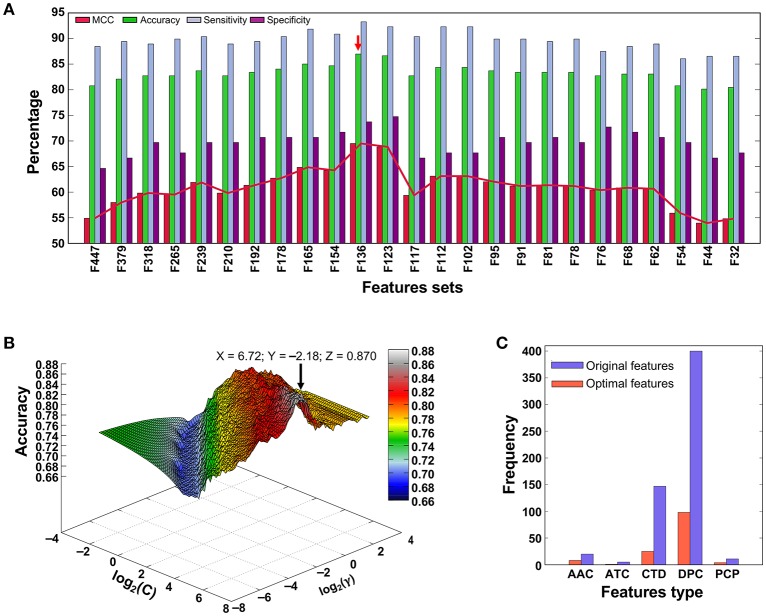
Accurately identifying bacteriophage virion proteins from uncharacterized sequences is important to understand interactions between the phage and its host bacteria in order to develop new antibacterial drugs. However, identification of such proteins using experimental techniques is expensive and often time consuming; hence, development of an efficient computational algorithm for the prediction of phage virion proteins (PVPs) prior to experimentation is needed. Here, we describe a support vector machine (SVM)-based PVP predictor, called PVP-SVM, which was trained with 136 optimal features. A feature selection protocol was employed to identify the optimal features from a large set that included amino acid composition, dipeptide composition, atomic composition, physicochemical properties, and chain-transition-distribution. PVP-SVM achieved an accuracy of 0.870 during leave-one-out cross-validation, which was 6% higher than control SVM predictors trained with all features, indicating the efficiency of the feature selection method. Furthermore, PVP-SVM displayed superior performance compared to the currently available method, PVPred, and two other machine-learning methods developed in this study when objectively evaluated with an independent dataset. For the convenience of the scientific community, a user-friendly and publicly accessible web server has been established at www.thegleelab.org/PVP-SVM/PVP-SVM.html.

摘要

从未经表征的序列中准确识别噬菌体病毒粒子蛋白对于理解噬菌体与其宿主细菌之间的相互作用至关重要,以便开发新的抗菌药物。然而,使用实验技术鉴定此类蛋白既昂贵又耗时;因此,需要开发一种高效的计算算法,以便在实验之前预测噬菌体病毒粒子蛋白(PVP)。在此,我们描述了一种基于支持向量机(SVM)的PVP预测器,称为PVP-SVM,它使用136个最佳特征进行训练。采用了一种特征选择方案,从包括氨基酸组成、二肽组成、原子组成、物理化学性质和链转移分布在内的大量特征中识别最佳特征。在留一法交叉验证期间,PVP-SVM的准确率达到0.870,比使用所有特征训练的对照SVM预测器高6%,表明特征选择方法的有效性。此外,当使用独立数据集进行客观评估时,PVP-SVM与当前可用的方法PVPred以及本研究中开发的其他两种机器学习方法相比,表现出更优的性能。为方便科学界使用,已在www.thegleelab.org/PVP-SVM/PVP-SVM.html上建立了一个用户友好且可公开访问的网络服务器。
https://cdn.ncbi.nlm.nih.gov/pmc/blobs/fb1e/5864850/24335d921730/fmicb-09-00476-g0005.jpg
https://cdn.ncbi.nlm.nih.gov/pmc/blobs/fb1e/5864850/71ea09f1a916/fmicb-09-00476-g0001.jpg
https://cdn.ncbi.nlm.nih.gov/pmc/blobs/fb1e/5864850/9ea382197a5a/fmicb-09-00476-g0002.jpg
https://cdn.ncbi.nlm.nih.gov/pmc/blobs/fb1e/5864850/9c461e2e3c2a/fmicb-09-00476-g0003.jpg
https://cdn.ncbi.nlm.nih.gov/pmc/blobs/fb1e/5864850/fae360cb16d3/fmicb-09-00476-g0004.jpg
https://cdn.ncbi.nlm.nih.gov/pmc/blobs/fb1e/5864850/24335d921730/fmicb-09-00476-g0005.jpg
https://cdn.ncbi.nlm.nih.gov/pmc/blobs/fb1e/5864850/71ea09f1a916/fmicb-09-00476-g0001.jpg
https://cdn.ncbi.nlm.nih.gov/pmc/blobs/fb1e/5864850/9ea382197a5a/fmicb-09-00476-g0002.jpg
https://cdn.ncbi.nlm.nih.gov/pmc/blobs/fb1e/5864850/9c461e2e3c2a/fmicb-09-00476-g0003.jpg
https://cdn.ncbi.nlm.nih.gov/pmc/blobs/fb1e/5864850/fae360cb16d3/fmicb-09-00476-g0004.jpg
https://cdn.ncbi.nlm.nih.gov/pmc/blobs/fb1e/5864850/24335d921730/fmicb-09-00476-g0005.jpg

相似文献

1
PVP-SVM: Sequence-Based Prediction of Phage Virion Proteins Using a Support Vector Machine.PVP-SVM:使用支持向量机基于序列预测噬菌体病毒粒子蛋白
Front Microbiol. 2018 Mar 16;9:476. doi: 10.3389/fmicb.2018.00476. eCollection 2018.
2
PVPred-SCM: Improved Prediction and Analysis of Phage Virion Proteins Using a Scoring Card Method.PVPred-SCM:利用评分卡方法改进噬菌体衣壳蛋白的预测和分析。
Cells. 2020 Feb 3;9(2):353. doi: 10.3390/cells9020353.
3
DHSpred: support-vector-machine-based human DNase I hypersensitive sites prediction using the optimal features selected by random forest.DHSpred:基于支持向量机,利用随机森林选择的最优特征进行人类DNA酶I超敏感位点预测。
Oncotarget. 2017 Dec 8;9(2):1944-1956. doi: 10.18632/oncotarget.23099. eCollection 2018 Jan 5.
4
Review and comparative analysis of machine learning-based phage virion protein identification methods.基于机器学习的噬菌体病毒蛋白鉴定方法的回顾与比较分析。
Biochim Biophys Acta Proteins Proteom. 2020 Jun;1868(6):140406. doi: 10.1016/j.bbapap.2020.140406. Epub 2020 Mar 2.
5
Meta-iPVP: a sequence-based meta-predictor for improving the prediction of phage virion proteins using effective feature representation.Meta-iPVP:一种基于序列的元预测器,用于使用有效的特征表示来改进噬菌体衣壳蛋白的预测。
J Comput Aided Mol Des. 2020 Oct;34(10):1105-1116. doi: 10.1007/s10822-020-00323-z. Epub 2020 Jun 16.
6
MLACP: machine-learning-based prediction of anticancer peptides.MLACP:基于机器学习的抗癌肽预测
Oncotarget. 2017 Aug 19;8(44):77121-77136. doi: 10.18632/oncotarget.20365. eCollection 2017 Sep 29.
7
Prediction of Phage Virion Proteins Using Machine Learning Methods.利用机器学习方法预测噬菌体病毒粒子蛋白。
Molecules. 2023 Feb 28;28(5):2238. doi: 10.3390/molecules28052238.
8
Identifying Phage Virion Proteins by Using Two-Step Feature Selection Methods.利用两步特征选择方法鉴定噬菌体病毒蛋白。
Molecules. 2018 Aug 10;23(8):2000. doi: 10.3390/molecules23082000.
9
Identification of bacteriophage virion proteins by the ANOVA feature selection and analysis.通过方差分析特征选择和分析鉴定噬菌体病毒粒子蛋白。
Mol Biosyst. 2014 Aug;10(8):2229-35. doi: 10.1039/c4mb00316k.
10
Recent Advances of Computational Methods for Identifying Bacteriophage Virion Proteins.用于鉴定噬菌体病毒粒子蛋白的计算方法的最新进展
Protein Pept Lett. 2020;27(4):259-264. doi: 10.2174/0929866526666190410124642.

引用本文的文献

1
Progress and trends on machine learning in proteomics during 1997-2024: a bibliometric analysis.1997 - 2024年蛋白质组学中机器学习的进展与趋势:文献计量分析
Front Med (Lausanne). 2025 Aug 15;12:1594442. doi: 10.3389/fmed.2025.1594442. eCollection 2025.
2
ProtPhage: a deep learning framework for phage viral protein identification and functional annotation.原噬菌体:一种用于噬菌体病毒蛋白识别和功能注释的深度学习框架。
Brief Bioinform. 2025 May 1;26(3). doi: 10.1093/bib/bbaf285.
3
A review of neural networks for metagenomic binning.宏基因组分箱的神经网络综述。

本文引用的文献

1
DHSpred: support-vector-machine-based human DNase I hypersensitive sites prediction using the optimal features selected by random forest.DHSpred:基于支持向量机,利用随机森林选择的最优特征进行人类DNA酶I超敏感位点预测。
Oncotarget. 2017 Dec 8;9(2):1944-1956. doi: 10.18632/oncotarget.23099. eCollection 2018 Jan 5.
2
iDNA6mA-PseKNC: Identifying DNA N-methyladenosine sites by incorporating nucleotide physicochemical properties into PseKNC.iDNA6mA-PseKNC:通过将核苷酸理化性质纳入 PseKNC 来鉴定 DNA N6-甲基腺苷位点。
Genomics. 2019 Jan;111(1):96-102. doi: 10.1016/j.ygeno.2018.01.005. Epub 2018 Jan 31.
3
Brief Bioinform. 2025 Mar 4;26(2). doi: 10.1093/bib/bbaf065.
4
Recent Applications of Artificial Intelligence in Discovery of New Antibacterial Agents.人工智能在新型抗菌药物发现中的最新应用
Adv Appl Bioinform Chem. 2024 Dec 3;17:139-157. doi: 10.2147/AABC.S484321. eCollection 2024.
5
PhageScanner: a reconfigurable machine learning framework for bacteriophage genomic and metagenomic feature annotation.噬菌体扫描器:一种用于噬菌体基因组和宏基因组特征注释的可重构机器学习框架。
Front Microbiol. 2024 Sep 17;15:1446097. doi: 10.3389/fmicb.2024.1446097. eCollection 2024.
6
PMTPred: machine-learning-based prediction of protein methyltransferases using the composition of k-spaced amino acid pairs.PMTPred:基于k间隔氨基酸对组成的蛋白质甲基转移酶的机器学习预测
Mol Divers. 2024 Aug;28(4):2301-2315. doi: 10.1007/s11030-024-10937-2. Epub 2024 Jul 21.
7
MIBPred: Ensemble Learning-Based Metal Ion-Binding Protein Classifier.MIBPred:基于集成学习的金属离子结合蛋白分类器。
ACS Omega. 2024 Feb 8;9(7):8439-8447. doi: 10.1021/acsomega.3c09587. eCollection 2024 Feb 20.
8
Knowing and Naming: Phage Annotation and Nomenclature for Phage Therapy.认识和命名:噬菌体注释和噬菌体治疗的命名法。
Clin Infect Dis. 2023 Nov 2;77(Suppl 5):S352-S359. doi: 10.1093/cid/ciad539.
9
Empirical comparison and analysis of machine learning-based approaches for druggable protein identification.基于机器学习的可成药蛋白识别方法的实证比较与分析
EXCLI J. 2023 Aug 29;22:915-927. doi: 10.17179/excli2023-6410. eCollection 2023.
10
Information Theory for Biological Sequence Classification: A Novel Feature Extraction Technique Based on Tsallis Entropy.用于生物序列分类的信息论:一种基于Tsallis熵的新型特征提取技术。
Entropy (Basel). 2022 Oct 1;24(10):1398. doi: 10.3390/e24101398.
IL17eScan: A Tool for the Identification of Peptides Inducing IL-17 Response.
IL17eScan:一种用于鉴定诱导白细胞介素-17反应的肽的工具。
Front Immunol. 2017 Oct 31;8:1430. doi: 10.3389/fimmu.2017.01430. eCollection 2017.
4
Screening Phage-Display Antibody Libraries Using Protein Arrays.使用蛋白质阵列筛选噬菌体展示抗体文库。
Methods Mol Biol. 2018;1701:365-380. doi: 10.1007/978-1-4939-7447-4_20.
5
MLACP: machine-learning-based prediction of anticancer peptides.MLACP:基于机器学习的抗癌肽预测
Oncotarget. 2017 Aug 19;8(44):77121-77136. doi: 10.18632/oncotarget.20365. eCollection 2017 Sep 29.
6
Methods for estimation of model accuracy in CASP12.在蛋白质结构预测技术评估第12轮(CASP12)中估计模型准确性的方法。
Proteins. 2018 Mar;86 Suppl 1:361-373. doi: 10.1002/prot.25395. Epub 2017 Oct 17.
7
iDNA4mC: identifying DNA N4-methylcytosine sites based on nucleotide chemical properties.iDNA4mC:基于核苷酸化学性质鉴定 DNA N4-甲基胞嘧啶位点。
Bioinformatics. 2017 Nov 15;33(22):3518-3523. doi: 10.1093/bioinformatics/btx479.
8
Assessment of model accuracy estimations in CASP12.在蛋白质结构预测技术关键评估(CASP)12中对模型准确性估计的评估。
Proteins. 2018 Mar;86 Suppl 1(Suppl 1):345-360. doi: 10.1002/prot.25371. Epub 2017 Sep 8.
9
PhosphoPredict: A bioinformatics tool for prediction of human kinase-specific phosphorylation substrates and sites by integrating heterogeneous feature selection.磷酸化预测:一种通过整合异构特征选择来预测人类激酶特异性磷酸化底物和位点的生物信息学工具。
Sci Rep. 2017 Jul 31;7(1):6862. doi: 10.1038/s41598-017-07199-4.
10
Computational Prediction of the Immunomodulatory Potential of RNA Sequences.RNA序列免疫调节潜力的计算预测
Methods Mol Biol. 2017;1632:75-90. doi: 10.1007/978-1-4939-7138-1_5.