Environmental Epidemiology Group, Institute of Occupational, Social and Environmental Medicine, Medical Faculty, Heinrich-Heine University Düsseldorf, Düsseldorf, Germany
Institute for Health Services Research and Health Economics, Centre for Health and Society, Medical Faculty, Heinrich-Heine University Düsseldorf, Düsseldorf, Germany
Environ Health Perspect. 2018 Apr 3;126(4):047001. doi: 10.1289/EHP2561.
Despite the importance of understanding the connection between air pollution exposure and diabetes, studies investigating links between air pollution and glucose metabolism in nondiabetic adults are limited.
We aimed to estimate the association of medium-term air pollution exposures with blood glucose and glycated hemoglobin A1c (HbA1c) among nondiabetics.
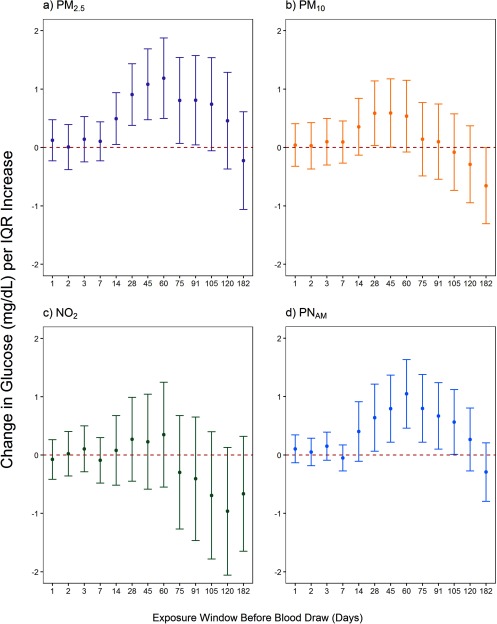
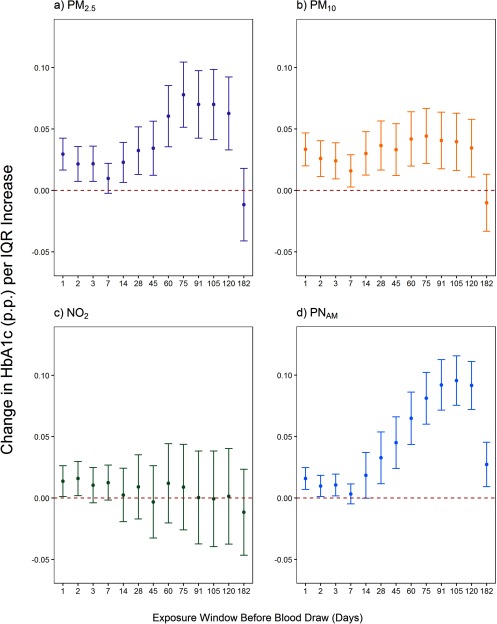
This study included observations from nondiabetic participants (n=7,108) of the population-based Heinz Nixdorf Recall study at baseline (2000–2003) and follow-up examination (2006–2008). Daily fine particulate matter (aerodynamic diameter≤2.5 μm, PM; aerodynamic diameter≤10 μm, PM), accumulation mode particle number (PN), and nitrogen dioxide (NO) exposures were estimated at participants’ residences using the spatiotemporal European Air Pollution Dispersion (EURAD) chemistry transport model. We evaluated the associations between medium-term air pollution exposures (28- and 91-d means) and glucose metabolism measures using mixed linear regression and adjusting for season, meteorology, and personal characteristics. A range of other exposure windows (1-, 2-, 3-, 7-, 14-, 45-, 60-, 75-, 105-, 120-, and 182-d means) were also evaluated to identify potentially relevant biological windows.
We observed positive associations between PM and PN exposures and blood glucose levels [e.g., 28-d PM: 0.91 mg/dL (95% CI: 0.38, 1.44) per 5.7 μg/m]. PM, PM, and PN exposures were positively associated with HbA1c [e.g., 91-d PM: 0.07 p.p. (95% CI: 0.04, 0.10) per 4.0 μg/m]. Mean exposures during longer exposure windows (75- to 105-d) were most strongly associated with HbA1c, whereas 7- to 45-d exposures were most strongly associated with blood glucose. NO exposure was not associated with blood glucose or with HbA1c.
Medium-term PM and PN exposures were positively associated with glucose measures in nondiabetic adults. These findings indicate that reducing ambient air pollution levels may decrease the risk of diabetes. https://doi.org/10.1289/EHP2561.
尽管了解空气污染暴露与糖尿病之间的关系很重要,但研究空气污染与非糖尿病成年人葡萄糖代谢之间联系的研究仍然有限。
我们旨在评估中期空气污染暴露与非糖尿病患者的血糖和糖化血红蛋白 A1c(HbA1c)之间的关联。
本研究包括来自人群为基础的 Heinz Nixdorf 召回研究的非糖尿病参与者(n=7108)的观察结果,这些参与者在基线(2000-2003 年)和随访检查(2006-2008 年)时进行了观察。使用时空欧洲空气污染分散(EURAD)化学传输模型,在参与者的住所估算了细颗粒物(空气动力学直径≤2.5μm,PM;空气动力学直径≤10μm,PM)、积聚模态颗粒数(PN)和二氧化氮(NO)的短期暴露。我们使用混合线性回归评估了中期空气污染暴露(28 天和 91 天均值)与葡萄糖代谢指标之间的关系,并调整了季节、气象和个人特征。还评估了一系列其他暴露窗口(1、2、3、7、14、45、60、75、105、120 和 182 天均值),以确定潜在的相关生物学窗口。
我们观察到 PM 和 PN 暴露与血糖水平呈正相关[例如,28 天 PM:每 5.7μg/m 增加 0.91mg/dL(95%CI:0.38,1.44)]。PM、PM 和 PN 暴露与 HbA1c 呈正相关[例如,91 天 PM:每 4.0μg/m 增加 0.07p.p.(95%CI:0.04,0.10)]。较长暴露窗口(75-105 天)期间的平均暴露与 HbA1c 相关性最强,而 7-45 天的暴露与血糖相关性最强。NO 暴露与血糖或 HbA1c 无关。
中期 PM 和 PN 暴露与非糖尿病成年人的血糖指标呈正相关。这些发现表明,降低环境空气污染水平可能会降低患糖尿病的风险。