Max Planck Institute for Biophysical Chemistry, 37077 Göttingen, Germany
Genetics. 2018 Apr;208(4):1279-1289. doi: 10.1534/genetics.117.300521.
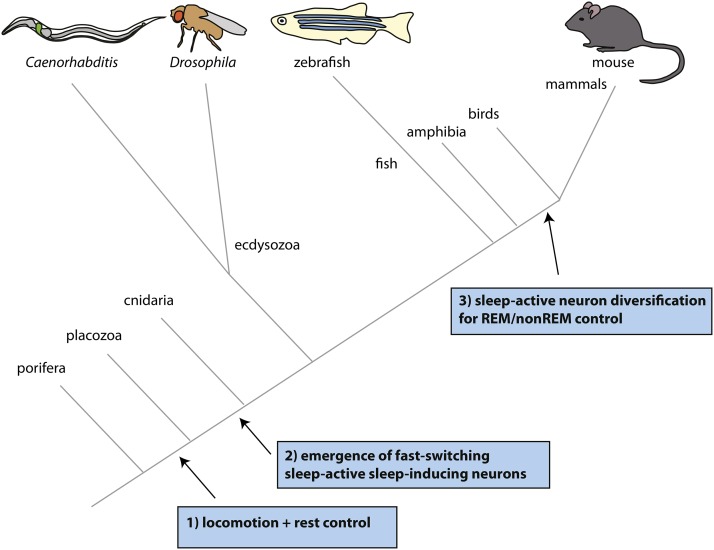
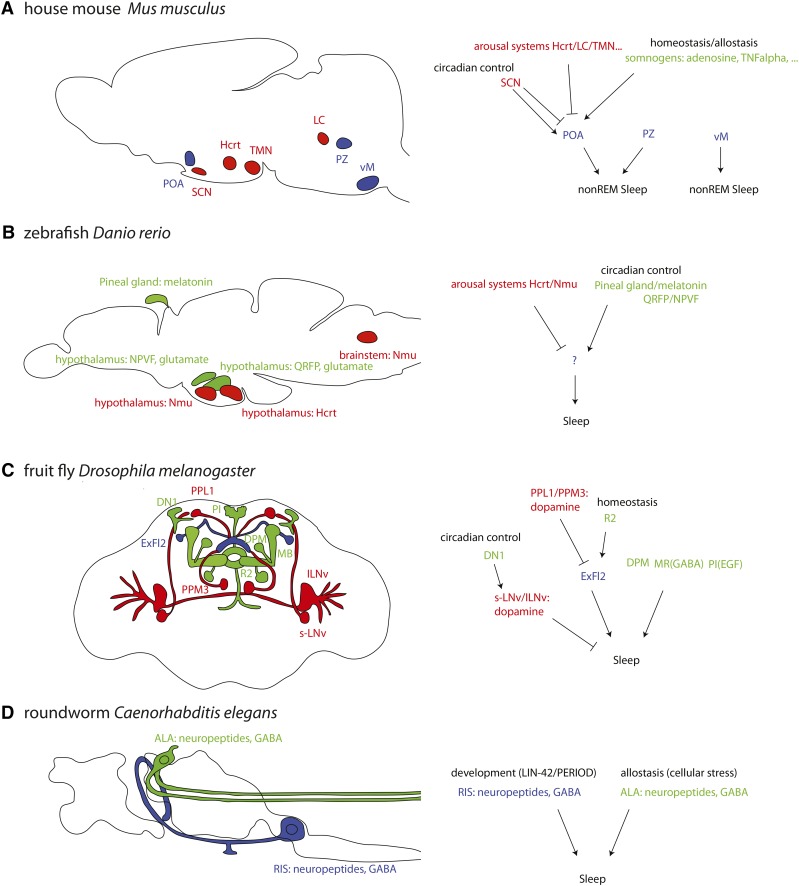
Sleep is crucial for survival and well-being. This behavioral and physiological state has been studied in all major genetically accessible model animals, including rodents, fish, flies, and worms. Genetic and optogenetic studies have identified several neurons that control sleep, making it now possible to compare circuit mechanisms across species. The "motor" of sleep across animal species is formed by neurons that depolarize at the onset of sleep to actively induce this state by directly inhibiting wakefulness. These sleep-inducing neurons are themselves controlled by inhibitory or activating upstream pathways, which act as the "drivers" of the sleep motor: arousal inhibits "sleep-active" neurons whereas various sleep-promoting "tiredness" pathways converge onto sleep-active neurons to depolarize them. This review provides the first overview of sleep-active neurons across the major model animals. The occurrence of sleep-active neurons and their regulation by upstream pathways in both vertebrate and invertebrate species suggests that these neurons are general and ancient components that evolved early in the history of nervous systems.
睡眠对于生存和健康至关重要。这种行为和生理状态已在包括啮齿动物、鱼类、苍蝇和蠕虫在内的所有主要的遗传上可及的模式动物中进行了研究。遗传和光遗传学研究已经确定了几种控制睡眠的神经元,使得现在可以比较跨物种的回路机制。在动物物种中,“运动”是由在睡眠开始时去极化的神经元形成的,通过直接抑制觉醒来主动诱导这种状态。这些诱导睡眠的神经元本身受抑制性或激活性上游通路的控制,这些通路是睡眠运动的“驱动者”:觉醒抑制“睡眠活跃”神经元,而各种促进睡眠的“疲劳”通路汇聚到睡眠活跃神经元上使其去极化。本综述首次概述了主要模式动物中的睡眠活跃神经元及其在上游通路中的调控。在脊椎动物和无脊椎动物物种中,睡眠活跃神经元的出现及其被上游通路的调控表明,这些神经元是普遍存在的古老成分,它们在神经系统的早期历史中就已经进化。