Kottenhahn Patrick, Schuchmann Kai, Müller Volker
Molecular Microbiology & Bioenergetics, Institute of Molecular Biosciences, Johann Wolfgang Goethe University, Max-von-Laue-Str. 9, 60439 Frankfurt am Main, Germany.
Biotechnol Biofuels. 2018 Apr 2;11:93. doi: 10.1186/s13068-018-1082-3. eCollection 2018.
Molecular hydrogen (H) is an attractive future energy carrier to replace fossil fuels. Biologically and sustainably produced H could contribute significantly to the future energy mix. However, biological H production methods are faced with multiple barriers including substrate cost, low production rates, and low yields. The C1 compound formate is a promising substrate for biological H production, as it can be produced itself from various sources including electrochemical reduction of CO or from synthesis gas. Many microbes that can produce H from formate have been isolated; however, in most cases H production rates cannot compete with other H production methods.
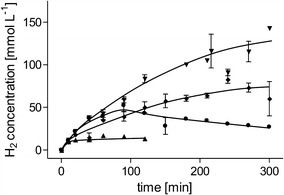
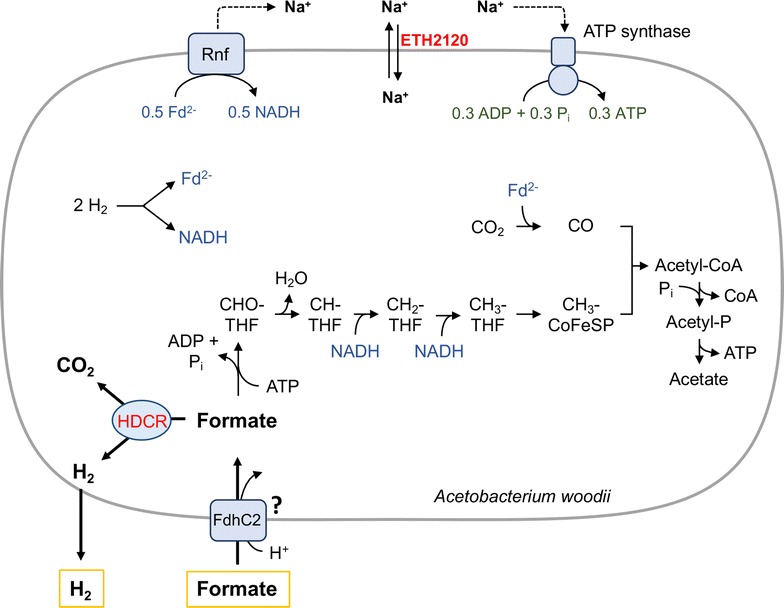
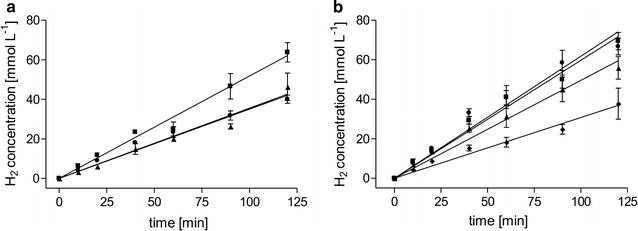
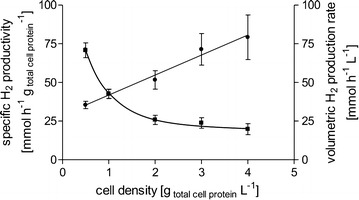
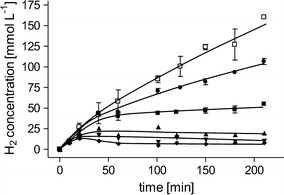
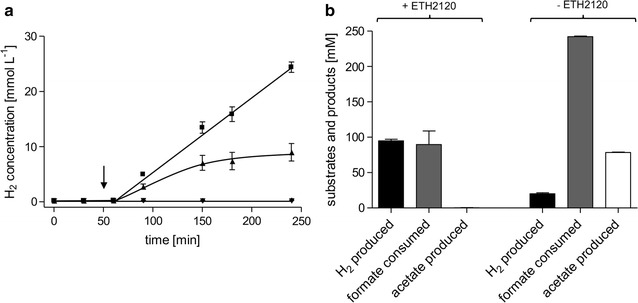
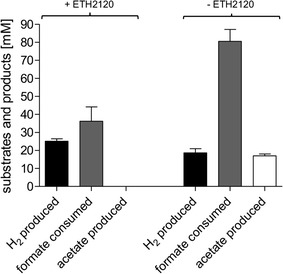
We established a formate-based H production method utilizing the acetogenic bacterium . This organism can use formate as sole energy and carbon source and possesses a novel enzyme complex, the hydrogen-dependent CO reductase that catalyzes oxidation of formate to H and CO. Cell suspensions reached specific formate-dependent H production rates of 71 mmol g h (30.5 mmol g h) and maximum volumetric H evolution rates of 79 mmol L h. Using growing cells in a two-step closed batch fermentation, specific H production rates reached 66 mmol g h with a volumetric H evolution rate of 7.9 mmol L h. Acetate was the major side product that decreased the H yield. We demonstrate that inhibition of the energy metabolism by addition of a sodium ionophore is suitable to completely abolish acetate formation. Under these conditions, yields up to 1 mol H per mol formate were achieved. The same ionophore can be used in cultures utilizing formate as specific switch from a growing phase to a H production phase.
reached one of the highest formate-dependent specific H productivity rates at ambient temperatures reported so far for an organism without genetic modification and converted the substrate exclusively to H. This makes this organism a very promising candidate for sustainable H production and, because of the reversibility of the enzyme, also a candidate for reversible H storage.
分子氢(H₂)是一种颇具吸引力的未来能源载体,有望取代化石燃料。通过生物可持续方式生产的H₂可为未来能源结构做出重大贡献。然而,生物制氢方法面临多种障碍,包括底物成本、低产率和低产量。C1化合物甲酸盐是生物制氢的一种有前景的底物,因为它可由包括CO的电化学还原或合成气等各种来源产生。许多能从甲酸盐产生H₂的微生物已被分离出来;然而,在大多数情况下,产氢率无法与其他制氢方法竞争。
我们利用产乙酸细菌建立了一种基于甲酸盐的制氢方法。这种微生物能将甲酸盐用作唯一的能量和碳源,并拥有一种新型酶复合物,即氢依赖型CO还原酶,它催化甲酸盐氧化为H₂和CO。细胞悬液的特定甲酸盐依赖型H₂产率达到71 mmol g⁻¹ h⁻¹(30.5 mmol g⁻¹ h⁻¹),最大体积H₂释放率为79 mmol L⁻¹ h⁻¹。在两步封闭分批发酵中使用生长中的细胞,特定H₂产率达到66 mmol g⁻¹ h⁻¹,体积H₂释放率为7.9 mmol L⁻¹ h⁻¹。乙酸盐是降低H₂产率的主要副产物。我们证明添加钠离子载体抑制能量代谢适合完全消除乙酸盐的形成。在这些条件下,每摩尔甲酸盐的H₂产率高达1 mol。相同的离子载体可用于以甲酸盐为底物的培养物中,作为从生长阶段到H₂生产阶段的特定转换。
在迄今报道的常温下,对于未经基因改造的生物体,该菌达到了最高的甲酸盐依赖型特定H₂生产率之一,并将底物完全转化为H₂。这使得这种微生物成为可持续制氢的非常有前景的候选者,并且由于该酶的可逆性,也是可逆H₂储存的候选者。