Department of Plastic Surgery, Zhongshan Hospital, Fudan University, Shanghai 200032, P.R. China.
Oncol Rep. 2018 Jun;39(6):2553-2562. doi: 10.3892/or.2018.6356. Epub 2018 Apr 4.
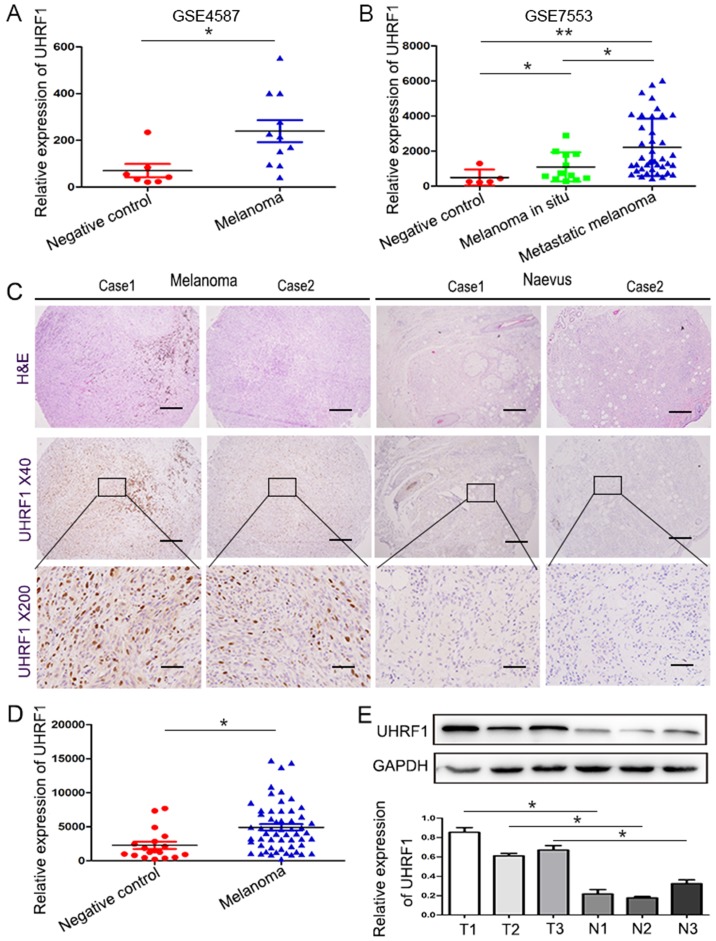
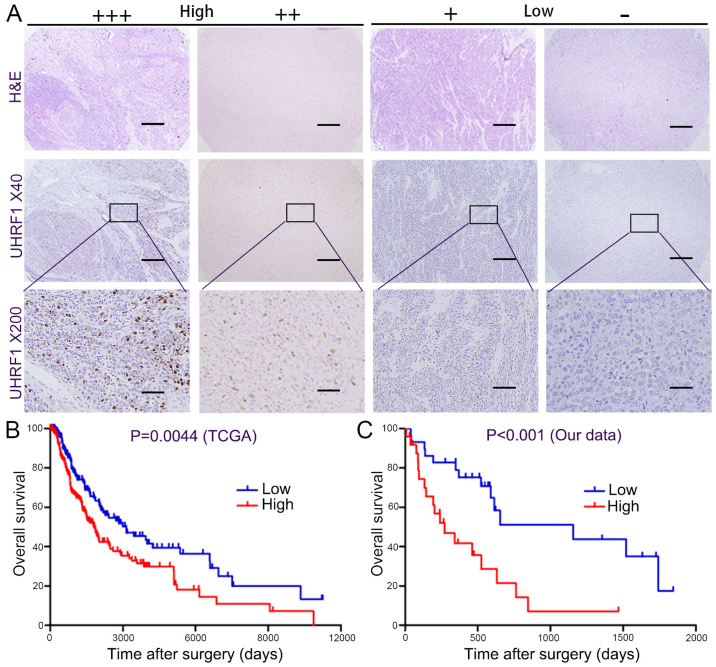
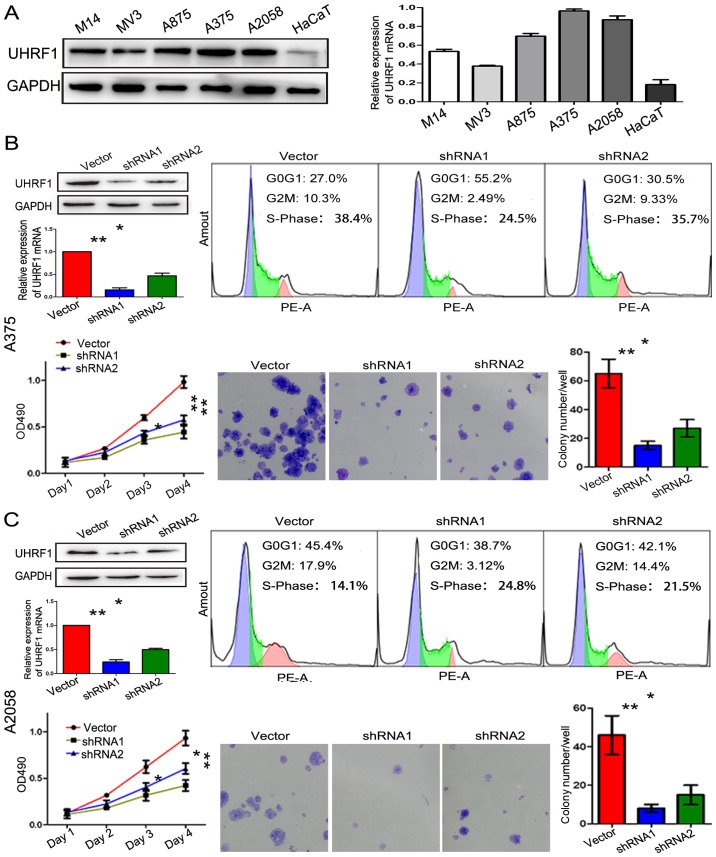
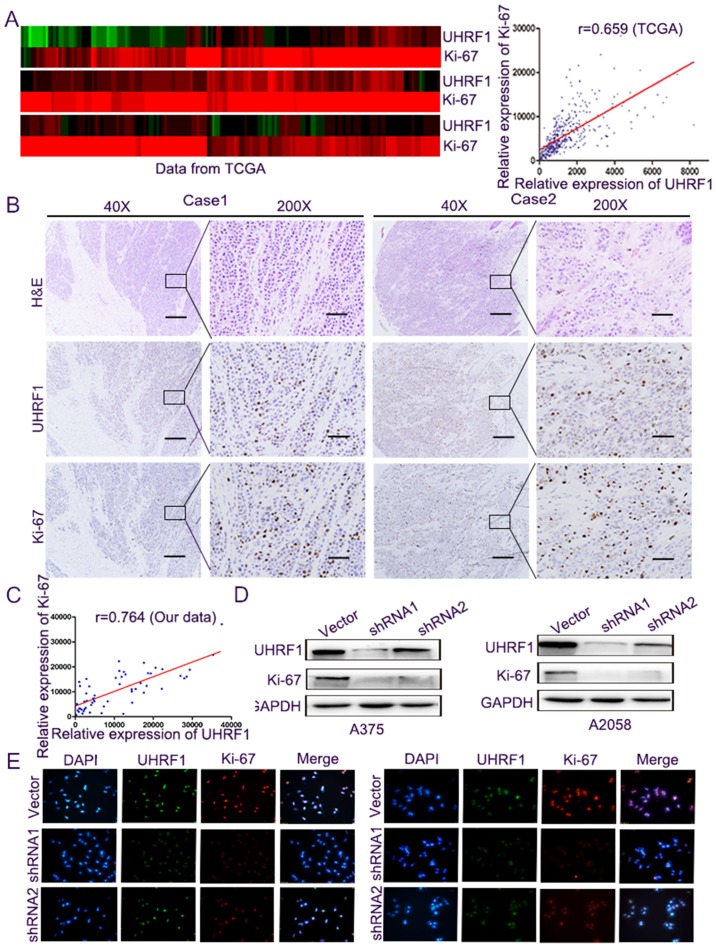
Melanoma is the most aggressive cutaneous cancer due to its propensity to metastasise and proliferate. Melanoma accounts for 80‑90% of skin‑cancer related deaths worldwide. Alhough numerous published studies have attempted to define the markers of diagnosis and prognosis of melanoma, a sensitive and specific biomarker for melanoma remains unknown. Recently, ubiquitin‑like with PHD and ring finger domains 1 (UHRF1) has attracted attention due to its role in cell proliferation and it has been deemed as a potential therapeutic target for cancer. The aim of the present study was to investigate the role and the clinical significance of UHRF1 in melanoma. Immunohistochemical analysis was performed with tissue microarray (TMA) to examine the expression of UHRF1 and Ki‑67, and the role of UHRF1 in cell proliferation was determined through CCK‑8, colony formation and flow cytometry by interfering with the expression of UHRF1. Subsequently, the relationship among the expression of UHRF1 and several major clinical characteristics of melanoma were analysed to evaluate the role of UHRF1 in the progression of melanoma. Finally, the clinical significance of UHRF1 was estimated in 56 melanoma patients. It was observed that the expression of UHRF1 was significantly upregulated in melanoma compared with benign nevi tissues (P<0.05). In addition, the downregulation of the expression of UHRF1 significantly decreased cell proliferation. Furthermore, the level of UHRF1 was positively correlated with the expression of Ki‑67 in melanoma cells, as well as in melanoma tissues. Clinically, a high level of UHRF1 was prone to be related to a high TNM classification (P=0.017) and Breslow's thickness (P=0.034) of melanoma. Furthermore, a high level of UHRF1 was positively associated with a shorter overall survival of melanoma patients. Importantly, the Cox regression model analysis demonstrated that the expression of UHRF1 was an independent prognostic factor for the overall survival of melanoma patients. In conclusion, the elevated expression of UHRF1 plays an important role in melanoma cell proliferation and progression, and it can be used as a prognostic biomarker for melanoma.
黑色素瘤是最具侵袭性的皮肤癌,因其易于转移和增殖。黑色素瘤占全球皮肤癌相关死亡人数的 80-90%。虽然有许多已发表的研究试图定义黑色素瘤的诊断和预后标志物,但黑色素瘤仍然缺乏敏感和特异性的生物标志物。最近,由于其在细胞增殖中的作用,泛素样含 PH 和环指域 1(UHRF1)引起了关注,并被认为是癌症的潜在治疗靶点。本研究旨在探讨 UHRF1 在黑色素瘤中的作用和临床意义。采用组织微阵列(TMA)进行免疫组织化学分析,检测 UHRF1 和 Ki-67 的表达,通过干扰 UHRF1 的表达,通过 CCK-8、集落形成和流式细胞术测定 UHRF1 在细胞增殖中的作用。随后,分析 UHRF1 的表达与黑色素瘤的几个主要临床特征之间的关系,以评估 UHRF1 在黑色素瘤进展中的作用。最后,在 56 例黑色素瘤患者中评估了 UHRF1 的临床意义。结果表明,与良性痣组织相比,黑色素瘤中 UHRF1 的表达明显上调(P<0.05)。此外,下调 UHRF1 的表达可显著降低细胞增殖。此外,UHRF1 的水平与黑色素瘤细胞和黑色素瘤组织中 Ki-67 的表达呈正相关。临床上,高水平的 UHRF1 容易与黑色素瘤的高 TNM 分类(P=0.017)和 Breslow 厚度(P=0.034)相关。此外,高水平的 UHRF1 与黑色素瘤患者的总生存期缩短呈正相关。重要的是,Cox 回归模型分析表明,UHRF1 的表达是黑色素瘤患者总生存期的独立预后因素。总之,UHRF1 的上调表达在黑色素瘤细胞增殖和进展中起重要作用,可作为黑色素瘤的预后生物标志物。