European Molecular Biology Laboratory, 71 Avenue des Martyrs, 38042 Grenoble, France.
School of Biochemistry, University of Bristol, Bristol BS8 1TD, U.K.
Biochem Soc Trans. 2018 Jun 19;46(3):503-512. doi: 10.1042/BST20170427. Epub 2018 Apr 6.
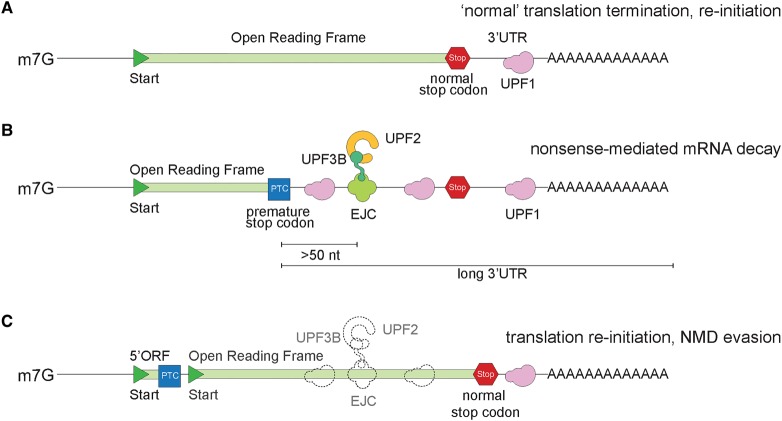
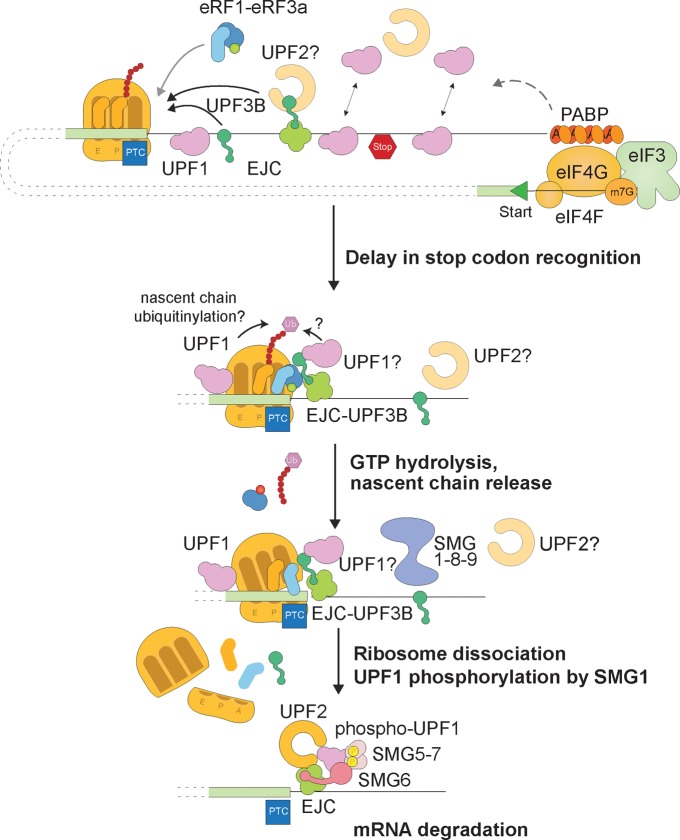
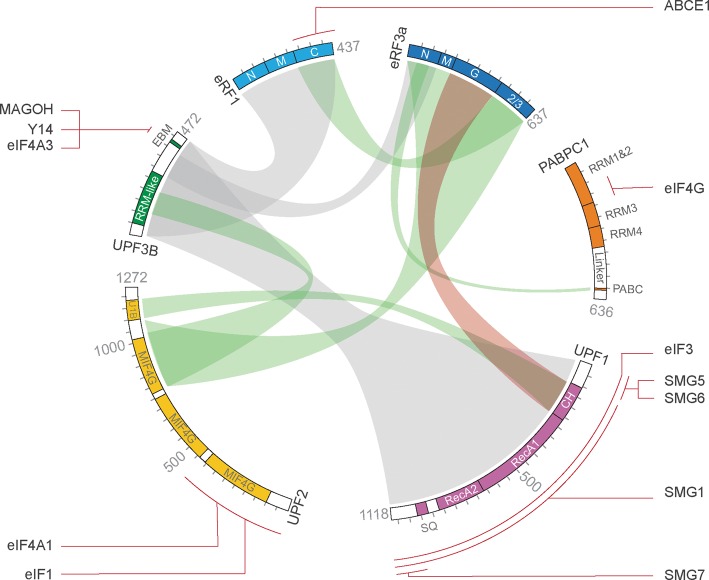
Faulty mRNAs with a premature stop codon (PTC) are recognized and degraded by nonsense-mediated mRNA decay (NMD). Recognition of a nonsense mRNA depends on translation and on the presence of NMD-enhancing or the absence of NMD-inhibiting factors in the 3'-untranslated region. Our review summarizes our current understanding of the molecular function of the conserved NMD factors UPF3B and UPF1, and of the anti-NMD factor Poly(A)-binding protein, and their interactions with ribosomes translating PTC-containing mRNAs. Our recent discovery that UPF3B interferes with human translation termination and enhances ribosome dissociation , whereas UPF1 is inactive in these assays, suggests a re-interpretation of previous experiments and modification of prevalent NMD models. Moreover, we discuss recent work suggesting new functions of the key NMD factor UPF1 in ribosome recycling, inhibition of translation re-initiation and nascent chain ubiquitylation. These new findings suggest that the interplay of UPF proteins with the translation machinery is more intricate than previously appreciated, and that this interplay quality-controls the efficiency of termination, ribosome recycling and translation re-initiation.
具有过早终止密码子(PTC)的错误 mRNA 被无意义介导的 mRNA 降解(NMD)识别和降解。对无意义 mRNA 的识别取决于翻译以及 3'-非翻译区中是否存在增强 NMD 的因子或抑制 NMD 的因子。我们的综述总结了我们对保守的 NMD 因子 UPF3B 和 UPF1 的分子功能的当前理解,以及抗 NMD 因子多聚(A)结合蛋白及其与翻译 PTC 含有 mRNA 的核糖体的相互作用。我们最近的发现表明,UPF3B 干扰人类翻译终止并增强核糖体解离,而 UPF1 在这些测定中没有活性,这表明需要重新解释以前的实验并修改流行的 NMD 模型。此外,我们讨论了最近的工作,这些工作表明关键的 NMD 因子 UPF1 在核糖体回收、翻译重新起始抑制和新生链泛素化中的新功能。这些新发现表明,UPF 蛋白与翻译机制的相互作用比以前认为的更加复杂,并且这种相互作用质量控制终止、核糖体回收和翻译重新起始的效率。