Department of Gynecology and Obstetrics, Wuhan Children's Hospital (Wuhan Maternal and Child Healthcare Hospital), Tongji Medical College, Huazhong University of Science and Technology, Wuhan, Hubei, China (mainland).
Department of Gynecology and Obstetrics, Second People's Hospital of Huanggang, Huanggang, Hubei, China (mainland).
Med Sci Monit. 2018 Apr 7;24:2063-2071. doi: 10.12659/msm.906728.
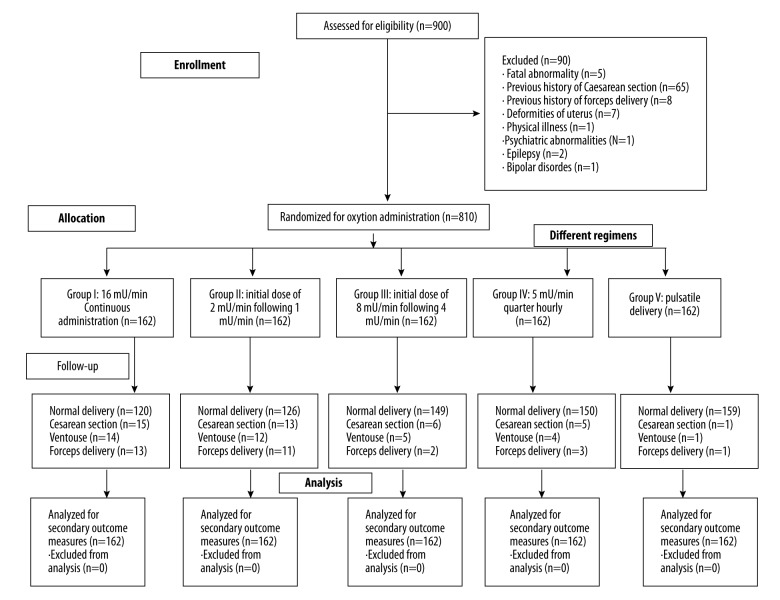
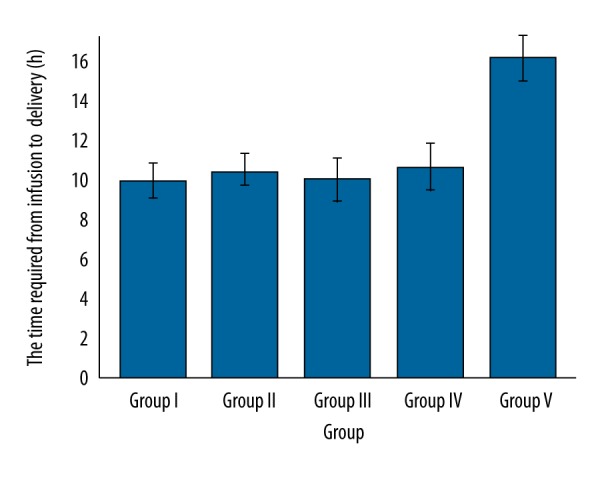
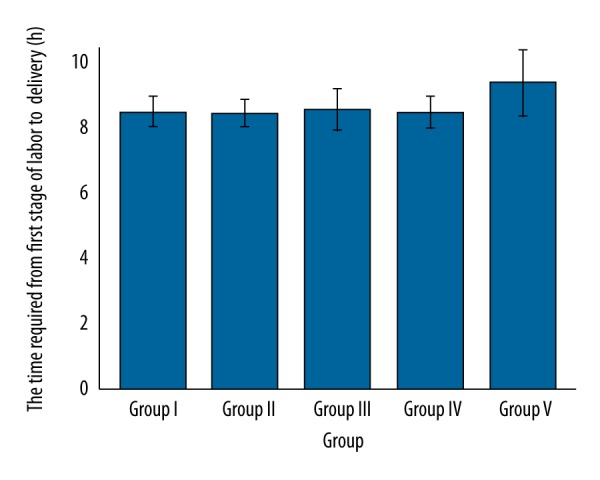
BACKGROUND The current guideline for oxytocin regimens in the abnormal labor of delivery is continuous infusion. The objective of the present study was to compare effects and safety measures of various available regimens of oxytocin in abnormal labor delivery. MATERIAL AND METHODS In this clinical experimental study, a total of 900 pregnant women admitted for delivery were randomized into 5 group with 162 each. Pregnant women received oxytocin as continuous administration of 16 mU/min (Group I), 1 mU/min (group II), 4 mU/min (group III), 5 mU/min quarter-hourly (group IV), and through a syringe pump (group V). Measurement of the expense of delivery, the ratio of the instrumental delivery, and the other secondary outcome measures was performed to find the best regimen of oxytocin. The 2-tailed paired t test and Mann-Whitney U test following Dunnett's multiple comparison tests were used at 95% confidence level. RESULTS Pulsatile delivery had least risk of instrumental delivery as compared to continuous infusion (p<0.0001, q=6.663) and normal-frequency low-dose (p<0.0001, q=5.638) of oxytocin. The time required from infusion to delivery was longer for group II (p=0.001, q=2.925), group IV (p<0.0001, q=4.829), and group V (p<0.0001, q=41.456) than for group I. The expense of delivery was: group I < group II < group IV < group III < group V. CONCLUSIONS High-dose and pulsatile preparation of oxytocin had reduced risks of operative delivery vs. continuous administration.
目前分娩异常时催产素方案的指南是持续输注。本研究的目的是比较各种可用的催产素方案在分娩异常时的效果和安全性措施。
在这项临床实验研究中,共有 900 名因分娩而住院的孕妇被随机分为 5 组,每组 162 名。孕妇接受催产素连续输注,剂量分别为 16 mU/min(I 组)、1 mU/min(II 组)、4 mU/min(III 组)、每 15 分钟 5 mU (IV 组)和通过注射器泵(V 组)。测量分娩费用、器械分娩率和其他次要结局指标,以找到最佳的催产素方案。采用双尾配对 t 检验和 Mann-Whitney U 检验,随后进行 Dunnett 多重比较检验,置信水平为 95%。
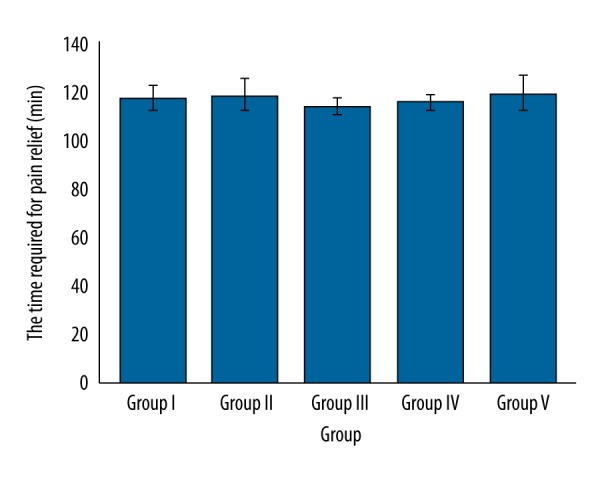
与连续输注(p<0.0001,q=6.663)和正常频率低剂量(p<0.0001,q=5.638)催产素相比,脉冲式分娩的器械分娩风险最低。从输注到分娩所需的时间,II 组(p=0.001,q=2.925)、IV 组(p<0.0001,q=4.829)和 V 组(p<0.0001,q=41.456)均长于 I 组。分娩费用为:I 组<II 组<IV 组<III 组<V 组。
与连续给药相比,高剂量和脉冲式催产素制剂可降低手术分娩的风险。