Kim Jeehyun, Kwon Hyuktae, Heo Bo-Kyoung, Joh Hee-Kyung, Lee Cheol Min, Hwang Seung-Sik, Park Danbee, Park Jae-Hong
Department of Family Medicine, Seoul National University Hospital, Seoul, Korea.
Department of Family Medicine, Seoul National University Health Service Center, Seoul, Korea.
Korean J Fam Med. 2018 Mar;39(2):74-84. doi: 10.4082/kjfm.2018.39.2.74. Epub 2018 Mar 22.
We investigated the association between body composition, especially truncal or non-truncal fat mass (FM), and bone mineral density (BMD) in premenopausal women in Korea.
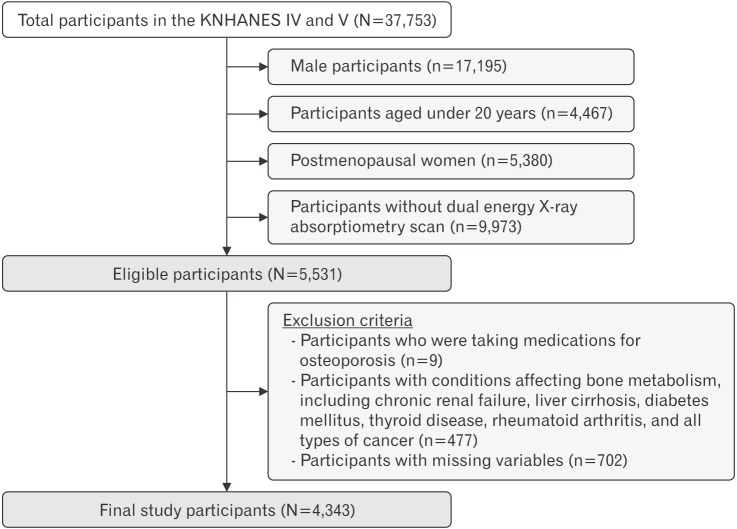
A cross-sectional study was performed using data from the Korea National Health and Nutrition Examination Survey IV and V (2008-2011). Total lean mass (LM), total FM (TFM), truncal FM, and non-truncal FM, and BMD of the total femur, femoral neck (FN), and lumbar spine were measured using dual-energy X-ray absorptiometry. The association between body composition and BMD was analyzed using multiple linear regression. The risk of low BMD according to quartiles of TFM, truncal FM, and non-truncal FM was calculated using logistic regression. Subgroup analysis according to body mass index was also performed.
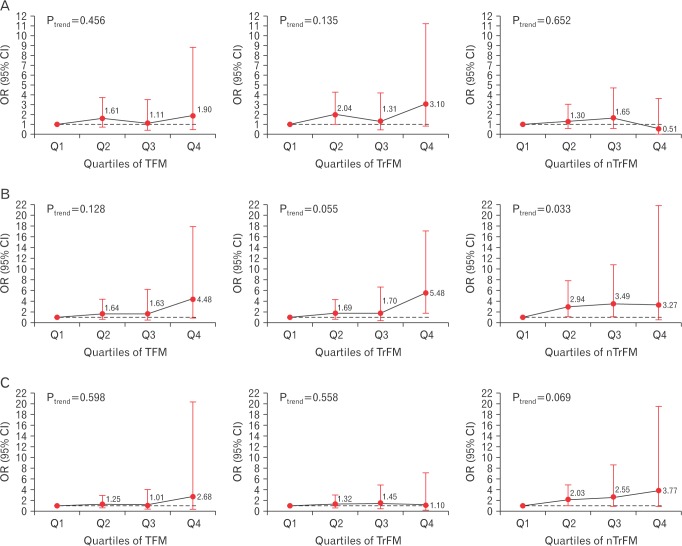
In 4,343 premenopausal women, total LM was positively associated with BMD regardless of weight adjustment. TFM, truncal FM, and non-truncal FM were inversely associated with BMD after adjusting for weight. Odds ratios (ORs) for low BMD and 95% confidence intervals (CIs) of the highest quartile of TFM, truncal FM, and non-truncal FM compared with the lowest quartile were calculated. The risk of low BMD of the FN was higher in the highest quartile of TFM (OR, 4.48; 95% CI, 1.11-18.01) and truncal FM (OR, 5.48; 95% CI, 1.75-17.20). Truncal FM and not-truncal FM had an inverse association with BMD in the non-obese and obese subgroups of women.
Total LM has a protective effect on BMD and FM can have a detrimental effect on BMD besides its skeletal loading effect.
我们研究了韩国绝经前女性的身体成分,尤其是躯干或非躯干脂肪量(FM)与骨矿物质密度(BMD)之间的关联。
利用韩国国家健康与营养检查调查IV和V(2008 - 2011年)的数据进行了一项横断面研究。使用双能X线吸收法测量了总瘦体重(LM)、总脂肪量(TFM)、躯干FM和非躯干FM,以及全股骨、股骨颈(FN)和腰椎的BMD。使用多元线性回归分析身体成分与BMD之间的关联。使用逻辑回归计算根据TFM、躯干FM和非躯干FM四分位数划分的低BMD风险。还根据体重指数进行了亚组分析。
在4343名绝经前女性中,无论体重调整情况如何,总LM与BMD呈正相关。调整体重后,TFM、躯干FM和非躯干FM与BMD呈负相关。计算了TFM、躯干FM和非躯干FM最高四分位数与最低四分位数相比的低BMD的比值比(OR)和95%置信区间(CI)。TFM最高四分位数(OR,4.48;95%CI,1.11 - 18.01)和躯干FM最高四分位数(OR,5.48;95%CI,1.75 - 17.20)时,FN低BMD风险更高。在非肥胖和肥胖女性亚组中,躯干FM和非躯干FM与BMD呈负相关。
总LM对BMD有保护作用,而FM除了其骨骼负荷作用外,可能对BMD有不利影响。