Krishnamoorthy Kurinji, Hoffmann Kyle, Kewalramani Sumit, Brodin Jeffrey D, Moreau Liane M, Mirkin Chad A, Olvera de la Cruz Monica, Bedzyk Michael J
Applied Physics Program, Northwestern University, Evanston, Illinois 60208, United States.
Department of Materials Science and Engineering, Northwestern University, Evanston, Illinois 60208, United States.
ACS Cent Sci. 2018 Mar 28;4(3):378-386. doi: 10.1021/acscentsci.7b00577. Epub 2018 Mar 13.
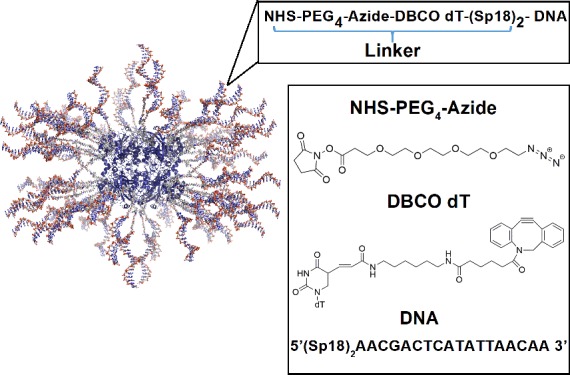
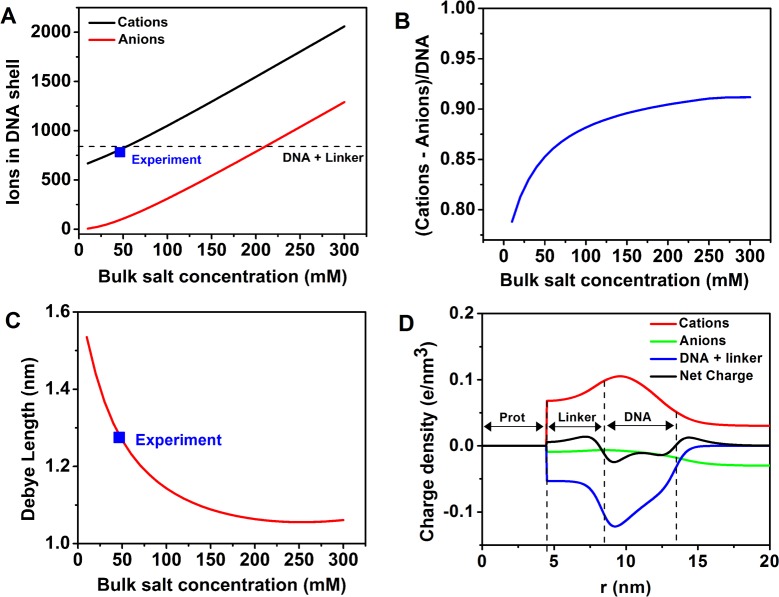
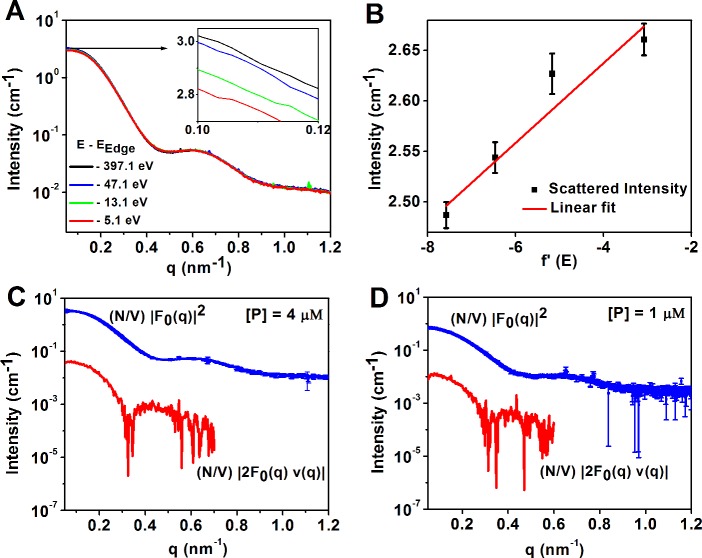
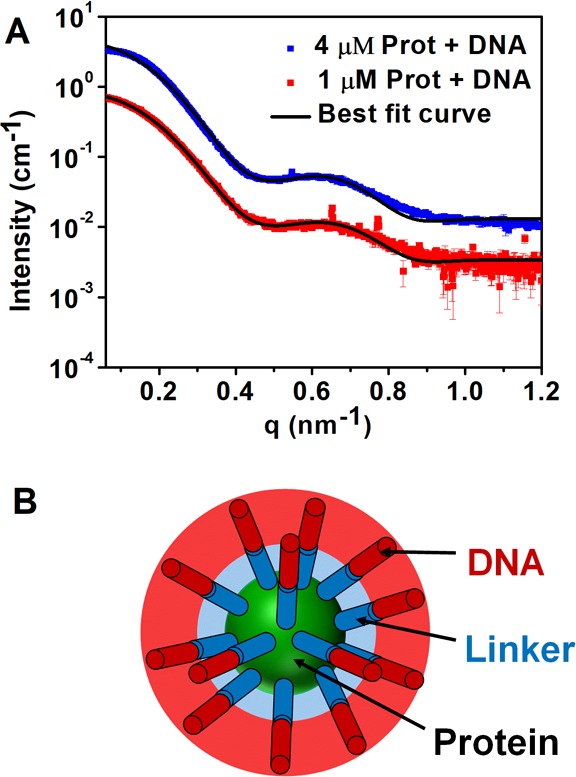
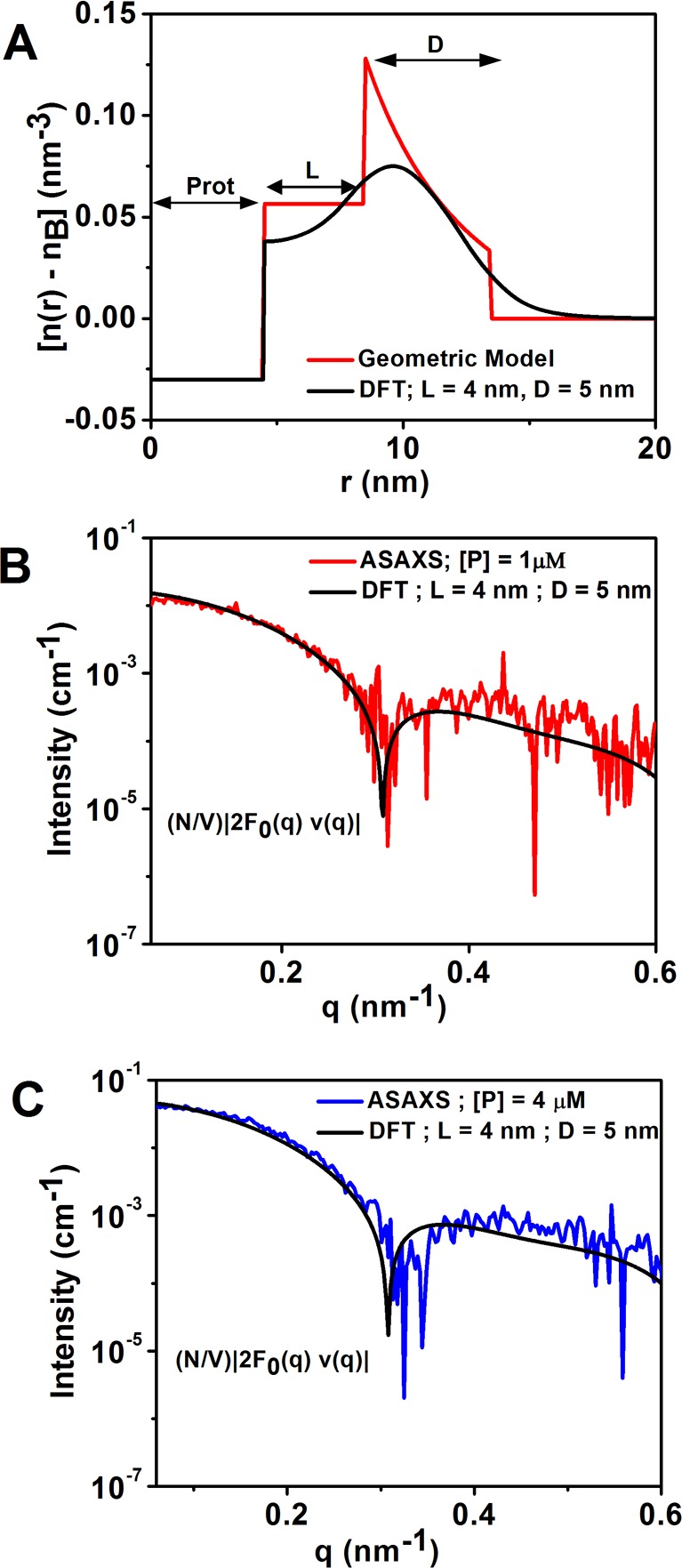
Protein-spherical nucleic acid conjugates (Pro-SNAs) are an emerging class of bioconjugates that have properties defined by their protein cores and dense shell of oligonucleotides. They have been used as building blocks in DNA-driven crystal engineering strategies and show promise as agents that can cross cell membranes and affect both protein and DNA-mediated processes inside cells. However, ionic environments surrounding proteins can influence their activity and conformational stability, and functionalizing proteins with DNA substantively changes the surrounding ionic environment in a nonuniform manner. Techniques typically used to determine protein structure fail to capture such irregular ionic distributions. Here, we determine the counterion radial distribution profile surrounding Pro-SNAs dispersed in RbCl with 1 nm resolution through anomalous small-angle X-ray scattering (ASAXS) and classical density functional theory (DFT). SAXS analysis also reveals the radial extension of the DNA and the linker used to covalently attach the DNA to the protein surface. At the experimental salt concentration of 50 mM RbCl, Rb cations compensate ∼90% of the negative charge due to the DNA and linker. Above 75 mM, DFT calculations predict overcompensation of the DNA charge by Rb. This study suggests a method for exploring Pro-SNA structure and function in different environments through predictions of ionic cloud densities as a function of salt concentration, DNA grafting density, and length. Overall, our study demonstrates that solution X-ray scattering combined with DFT can discern counterionic distribution and submolecular features of highly charged, complex nanoparticle constructs such as Pro-SNAs and related nucleic acid conjugate materials.
蛋白质-球形核酸缀合物(Pro-SNAs)是一类新兴的生物缀合物,其性质由蛋白质核心和密集的寡核苷酸外壳决定。它们已被用作DNA驱动的晶体工程策略中的构建模块,并有望成为能够穿过细胞膜并影响细胞内蛋白质和DNA介导过程的试剂。然而,蛋白质周围的离子环境会影响其活性和构象稳定性,用DNA对蛋白质进行功能化会以不均匀的方式实质性地改变周围的离子环境。通常用于确定蛋白质结构的技术无法捕捉到这种不规则的离子分布。在这里,我们通过反常小角X射线散射(ASAXS)和经典密度泛函理论(DFT),以1纳米的分辨率确定了分散在RbCl中的Pro-SNAs周围的抗衡离子径向分布轮廓。SAXS分析还揭示了DNA以及用于将DNA共价连接到蛋白质表面的连接子的径向延伸。在50 mM RbCl的实验盐浓度下,Rb阳离子补偿了由于DNA和连接子产生的约90%的负电荷。在75 mM以上,DFT计算预测Rb会对DNA电荷进行过度补偿。这项研究提出了一种通过预测离子云密度作为盐浓度、DNA接枝密度和长度的函数来探索不同环境中Pro-SNA结构和功能的方法。总体而言,我们的研究表明,溶液X射线散射与DFT相结合可以辨别高电荷、复杂纳米颗粒构建体(如Pro-SNAs和相关核酸缀合材料)的抗衡离子分布和亚分子特征。