Song Yangmeihui, Song Wenyu, Lan Xiaoli, Cai Weibo, Jiang Dawei
Department of Nuclear Medicine, Union Hospital, Tongji Medical College, Huazhong University of Science and Technology, Wuhan, China.
Hubei Key Laboratory of Molecular Imaging, Wuhan, China.
Aggregate (Hoboken). 2022 Feb;3(1). doi: 10.1002/agt2.120. Epub 2021 Sep 14.
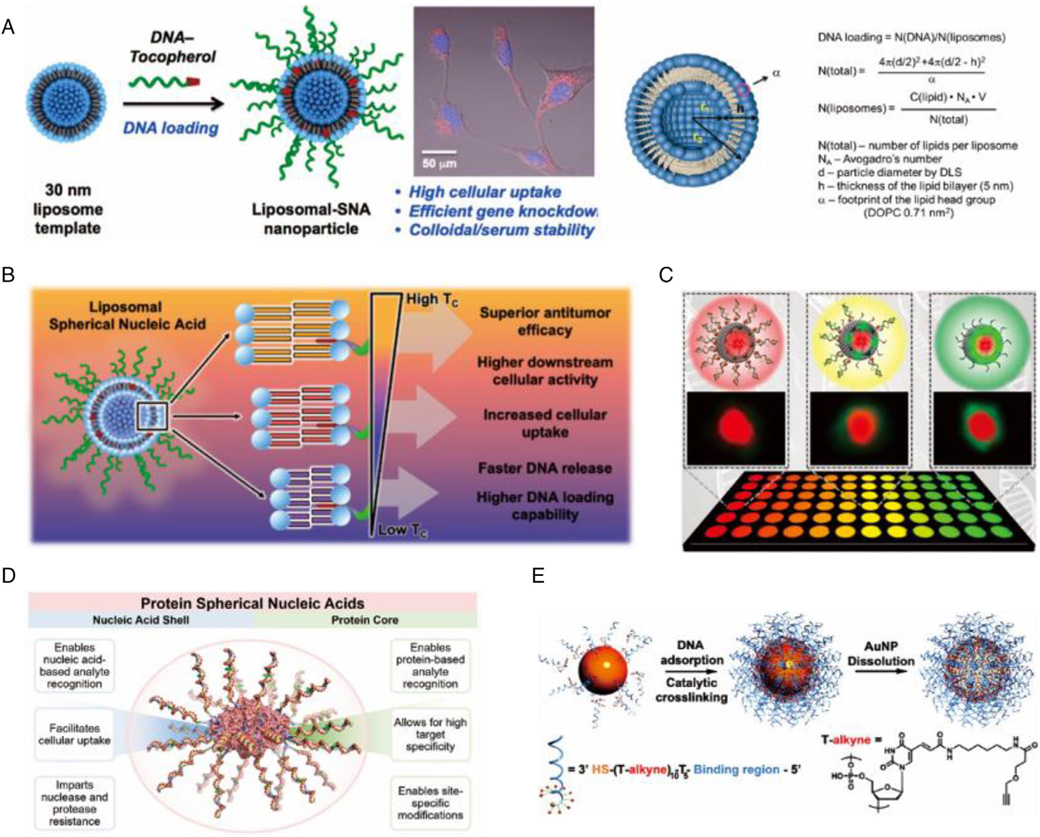
Spherical nucleic acids (SNAs) are composed of a nanoparticle core and a layer of densely arranged oligonucleotide shells. After the first report of SNA by Mirkin and coworkers in 1996, it has created a significant interest by offering new possibilities in the field of gene and drug delivery. The controlled aggregation of oligonucleotides on the surface of organic/inorganic nanoparticles improves the delivery of genes and nucleic acid-based drugs and alters and regulates the biological profiles of the nanoparticle core within living organisms. Here in this review, we present an overview of the recent progress of SNAs that has speeded up their biomedical application and their potential transition to clinical use. We start with introducing the concept and characteristics of SNAs as drug/gene delivery systems and highlight recent efforts of bioengineering SNA by imaging and treatmenting various diseases. Finally, we discuss potential challenges and opportunities of SNAs, their ongoing clinical trials, and future translation, and how they may affect the current landscape of clinical practices. We hope that this review will update our current understanding of SNA, organized oligonucleotide aggregates, for disease diagnosis and treatment.
球形核酸(SNA)由纳米颗粒核心和一层紧密排列的寡核苷酸壳组成。1996年米尔金及其同事首次报道SNA后,它通过在基因和药物递送领域提供新的可能性引起了广泛关注。寡核苷酸在有机/无机纳米颗粒表面的可控聚集改善了基因和基于核酸的药物的递送,并改变和调节了纳米颗粒核心在活生物体内的生物学特性。在本综述中,我们概述了SNA的最新进展,这些进展加速了它们在生物医学中的应用及其向临床应用的潜在转变。我们首先介绍SNA作为药物/基因递送系统的概念和特性,并重点介绍通过成像和治疗各种疾病对SNA进行生物工程的最新努力。最后,我们讨论了SNA的潜在挑战和机遇、它们正在进行的临床试验以及未来的转化,以及它们可能如何影响当前的临床实践格局。我们希望这篇综述将更新我们目前对用于疾病诊断和治疗的SNA(有组织的寡核苷酸聚集体)的理解。