Krysiak-Baltyn Konrad, Martin Gregory J O, Gras Sally L
Department of Chemical Engineering, The University of Melbourne, Parkville 3010, Australia.
The Bio21 Institute, 30 Flemington Rd, The University of Melbourne, Parkville 3052, Australia.
Pharmaceuticals (Basel). 2018 Apr 8;11(2):31. doi: 10.3390/ph11020031.
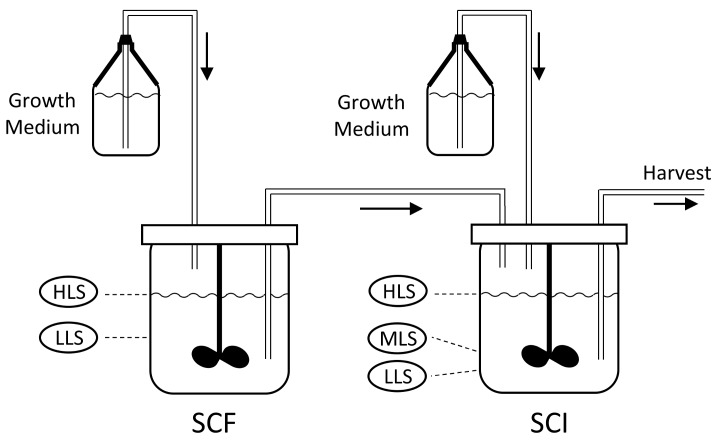
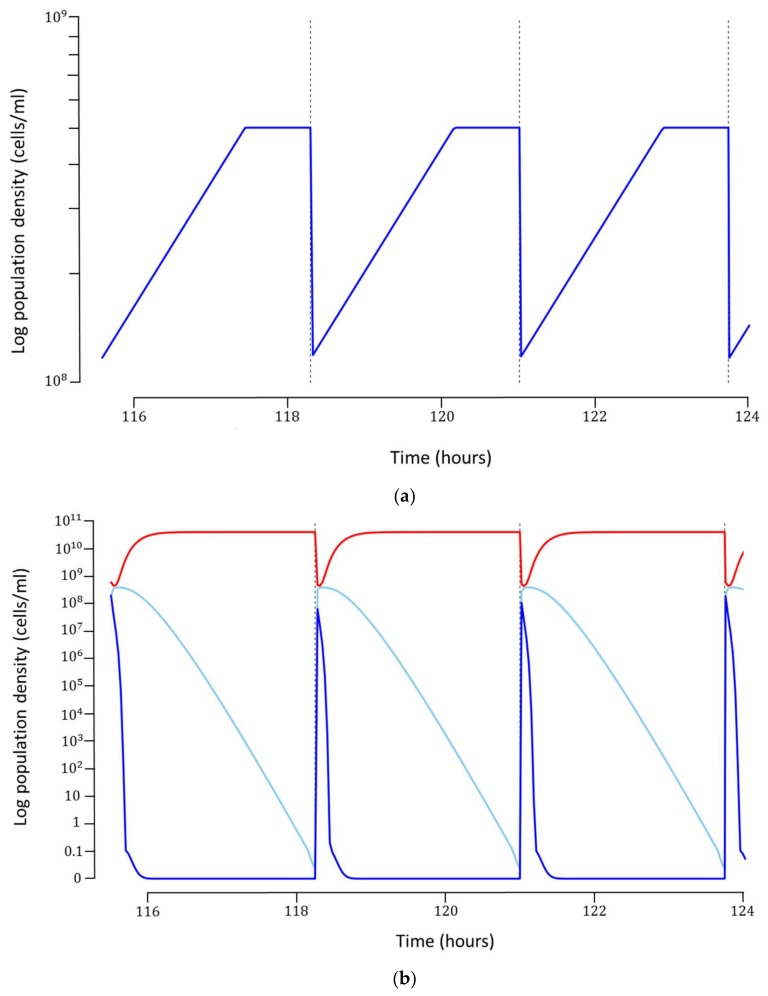
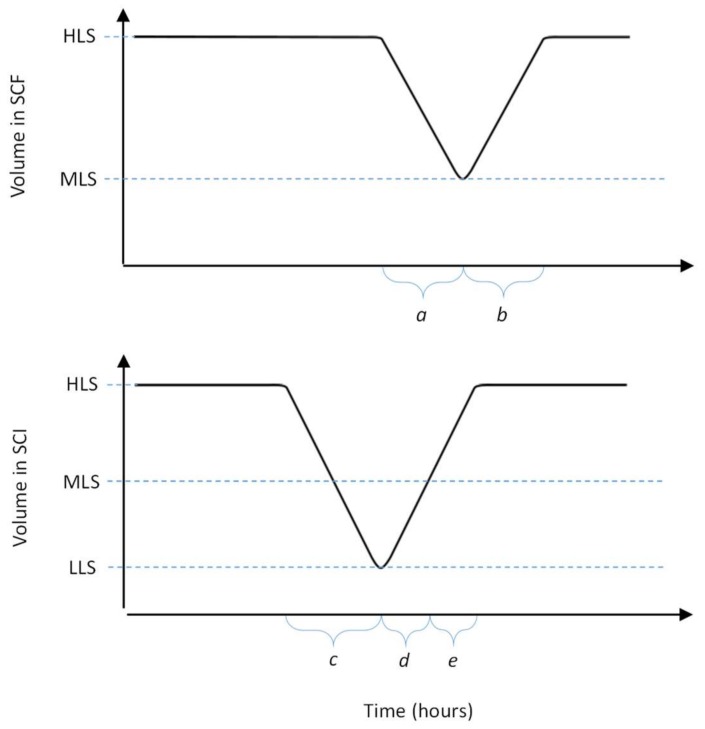
Cost effective and scalable methods for phage production are required to meet an increasing demand for phage, as an alternative to antibiotics. Computational models can assist the optimization of such production processes. A model is developed here that can simulate the dynamics of phage population growth and production in a two-stage, self-cycling process. The model incorporates variable infection parameters as a function of bacterial growth rate and employs ordinary differential equations, allowing application to a setup with multiple reactors. The model provides simple cost estimates as a function of key operational parameters including substrate concentration, feed volume and cycling times. For the phage and bacteria pairing examined, costs and productivity varied by three orders of magnitude, with the lowest cost found to be most sensitive to the influent substrate concentration and low level setting in the first vessel. An example case study of phage production is also presented, showing how parameter values affect the production costs and estimating production times. The approach presented is flexible and can be used to optimize phage production at laboratory or factory scale by minimizing costs or maximizing productivity.
作为抗生素的替代品,为满足对噬菌体日益增长的需求,需要具有成本效益且可扩展的噬菌体生产方法。计算模型可协助优化此类生产过程。本文开发了一个模型,该模型可以模拟两阶段自循环过程中噬菌体种群增长和生产的动态。该模型将可变感染参数纳入其中,作为细菌生长速率的函数,并采用常微分方程,从而可应用于具有多个反应器的装置。该模型根据关键操作参数(包括底物浓度、进料体积和循环次数)提供简单的成本估算。对于所研究的噬菌体和细菌配对,成本和生产率相差三个数量级,发现最低成本对进水底物浓度和第一容器中的低水平设置最为敏感。还给出了一个噬菌体生产的实例案例研究,展示了参数值如何影响生产成本并估算生产时间。所提出的方法具有灵活性,可用于通过最小化成本或最大化生产率来优化实验室或工厂规模的噬菌体生产。