Manzano Aránzazu, Herranz Raúl, den Toom Leonardus A, Te Slaa Sjoerd, Borst Guus, Visser Martijn, Medina F Javier, van Loon Jack J W A
1Centro de Investigaciones Biológicas (CSIC), Madrid, Spain.
DESC (Dutch Experiment Support Center), Department of Oral and Maxillofacial Surgery / Oral Pathology, VU University Medical Center & Academic Centre for Dentistry Amsterdam (ACTA), Amsterdam Movement Sciences, Amsterdam, The Netherlands.
NPJ Microgravity. 2018 Apr 4;4:9. doi: 10.1038/s41526-018-0041-4. eCollection 2018.
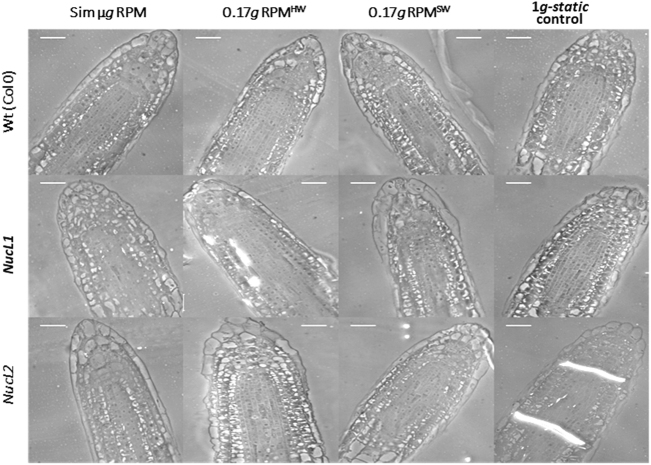
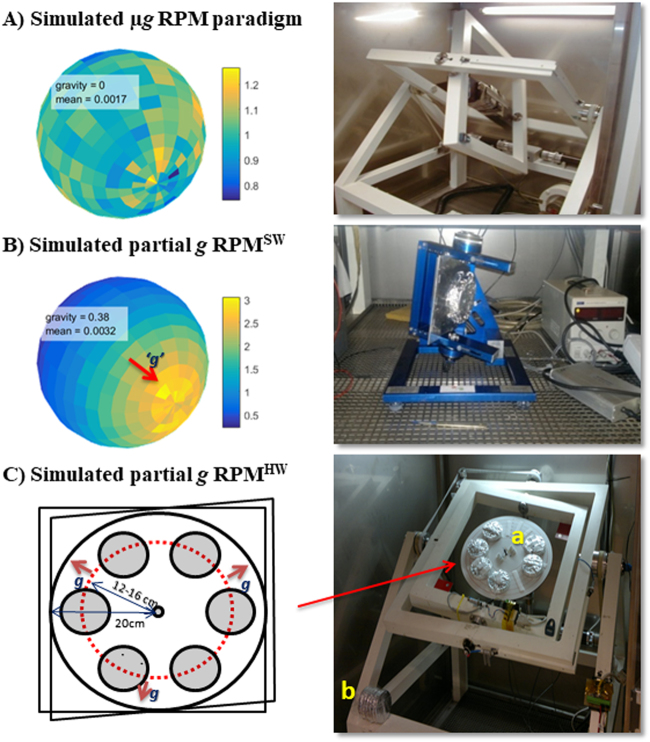
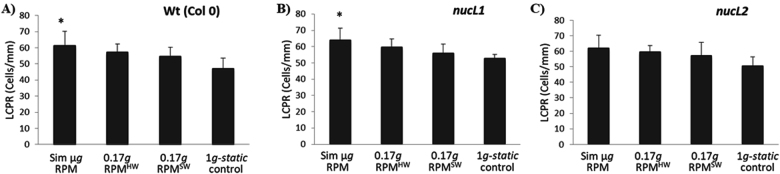
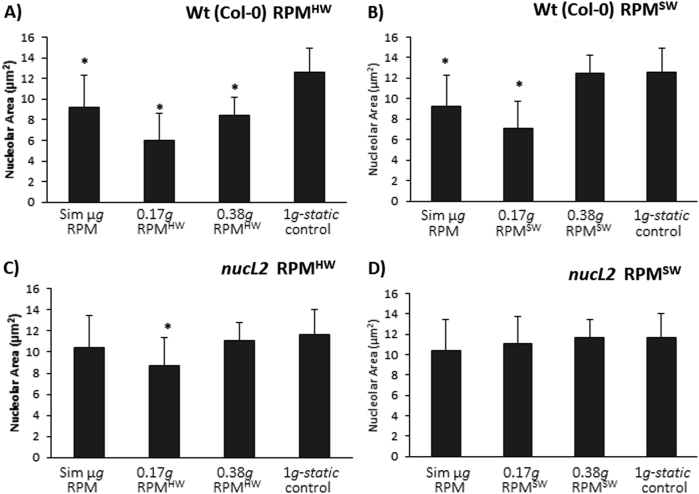
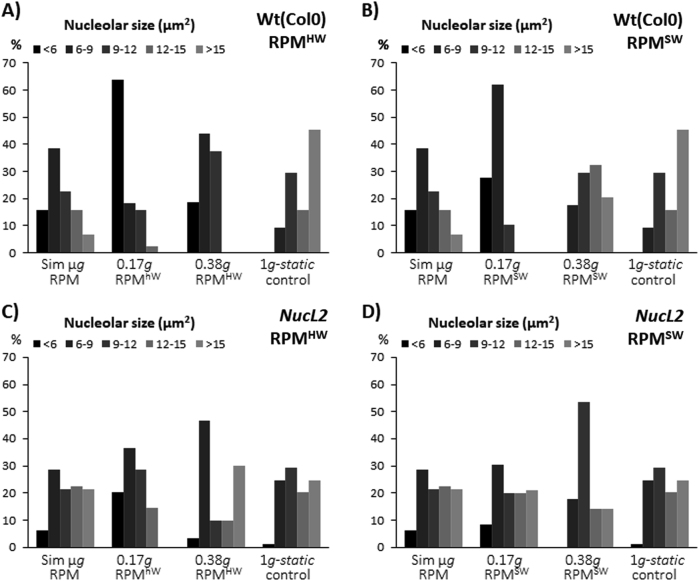
Clinostats and Random Positioning Machine (RPM) are used to simulate microgravity, but, for space exploration, we need to know the response of living systems to fractional levels of gravity (partial gravity) as they exist on Moon and Mars. We have developed and compared two different paradigms to simulate partial gravity using the RPM, one by implementing a centrifuge on the RPM (RPM), the other by applying specific software protocols to driving the RPM motors (RPM). The effects of the simulated partial gravity were tested in plant root meristematic cells, a system with known response to real and simulated microgravity. Seeds of were germinated under simulated Moon (0.17 ) and Mars (0.38 ) gravity. In parallel, seeds germinated under simulated microgravity (RPM), or at 1 control conditions. Fixed root meristematic cells from 4-day grown seedlings were analyzed for cell proliferation rate and rate of ribosome biogenesis using morphometrical methods and molecular markers of the regulation of cell cycle and nucleolar activity. Cell proliferation appeared increased and cell growth was depleted under Moon gravity, compared with the 1 control. The effects were even higher at the Moon level than at simulated microgravity, indicating that meristematic competence (balance between cell growth and proliferation) is also affected at this gravity level. However, the results at the simulated Mars level were close to the 1 static control. This suggests that the threshold for sensing and responding to gravity alteration in the root would be at a level intermediate between Moon and Mars gravity. Both partial simulation strategies seem valid and show similar results at Moon -levels, but further research is needed, in spaceflight and simulation facilities, especially around and beyond Mars g levels to better understand more precisely the differences and constrains in the use of these facilities for the space biology community.
clinostat和随机定位机(RPM)用于模拟微重力,但对于太空探索而言,我们需要了解生命系统对月球和火星上存在的部分重力水平(分重力)的反应。我们已经开发并比较了两种使用RPM模拟部分重力的不同范例,一种是在RPM上安装离心机(RPM),另一种是应用特定的软件协议来驱动RPM电机(RPM)。在植物根尖分生组织细胞中测试了模拟部分重力的影响,该系统对真实和模拟微重力具有已知反应。在模拟月球(0.17g)和火星(0.38g)重力条件下使[植物名称]种子发芽。同时,种子在模拟微重力(RPM)或1g对照条件下发芽。使用形态计量学方法以及细胞周期调控和核仁活性的分子标记,对4天龄幼苗的固定根尖分生组织细胞进行细胞增殖率和核糖体生物合成率分析。与1g对照相比,在月球重力条件下细胞增殖似乎增加,而细胞生长减少。在月球重力水平下的影响甚至比模拟微重力下更高,这表明在该重力水平下分生组织能力(细胞生长与增殖之间的平衡)也受到影响。然而,模拟火星重力水平下的结果接近1g静态对照。这表明根部感知和响应重力变化的阈值将处于月球和火星重力之间的某个水平。两种部分重力模拟策略似乎都是有效的,并且在月球重力水平下显示出相似的结果,但需要在航天飞行和模拟设施中进行进一步研究,特别是在火星重力水平及其以上,以更精确地了解这些设施在空间生物学领域使用中的差异和限制。