Equine Diseases Study Group (COPAR, GI-2120), Animal Pathology Department, Veterinary Faculty, Santiago de Compostela University, 27002, Lugo, Spain.
Parasitología, Universidad de la República (Regional Norte), Salto, Uruguay.
Parasit Vectors. 2018 Apr 12;11(1):240. doi: 10.1186/s13071-018-2827-3.
An approach to preventing strongyle infection in horses was tested, comprising rotational pasturing and the administration of spores of two parasiticidal fungi, Mucor circinelloides and Duddingtonia flagrans.
Twenty-two adult Spanish Sport Horses were dewormed with ivermectin (1 mg pour-on/kg body weight) and then randomly divided into three groups. G-1 was maintained with continuous grazing, and G-2 and G-3 were kept on a four-paddock rotation system. Commercial pelleted feed (2.5 kg/horse) was supplied to G-1 and G-2 twice a week; horses in G-3 received pellets containing 2 × 10 spores/kg of each fungus. Fecal samples were analyzed by the flotation method to estimate the reduction in the fecal egg counts (FECR), the percentage of horses shedding eggs (PHR), and the egg reappearance period (ERP).
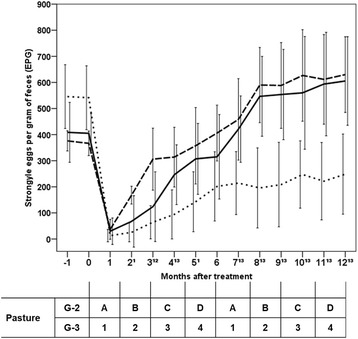
Third-stage larvae were identified in fecal pats as Cyathostomum (sensu lato) types A, C and D, Gyalocephalus capitatus, Triodontophorus serratus, Poteriosthomum spp., Strongylus vulgaris and S. edentatus. Two weeks after treatment, the FECR values were 100% in G-1, 96% in G-2 and 99% in G-3; the PHR values were 100% in G-1, 75% in G-2 and 88% in G-3. A strongyle ERP of 6 weeks was observed in G-1, ERP of 10 weeks was observed in G-2, and ERP of 16 weeks was observed in G-3. The counts of eggs per gram of feces (EPG) were > 300 EPG in G-1 and G-2 but remained below 250 EPG in G-3 throughout the observation period of 12 months.
These results suggest that horse strongyle infection could be decreased by combining rotational pasturing with feeding pellets containing the spores of parasiticidal fungi.
本研究旨在测试一种防治马属动物强烈寄生虫感染的方法,该方法包括轮牧和使用两种杀寄生虫真菌——卷枝毛霉和伞枝多毛孢的孢子进行治疗。
22 匹西班牙运动马在使用伊维菌素(1mg 浇泼剂/kg 体重)驱虫后,随机分为三组。G-1 组持续放牧,G-2 和 G-3 组采用四围场轮牧制度。G-1 和 G-2 组每周投喂两次商业颗粒饲料(2.5kg/马);G-3 组投喂含有两种真菌各 2×10 孢子/kg 的颗粒饲料。采用漂浮法对粪便样本进行分析,以评估粪便虫卵减少率(FECR)、排虫卵马匹比例(PHR)和虫卵重现期(ERP)。
粪便垫中鉴定出第三期幼虫为广义胃线虫(Cyathostomum(sensu lato))A、C 和 D 型、Gyalocephalus capitatus、Triodontophorus serratus、Poteriosthomum spp.、普通圆形线虫(Strongylus vulgaris)和无齿圆形线虫(S. edentatus)。治疗后两周,G-1 组的 FECR 值为 100%,G-2 组为 96%,G-3 组为 99%;G-1 组的 PHR 值为 100%,G-2 组为 75%,G-3 组为 88%。G-1 组的强烈线虫 ERP 为 6 周,G-2 组为 10 周,G-3 组为 16 周。在 12 个月的观察期内,G-1 和 G-2 组的粪便虫卵计数(EPG)>300 EPG,但 G-3 组的 EPG 保持在 250 EPG 以下。
这些结果表明,通过轮牧和投喂含杀寄生虫真菌孢子的颗粒饲料,可降低马属动物的强烈寄生虫感染。