Voinot Mathilde, Bonilla Rodrigo, Sousa Sérgio, Sanchís Jaime, Canhão-Dias Miguel, Romero Delgado José, Lozano João, Sánchez-Andrade Rita, Sol Arias María, Madeira de Carvalho Luís
Control of Parasites Research Group (COPAR, GI-2120), Department of Animal Pathology, Faculty of Veterinary, University of Santiago de Compostela, 27142 Lugo, Spain.
CARVAL Pharmaceuticals, Bogotá 110211, Colombia.
Pathogens. 2021 Oct 17;10(10):1338. doi: 10.3390/pathogens10101338.
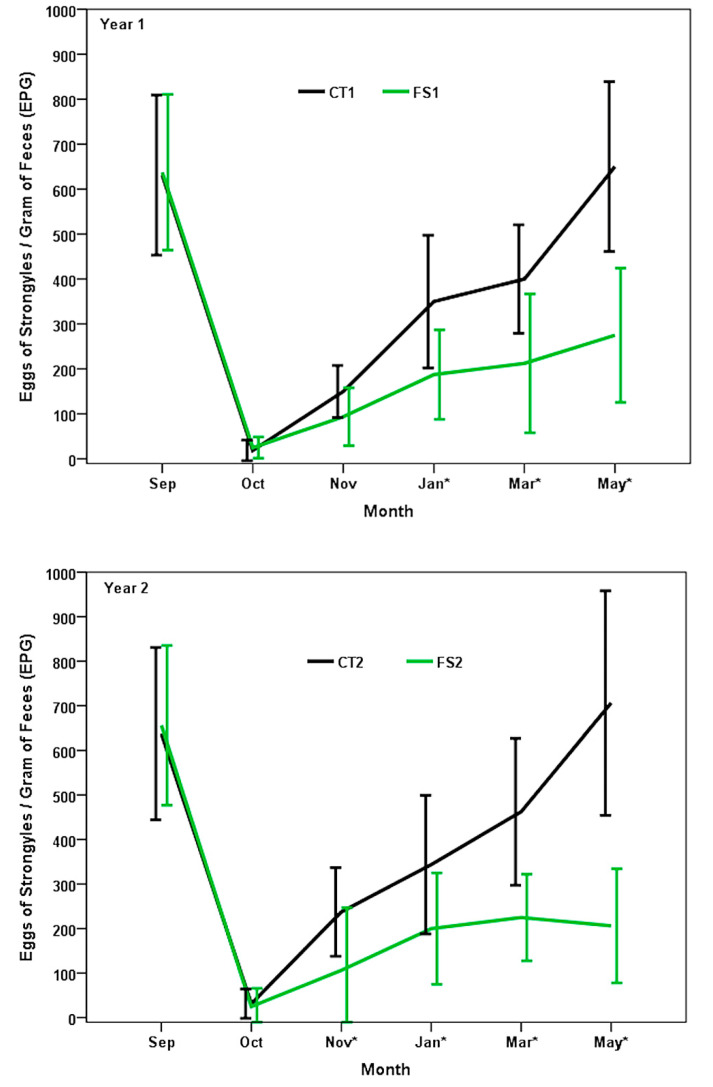
Parasiticidal fungi have been used in several in vivo experiments in livestock farms worldwide, constituting an effective tool for the biocontrol of gastrointestinal parasites in grazing animals. In the first year of study, two groups of eight first-season pasturing ewe lambs infected by strongyles were dewormed with albendazole, and then, the test group received an oral dose of 10 chlamydospores of and 10 individually and thrice a week from mid-September to May (FS1), while the control group remained without fungi (CT1). In the second year, two new groups of first-season grazing ewe lambs were treated with ivermectin and subjected to the same experimental design (FS2 and CT2, respectively). The anthelmintic efficacy was 96.6% (CT1), 95.6% (FS1), 96.1% (CT2), and 95.1% (FS2). The counts of strongyle egg output increased in the control groups (CT1 and CT2) throughout the study and reached numbers higher than 600 eggs per gram of feces (EPG), while in FS1 and FS2, they were <250 EPG. The values of red blood cell parameters registered for CT1 and CT2 were lower than those of the reference standards, while a significant increment was recorded in FS1 and FS2, and values within the physiological range were attained. It is concluded that integrating efficient anthelminthic deworming with rotational pasturing and the regular intake of chlamydospores of and provides a helpful strategy for maintaining low levels of strongyle egg output in first-season grazing ewe lambs and improves their health status.
杀寄生虫真菌已在全球多个畜牧场的多项体内实验中得到应用,是控制放牧动物胃肠道寄生虫的一种有效生物防治工具。在研究的第一年,两组各八只感染圆线虫的首季放牧母羊羔用阿苯达唑驱虫,然后,试验组从9月中旬至次年5月每周三次单独口服10个 和10个厚垣孢子(FS1),而对照组不施用真菌(CT1)。第二年,两组新的首季放牧母羊羔用伊维菌素治疗,并采用相同的实验设计(分别为FS2和CT2)。驱虫效果分别为96.6%(CT1)、95.6%(FS1)、96.1%(CT2)和95.1%(FS2)。在整个研究过程中,对照组(CT1和CT2)的圆线虫卵排出量增加,每克粪便中的卵数超过600个(EPG),而在FS1和FS2组中,该数值<250 EPG。CT1和CT2组的红细胞参数值低于参考标准,而FS1和FS2组则有显著增加,并达到生理范围内的值。研究得出结论,将高效驱虫与轮牧以及定期摄入 和 的厚垣孢子相结合,为维持首季放牧母羊羔低水平的圆线虫卵排出量并改善其健康状况提供了一种有益策略。