Key Laboratory of Protein and Peptide Pharmaceuticals, CAS-University of Tokyo Joint Laboratory of Structural Virology and Immunology, Institute of Biophysics, Chinese Academy of Sciences, Beijing, 100101, China.
Department of Pharmacology, School of Medicine, Institute of Translational Medicine, Yangzhou University, Yangzhou, 225001, China.
Nat Commun. 2018 Apr 12;9(1):1440. doi: 10.1038/s41467-018-03903-8.
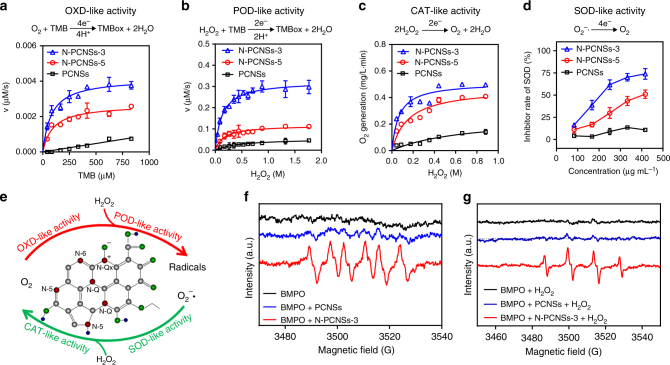
Nanomaterials with intrinsic enzyme-like activities (nanozymes), have been widely used as artificial enzymes in biomedicine. However, how to control their in vivo performance in a target cell is still challenging. Here we report a strategy to coordinate nanozymes to target tumor cells and selectively perform their activity to destruct tumors. We develop a nanozyme using nitrogen-doped porous carbon nanospheres which possess four enzyme-like activities (oxidase, peroxidase, catalase and superoxide dismutase) responsible for reactive oxygen species regulation. We then introduce ferritin to guide nitrogen-doped porous carbon nanospheres into lysosomes and boost reactive oxygen species generation in a tumor-specific manner, resulting in significant tumor regression in human tumor xenograft mice models. Together, our study provides evidence that nitrogen-doped porous carbon nanospheres are powerful nanozymes capable of regulating intracellular reactive oxygen species, and ferritinylation is a promising strategy to render nanozymes to target tumor cells for in vivo tumor catalytic therapy.
具有内在酶样活性的纳米材料(纳米酶)已被广泛用作生物医学中的人工酶。然而,如何控制它们在靶细胞中的体内性能仍然具有挑战性。在这里,我们报告了一种策略,可协调纳米酶靶向肿瘤细胞并选择性地发挥其活性以破坏肿瘤。我们开发了一种纳米酶,使用氮掺杂多孔碳纳米球,其具有四种酶样活性(氧化酶、过氧化物酶、过氧化氢酶和超氧化物歧化酶),负责调节活性氧物质。然后,我们引入铁蛋白将氮掺杂多孔碳纳米球引导到溶酶体中,并以肿瘤特异性的方式促进活性氧物质的产生,从而导致人肿瘤异种移植小鼠模型中的肿瘤明显消退。总之,我们的研究提供了证据,证明氮掺杂多孔碳纳米球是能够调节细胞内活性氧物质的强大纳米酶,铁蛋白化是使纳米酶靶向肿瘤细胞进行体内肿瘤催化治疗的有前途的策略。