Gilhooly David Andrew, Cole Michelle, Moonesinghe Suneetha Ramani
1UCLH NIHR Surgical Outcomes Research Centre, Department of Anaesthesia and Perioperative Medicine, University College Hospital, London, NW1 2BU UK.
Department of Applied Health and Research, 1-19 Torrington Place, London, WE1C 7HB UK.
Perioper Med (Lond). 2018 Apr 10;7:6. doi: 10.1186/s13741-018-0088-5. eCollection 2018.
As the prevalence of obesity is increasing, the number of patients requiring surgical intervention for obesity-related illness is also rising. The aim of this pilot study was to explore predictors of short-term morbidity and longer-term poor weight loss after bariatric surgery.
This was a single-centre prospective observational cohort pilot study in patients undergoing bariatric surgery. We assessed the accuracy (discrimination and calibration) of two previously validated risk prediction models (the Physiological and Operative Severity Score for the enumeration of Morbidity and Mortality, POSSUM score, and the Obesity Surgical Mortality Risk Score, OS-MS) for postoperative outcome (postoperative morbidity defined using the Post Operative Morbidity Survey). We then tested the relationship between postoperative morbidity and longer-term weight loss outcome adjusting for known patient risk factors.
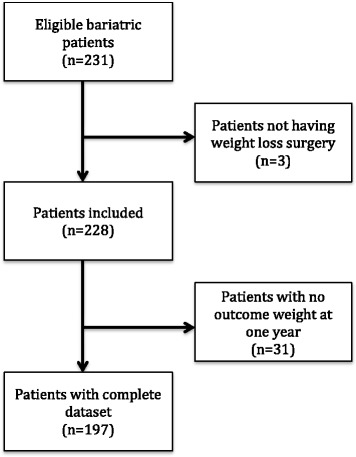
Complete data were collected on 197 patients who underwent surgery for obesity or obesity-related illnesses between March 2010 and September 2013. Results showed POSSUM and OS-MRS were less accurate at predicting Post Operative Morbidity Survey (POMS)-defined morbidity on day 3 than defining prolonged length of stay due to poor mobility and/or POMS-defined morbidity. Having fewer than 28 days alive and out of hospital within 30 days of surgery was predictive of poor weight loss at 1 year, independent of POSSUM-defined risk (odds ratio 2.6; 95% confidence interval 1.28-5.24).
POSSUM may be used to predict patients who will have prolonged postoperative LOS after bariatric surgery due to morbidity or poor mobility. However, independent of POSSUM score, having less than 28 days alive and out of hospital predicted poor weight loss outcome at 1 year. This adds to the literature that postoperative complications are independently associated with poor longer-term surgical outcomes.
随着肥胖症患病率的上升,因肥胖相关疾病而需要手术干预的患者数量也在增加。这项初步研究的目的是探讨减肥手术后短期发病率和长期体重减轻不佳的预测因素。
这是一项针对接受减肥手术患者的单中心前瞻性观察队列初步研究。我们评估了两种先前验证过的风险预测模型(用于枚举发病率和死亡率的生理和手术严重程度评分,POSSUM评分,以及肥胖手术死亡率风险评分,OS-MS)对术后结果(使用术后发病率调查定义的术后发病率)的准确性(辨别力和校准)。然后,我们在调整已知患者风险因素的情况下,测试了术后发病率与长期体重减轻结果之间的关系。
收集了2010年3月至2013年9月期间197例接受肥胖或肥胖相关疾病手术患者的完整数据。结果显示,与因活动能力差导致的住院时间延长和/或术后发病率调查(POMS)定义的发病率相比,POSSUM和OS-MRS在预测术后第3天POMS定义的发病率方面准确性较低。术后30天内存活且出院天数少于28天可预测1年时体重减轻不佳,与POSSUM定义的风险无关(比值比2.6;95%置信区间1.28-5.24)。
POSSUM可用于预测减肥手术后因发病率或活动能力差而术后住院时间延长的患者。然而,与POSSUM评分无关,存活且出院天数少于28天可预测1年时体重减轻结果不佳。这进一步证明了术后并发症与长期手术效果不佳独立相关。