Thompson Atalie C, Woolson Sandra, Olsen Maren K, Danus Susanne, Bosworth Hayden B, Muir Kelly W
Department of Ophthalmology, Duke University School of Medicine, Durham, North Carolina, USA.
Center for Health Services Research in Primary Care, Durham Veterans Affairs Medical Center, Durham, North Carolina, USA.
BMJ Open Ophthalmol. 2018 Feb 19;3(1):e000114. doi: 10.1136/bmjophth-2017-000114. eCollection 2018.
To investigate whether electronically measured medication adherence is associated with vision-related quality of life (VRQoL) in patients with open-angle glaucoma.
This is a 3-year prospective cohort study of 79 subjects with open-angle glaucoma at a Veterans Affairs medical centre. Participants returned a medication event monitoring system (MEMS) for their glaucoma eye-drops and had at least two visits with glaucoma during the study period. Those taking less than 80% of prescribed glaucoma medication doses were considered to be non-adherent. Subjects were interviewed using the National Eye Institute's Visual Function Questionnaire-25 (VFQ-25) at baseline and after 3 years.
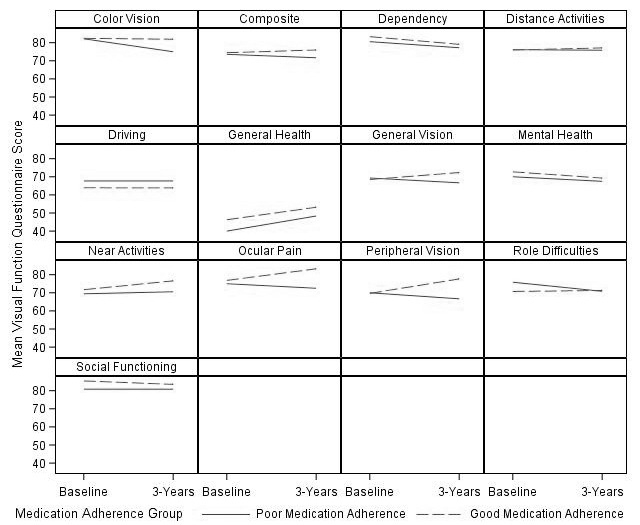
Thirty per cent (n=24/79) of participants took less than 80% of prescribed doses of their glaucoma medications at baseline. Patients who did not adhere to their medications at baseline had lower mean composite VFQ-25 scores at baseline (70.66±20.50 vs 75.91±19.12, standardised mean difference=0.27) and after 3 years (71.68±21.93 vs 76.25±21.67, standardised mean difference=0.21). Visual acuity (P=0.03), but not visual field severity (P=0.13) or medication adherence (P=0.30), was significantly associated with composite VFQ-25 score in an adjusted model.
Subjects who were non-adherent to their glaucoma medications at baseline as assessed by a MEMS device reported lower VRQoL than adherent subjects at baseline and after 3 years. However, visual acuity was significantly associated with VRQoL. Future studies should assess whether improved adherence to eye-drops impacts VRQoL in patients with glaucoma.
探讨电子测量的药物依从性与开角型青光眼患者视力相关生活质量(VRQoL)之间是否存在关联。
这是一项在退伍军人事务医疗中心对79例开角型青光眼患者进行的为期3年的前瞻性队列研究。参与者归还了用于滴眼治疗青光眼的药物事件监测系统(MEMS),并在研究期间至少进行了两次青光眼就诊。服用青光眼药物剂量低于规定剂量80%的患者被视为不依从。在基线和3年后,使用美国国立眼科研究所的视觉功能问卷25(VFQ-25)对受试者进行访谈。
30%(n = 24/79)的参与者在基线时服用的青光眼药物剂量低于规定剂量的80%。在基线时不坚持用药的患者在基线时(70.66±20.50对75.91±19.12,标准化平均差 = 0.27)和3年后(71.68±21.93对76.25±21.67,标准化平均差 = 0.21)的平均VFQ-25综合评分较低。在调整模型中,视力(P = 0.