Bayer AG.
Charité Mitte, Institute of Physiology, Berlin, Germany.
Invest Radiol. 2018 Sep;53(9):499-517. doi: 10.1097/RLI.0000000000000467.
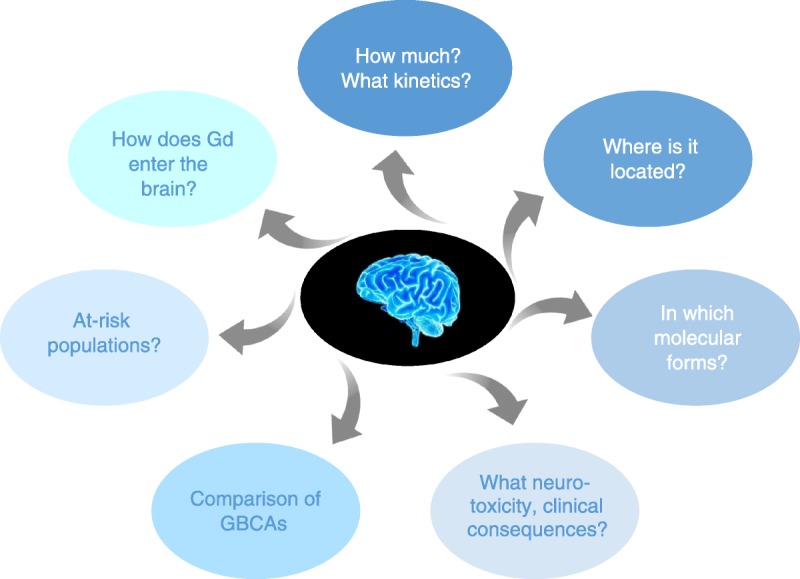
Gadolinium (Gd)-based contrast agents (GBCAs) are pharmaceuticals that have been approved for 30 years and used daily in millions of patients worldwide. Their clinical benefits are indisputable. Recently, unexpected long-term presence of Gd in the brain has been reported by numerous retrospective clinical studies and confirmed in preclinical models particularly after linear GBCA (L-GBCA) compared with macrocyclic GBCA (M-GBCA). Even if no clinical consequences of Gd presence in brain tissue has been demonstrated so far, in-depth investigations on potential toxicological consequences and the fate of Gd in the body remain crucial to potentially adapt the clinical use of GBCAs, as done during the nephrogenic systemic fibrosis crisis. Preclinical models are instrumental in the understanding of the mechanism of action as well as the potential safety consequences. However, such models may be associated with risks of biases, often related to the protocol design. Selection of adequate terminology is also crucial. This review of the literature intends to summarize and critically discuss the main methodological aspects for accurate design and translational character of preclinical studies.
钆(Gd)基对比剂(GBCA)已获批准使用 30 年,全球每天有数百万患者使用。其临床获益不容置疑。最近,大量回顾性临床研究报告了意想不到的 Gd 在脑内的长期存在,并在临床前模型中得到证实,尤其是在与大环 GBCA(M-GBCA)相比的线性 GBCA(L-GBCA)之后。尽管迄今为止尚未证明 Gd 存在于脑组织中有任何临床后果,但深入研究潜在的毒理学后果以及 Gd 在体内的命运对于潜在地适应 GBCA 的临床应用仍然至关重要,就像在肾源性系统性纤维化危机期间所做的那样。临床前模型对于了解作用机制以及潜在的安全后果非常重要。然而,此类模型可能存在与方案设计相关的偏倚风险。选择适当的术语也至关重要。本文旨在综述和批判性讨论准确设计和转化的临床前研究的主要方法学方面。