Faculty of Informatics and Management, University of Hradec Králové, Rokitanského 62, 500 03 Hradec Králové, Czech Republic.
Int J Environ Res Public Health. 2018 Apr 14;15(4):752. doi: 10.3390/ijerph15040752.
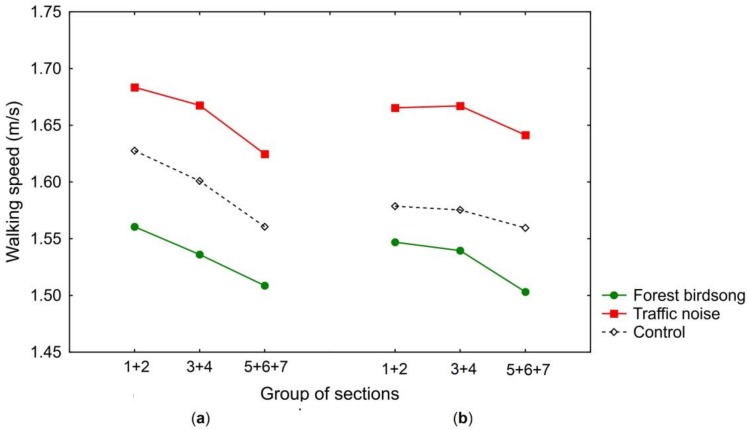
Exposure to noise in everyday urban life is considered to be an environmental stressor. A specific outcome of reactions to environmental stress is a fast pace of life that also includes a faster pedestrian walking speed. The present study examined the effect of listening to annoying acoustical stimuli (traffic noise) compared with relaxation sounds (forest birdsong) on walking speed in a real outdoor urban environment. The participants ( = 83) walked along an urban route of 1.8 km. They listened to either traffic noise or forest birdsong, or they walked without listening to any acoustical stimuli in the control condition. The results showed that participants listening to traffic noise walked significantly faster on the route than both the participants listening to forest birdsong sounds and the participants in the control condition. Participants who listened to forest birdsong walked slightly slower than those under control conditions; however, this difference was not significant. Analysis of the walk experience showed that participants who listened to forest birdsong during the walk liked the route more than those who listened to traffic sounds. The study demonstrated that exposure to traffic noise led to an immediate increase in walking speed. It was also shown that exposure to noise may influence participants' perception of an environment. The same environment may be more liked in the absence of noise or in the presence of relaxation sounds. The study also documented the positive effect of listening to various kinds of relaxation sounds while walking in an outdoor environment with traffic noise.
日常生活中的城市噪声被认为是一种环境应激源。对环境应激的反应的一个特定结果是快节奏的生活,这也包括更快的行人步行速度。本研究在真实的户外城市环境中,考察了聆听恼人的声学刺激(交通噪声)与放松的声音(森林鸟鸣)对步行速度的影响。参与者(n=83)沿着 1.8 公里的城市路线行走。他们分别聆听交通噪声、森林鸟鸣或在控制条件下不聆听任何声学刺激。结果表明,与聆听森林鸟鸣声的参与者和控制条件下的参与者相比,聆听交通噪声的参与者在路线上的步行速度明显更快。聆听森林鸟鸣声的参与者比控制条件下的参与者稍慢,但差异不显著。行走体验分析表明,在行走过程中聆听森林鸟鸣的参与者比聆听交通噪音的参与者更喜欢这条路线。该研究表明,暴露于交通噪声会立即导致步行速度加快。还表明,噪声暴露可能会影响参与者对环境的感知。在没有噪声或存在放松声音的情况下,相同的环境可能会更受喜爱。该研究还记录了在交通噪音环境中行走时聆听各种放松声音的积极效果。