Belstrøm D, Sembler-Møller M L, Grande M A, Kirkby N, Cotton S L, Paster B J, Twetman S, Holmstrup P
Section for Periodontology, Microbiology, and Community Dentistry, Department of Odontology, Faculty of Health Sciences, University of Copenhagen, Denmark.
Section for Oral Medicine, Department of Odontology, Faculty of Health Sciences, University of Copenhagen, Denmark.
JDR Clin Trans Res. 2018 Jan;3(1):57-64. doi: 10.1177/2380084417723625. Epub 2017 Jul 31.
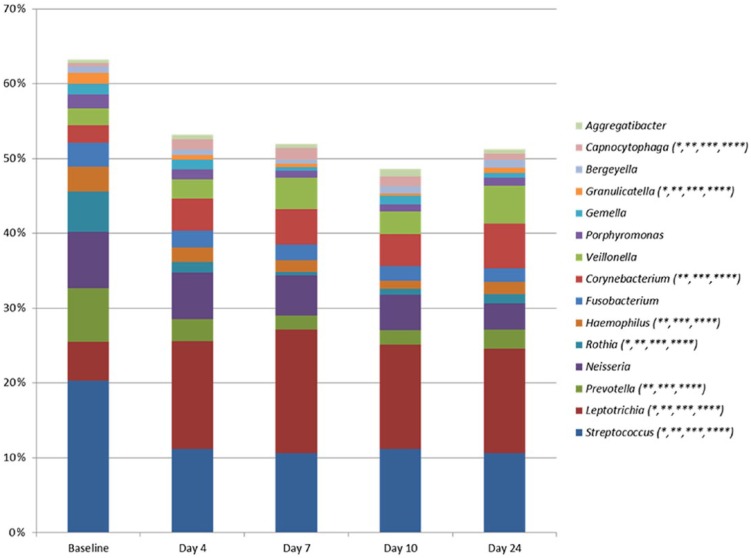
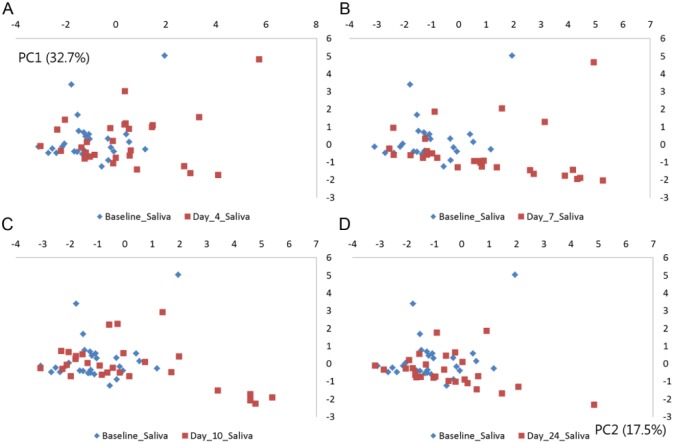
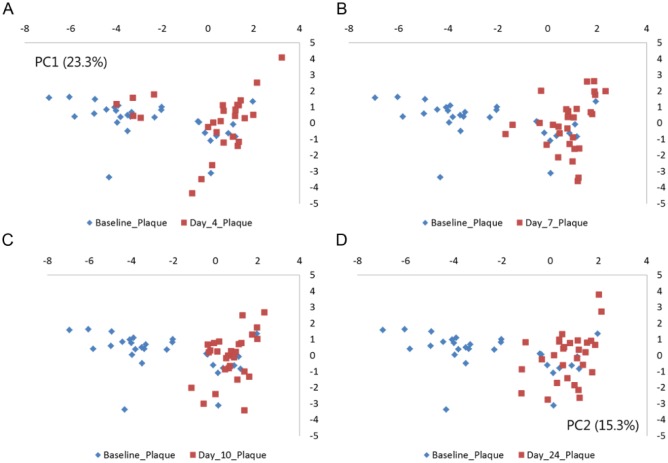
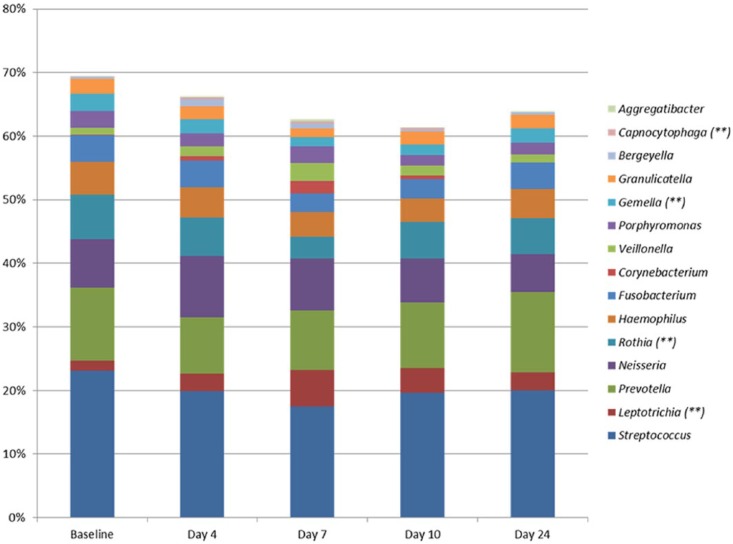
The purpose of the present study was to characterize and compare supragingival and salivary microbiotas during a 10-d period of oral hygiene discontinuation. We tested the hypothesis that the composition of the salivary microbiota will reflect local microbial changes associated with accumulated biofilm formation and maturation. Pooled supragingival plaque ( = 145) and stimulated saliva ( = 145) samples were collected and plaque and gingival indices were recorded from 29 orally healthy individuals at baseline, during oral hygiene discontinuation (days 4, 7, and 10), and 14 d after resumption of oral hygiene. Supragingival and salivary microbiotas were processed by next-generation sequencing (Human Oral Microbe Identification using Next Generation Sequencing) and microbial community profiles were compared. Microbial composition of supragingival plaque samples collected after 4, 7, and 10 d of oral hygiene discontinuation, as well as 14 d after reuptake of oral hygiene, differed significantly from baseline samples, by a 3-fold increase in relative abundance species and a 2-fold decrease in species (adjusted < 0.01). In saliva samples, a significant increase in relative abundance of species (adjusted < 0.01) was evident at day 7 but completely reversed 14 d after resumption of oral hygiene. While the salivary microbiota was resistant to accumulated local biofilm formation, data from this study showed that compositional changes of supragingival microbiotas were not reversed 14 d after resumption of oral hygiene, despite the restoration of plaque to baseline levels. (ClinicalTrials.gov UCPH_OI_002, NCT02913235). Data from this study showed compositional changes of supragingival microbiotas as a consequence of a 10-d period of oral hygiene discontinuation, that was not reversed 14 d after resumption of oral hygiene. Notably, oral hygiene discontinuation was associated with a significant increase in relative abundance of potential cariogenic species and a decrease in species. Thus, findings from this study highlight the necessity of regular oral hygiene in the maintenance of oral homeostasis.
本研究的目的是在停止口腔卫生护理10天的期间内,对龈上和唾液微生物群进行特征描述和比较。我们检验了这样一个假设,即唾液微生物群的组成将反映与累积生物膜形成和成熟相关的局部微生物变化。收集了29名口腔健康个体的龈上菌斑混合样本(n = 145)和刺激唾液样本(n = 145),并在基线、停止口腔卫生护理期间(第4、7和10天)以及恢复口腔卫生护理14天后记录菌斑和牙龈指数。通过下一代测序(使用下一代测序进行人类口腔微生物鉴定)对龈上和唾液微生物群进行处理,并比较微生物群落概况。停止口腔卫生护理4、7和10天后以及恢复口腔卫生护理14天后收集的龈上菌斑样本的微生物组成与基线样本有显著差异(校正P < 0.01),某些物种的相对丰度增加了3倍,而另一些物种减少了2倍。在唾液样本中,某些物种的相对丰度在第7天显著增加(校正P < 0.01),但在恢复口腔卫生护理14天后完全逆转。虽然唾液微生物群对累积的局部生物膜形成具有抗性,但本研究的数据表明,尽管菌斑恢复到基线水平,但恢复口腔卫生护理14天后龈上微生物群的组成变化并未逆转。(ClinicalTrials.gov UCPH_OI_002,NCT02913235)。本研究的数据表明,由于停止口腔卫生护理10天,龈上微生物群发生了组成变化,而恢复口腔卫生护理14天后并未逆转。值得注意的是,停止口腔卫生护理与潜在致龋菌某些物种的相对丰度显著增加以及另一些物种的减少有关。因此,本研究结果强调了定期口腔卫生护理对维持口腔内环境稳定的必要性。