Centro Multidisciplinario de Estudios en Biotecnología, FMVZ, Universidad Michoacana de San Nicolás de Hidalgo, Km. 9.5 Carretera Morelia-Zinapécuaro, Posta Veterinaria, C.P. 58000, Tarímbaro, Michoacán, Mexico.
Facultad de Medicina Veterinaria y Zootecnia, Universidad Autónoma de Tamaulipas, Km. 5, Carretera a Cd. Mante S/S, C.P. 87276, Ciudad Victoria, Tamaulipas, Mexico.
Genet Sel Evol. 2018 Apr 17;50(1):19. doi: 10.1186/s12711-018-0388-8.
The distribution of the wild turkey (Meleagris gallopavo) extends from Mexico to southeastern Canada and to the eastern and southern regions of the USA. Six subspecies have been described based on morphological characteristics and/or geographical variations in wild and domesticated populations. In this paper, based on DNA sequence data from the mitochondrial D-loop, we investigated the genetic diversity and structure, genealogical relationships, divergence time and demographic history of M. gallopavo populations including domesticated individuals.
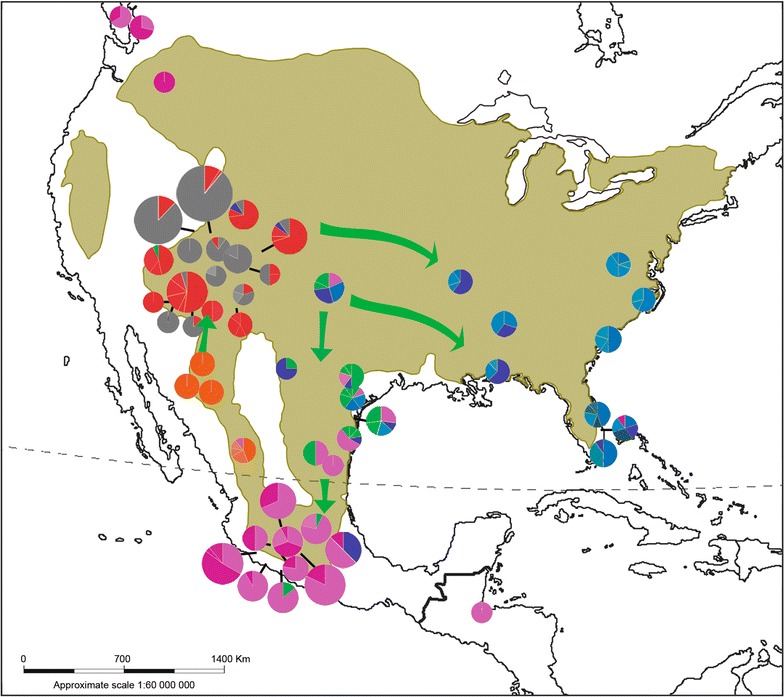
Analyses of 612 wild and domesticated turkey mitochondrial D-loop sequences, including 187 that were collected for this study and 425 from databases, revealed 64 haplotypes with few mutations, some of which are shared between domesticated and wild turkeys. We found a high level of haplotype and nucleotide diversity, which suggests that the total population of this species is large and stable with an old evolutionary history. The results of genetic differentiation, haplotype network, and genealogical relationships analyses revealed three main genetic groups within the species: mexicana as a population relict (C1), merriami (C2), and mexicana/intermedia/silvestris/osceola (C3). Haplotypes detected in domesticated turkeys belong to group C3. Estimates of divergence times agree with range expansion and diversification events of the relict population of M. gallopavo in northwestern Mexico during the Pliocene-Pleistocene and Pleistocene-Holocene boundaries. Demographic reconstruction showed that an expansion of the population occurred 110,000 to 130,000 years ago (Kya), followed by a stable period 100 Kya and finally a decline ~ 10 Kya (Pleistocene-Holocene boundary). In Mexico, the Trans-Mexican Volcanic Belt may be responsible for the range expansion of the C3 group. Two haplotypes with different divergence times, MGMDgoB/MICH1 and MICH2, are dominant in domesticated and commercial turkeys.
During the Pleistocene, a large and stable population of M. gallopavo covered a wide geographic distribution from the north to the center of America (USA and Mexico). The mexicana, merriami, and mexicana/intermedia/silvestris/osceola genetic groups originated after divergence and range expansion from northwestern Mexico during the Pliocene-Pleistocene and Pleistocene-Holocene boundaries. Old and new maternal lines of the mexicana/intermedia/silvestris/osceola genetic group were distributed within the Trans-Mexican Volcanic Belt where individuals were captured for domestication. Two haplotypes are the main founder maternal lines of domesticated turkeys.
野火鸡(Meleagris gallopavo)的分布范围从墨西哥延伸到加拿大东南部和美国的东部和南部地区。基于野生和家养种群的形态特征和/或地理变异,已经描述了六个亚种。在本文中,我们基于线粒体 D 环的 DNA 序列数据,研究了包括家养个体在内的火鸡种群的遗传多样性和结构、系统发育关系、分化时间和种群历史。
对 612 只野火鸡和家养火鸡的线粒体 D 环序列进行分析,包括本研究中收集的 187 个序列和数据库中的 425 个序列,发现了 64 种单倍型,突变较少,其中一些在家养和野生火鸡中共享。我们发现了高水平的单倍型和核苷酸多样性,这表明该物种的总体种群数量大且稳定,具有悠久的进化历史。遗传分化、单倍型网络和系统发育关系分析的结果表明,该物种内存在三个主要的遗传群体:墨西哥种群作为一个残余群体(C1)、merriami(C2)和 mexicana/intermedia/silvestris/osceola(C3)。在家养火鸡中检测到的单倍型属于 C3 群体。分化时间的估计与墨西哥西北部野火鸡的残余种群在更新世-全新世边界的范围扩张和多样化事件一致。种群重建表明,11 万至 13 万年前(Kya)发生了种群扩张,10 万 Kya 后进入稳定期,最后在 1 万 Kya(更新世-全新世边界)左右下降。在墨西哥,跨墨西哥火山带可能是 C3 群体范围扩张的原因。MGMDgoB/MICH1 和 MICH2 两种具有不同分化时间的单倍型在家养和商业火鸡中占主导地位。
在更新世时期,一个大而稳定的 M. gallopavo 种群分布在美国(美国和墨西哥)北部到中心的广阔地理区域。mexicana、merriami 和 mexicana/intermedia/silvestris/osceola 遗传群体起源于上新世-更新世和更新世-全新世边界时期的西北墨西哥的分化和范围扩张。mexicana/intermedia/silvestris/osceola 遗传群体的新旧母系谱系分布在个体被捕获进行驯化的跨墨西哥火山带内。两种单倍型是家养火鸡的主要创始母系谱系。