Exercise Physiology Laboratory, Camilo José Cela University, Madrid, Spain.
Performance and Sport Rehabilitation Laboratory, University of Castilla La Mancha, Toledo, Spain.
PLoS One. 2018 Apr 18;13(4):e0195943. doi: 10.1371/journal.pone.0195943. eCollection 2018.
The aim of this investigation was to analyze the influence of the genetic variations of the -163C>A polymorphism of the CYP1A2 gene on the ergogenic effects of caffeine in elite basketball players.
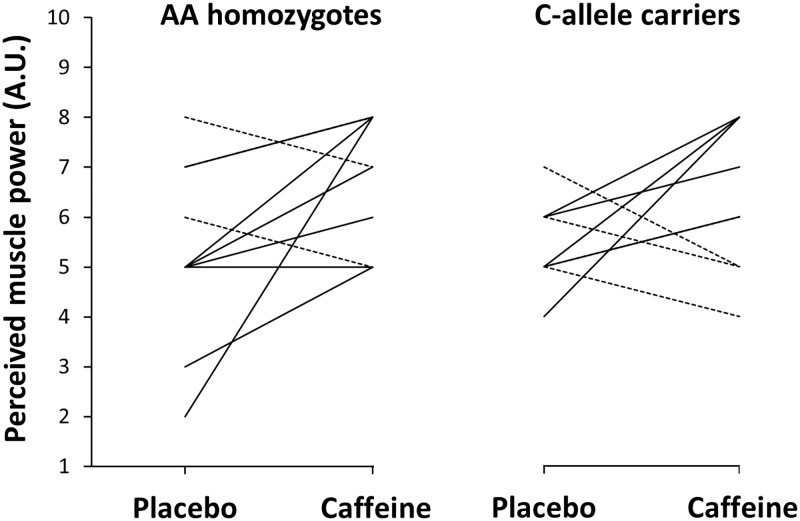
Nineteen elite basketball players (10 men and 9 women) ingested 3 mg⋅kg-1 of caffeine or a placebo 60 min before performing 10 repetitions of the following series: the Abalakov jump test followed by the Change-of-Direction and Acceleration Test (CODAT). The players then competed in a 20-min simulated basketball game. Self-perceived performance and side effects were recorded by questionnaires after the trials. The effects of caffeine on basketball performance were established according to players' CYP1A2 genotype (rs762551): AA homozygotes (n = 10) and C-allele carriers (n = 9).
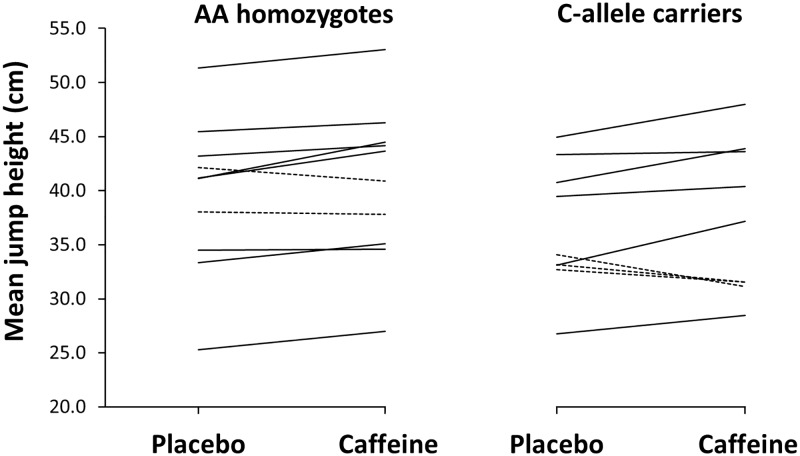
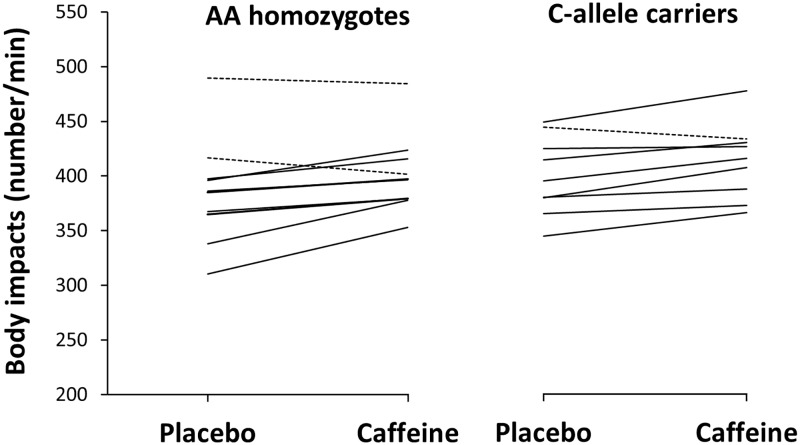
In the 10 repetitions, caffeine increased Abalakov jump height by a mean of 2.9±3.6% in AA homozygotes (p = 0.03) while this effect did not reach statistical significance for C-allele carriers (2.3 ± 6.8%; p = 0.33). Caffeine did not affect sprint time in the CODAT test in either genotype group but it increased the number of impacts performed during the simulated game in both AA homozygotes (4.1 ± 5.3%; p = 0.02) and C-allele carriers (3.3 ± 3.2%; p = 0.01). During the 24 h following the test, AA homozygotes tended to experience increased insomnia with caffeine while C-allele carriers did not present this effect. The remaining variables were unaffected by the genotype.
The CYP1A2 -163C>A polymorphism minimally altered the ergogenicity derived from the consumption of a moderate dose of caffeine in elite basketball players.
本研究旨在分析 CYP1A2 基因-163C>A 多态性的遗传变异对优秀篮球运动员咖啡因增效作用的影响。
19 名优秀篮球运动员(男 10 名,女 9 名)在进行 10 次以下系列运动前 60 分钟分别摄入 3mg/kg 的咖啡因或安慰剂:Abalakov 跳跃测试,然后是变向加速测试(CODAT)。然后,运动员进行 20 分钟的模拟篮球比赛。试验后,通过问卷记录运动员的自我表现和副作用。根据 CYP1A2 基因型(rs762551)评估咖啡因对篮球表现的影响:AA 纯合子(n=10)和 C 等位基因携带者(n=9)。
在 10 次重复中,咖啡因使 AA 纯合子的 Abalakov 跳跃高度平均增加 2.9±3.6%(p=0.03),而 C 等位基因携带者的这一效果不具有统计学意义(2.3±6.8%;p=0.33)。在两种基因型组中,咖啡因均不影响 CODAT 测试中的冲刺时间,但均增加了模拟比赛中的冲击次数:AA 纯合子(4.1±5.3%;p=0.02)和 C 等位基因携带者(3.3±3.2%;p=0.01)。在测试后的 24 小时内,AA 纯合子服用咖啡因后倾向于出现失眠增加,而 C 等位基因携带者则没有这种影响。其余变量不受基因型影响。
CYP1A2-163C>A 多态性轻微改变了优秀篮球运动员中中等剂量咖啡因的增效作用。