Daur Ihsanullah, Saad Maged M, Eida Abdul Aziz, Ahmad Shakeel, Shah Zahid Hussain, Ihsan Muhammad Z, Muhammad Yasir, Sohrab Sayed S, Hirt Heribert
Department of Arid Land Agriculture, King Abdulaziz University, Jeddah, Saudi Arabia.
Desert Agriculture Initiative, King Abdullah University of Science and Technology, Thuwal, Saudi Arabia.
Front Microbiol. 2018 Apr 4;9:477. doi: 10.3389/fmicb.2018.00477. eCollection 2018.
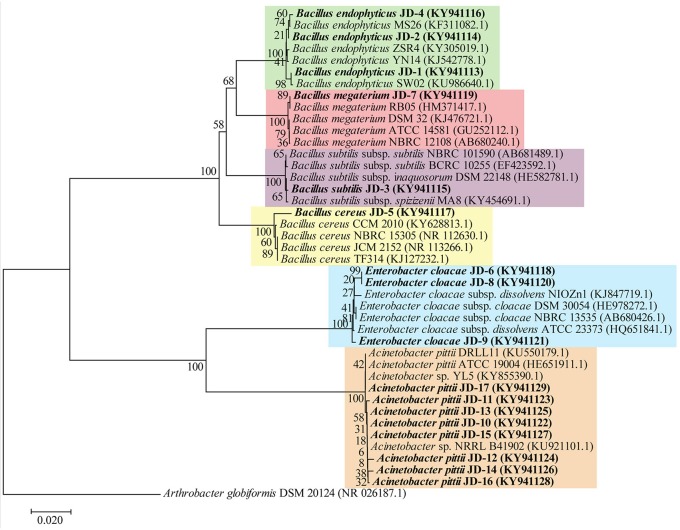
This study focused on rhizobacteria to promote sustainable crop production in arid regions of Saudi Arabia. The study isolated 17 tightly root-adhering rhizobacteria from various plants at Hada Al Sham in Saudi Arabia. All 17 rhizobacterial isolates were confirmed as plant growth promoting rhizobacteria by classical biochemical tests. Using 16S rDNA gene sequence analyses, the strains were identified as and . Subsequently, the strains were assessed for their ability to improve the physiology, nutrient uptake, growth, and yield of alfalfa plants grown under desert agriculture conditions. The field trials were conducted in a randomized complete block design. Inoculation of alfalfa with any of these 17 strains improved the relative water content; chlorophyll a; chlorophyll b; carotenoid contents; nitrogen (N), phosphorus, and potassium contents; plant height; leaf-to-stem ratio; and fresh and dry weight. JD-14 was most effective to increase fresh and dry weight of alfalfa by 41 and 34%, respectively, when compared to non-inoculated control plants. Nevertheless, all strains enhanced crop traits when compared to controls plants, indicating that these desert rhizobacterial strains could be used to develop an eco-friendly biofertilizer for alfalfa and possibly other crop plants to enhance sustainable production in arid regions.
本研究聚焦于根际细菌,以促进沙特阿拉伯干旱地区的作物可持续生产。该研究从沙特阿拉伯哈达勒沙姆的各种植物中分离出17种紧密附着于根部的根际细菌。通过经典生化试验,所有17种根际细菌分离株均被确认为植物促生细菌。利用16S rDNA基因序列分析,这些菌株被鉴定为[具体菌株名称未给出]和[具体菌株名称未给出]。随后,评估了这些菌株改善在沙漠农业条件下生长的苜蓿植株的生理状况、养分吸收、生长和产量的能力。田间试验采用随机完全区组设计。用这17种菌株中的任何一种接种苜蓿,均可提高相对含水量、叶绿素a、叶绿素b、类胡萝卜素含量、氮(N)、磷和钾含量、株高、叶茎比以及鲜重和干重。与未接种的对照植株相比,JD - 14对增加苜蓿鲜重和干重最为有效,分别提高了41%和34%。然而,与对照植株相比,所有菌株均增强了作物性状,这表明这些沙漠根际细菌菌株可用于开发一种生态友好型生物肥料,用于苜蓿以及可能的其他作物,以提高干旱地区的可持续产量。